On this page
- 01Key takeaways
- 02Why do business owners end up working too many hours?
- 03How many hours is too many for a business owner?
- 04How do you find the hours you could hand off?
- 05What is an owner's time actually worth?
- 06Which owner tasks are usually outsourced first?
- 07When is outsourcing not the fix for long hours?
- 08How do you protect the hours you free up?
- 09What does this look like in practice?
- 10Owner hours checklist
- 11Next step
- 12Sources and further reading
- 13Frequently asked questions
Key takeaways
A business owner working too many hours is usually doing 10 to 20 hours a week of repeatable work that someone else could do to a written process. Log two weeks of tasks, separate owner-only work from repeatable work, and outsource the largest repeatable block first. The goal is to return hours to selling, pricing and managing.
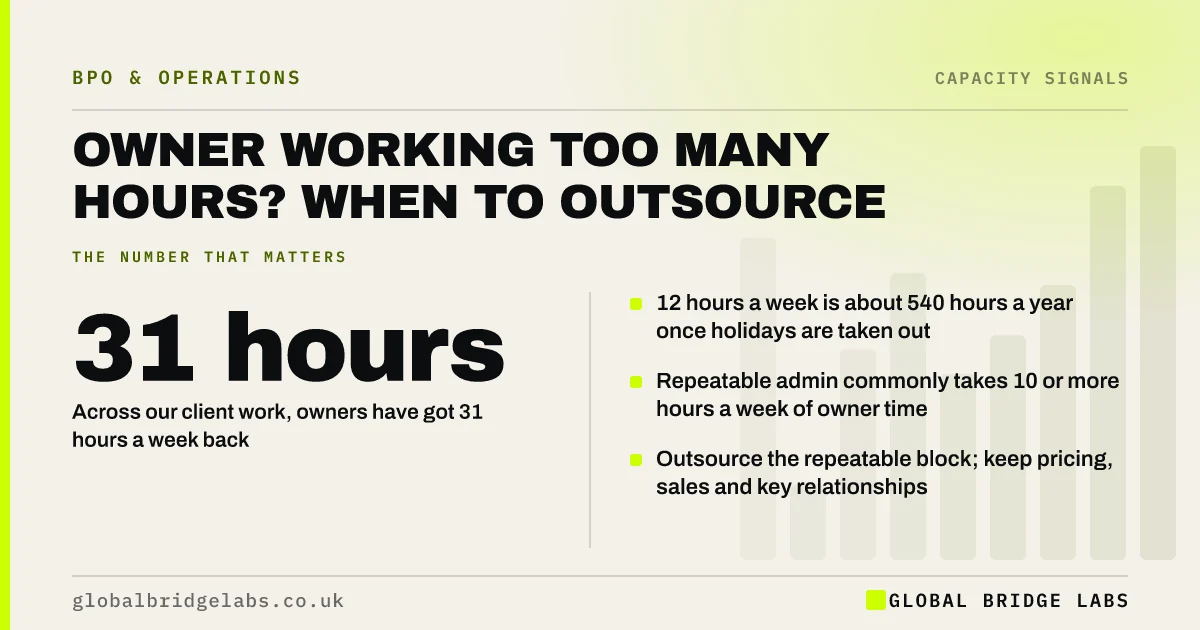
- Across our client work, owners have got 31 hours a week back.
- 12 hours a week is about 540 hours a year once holidays are taken out.
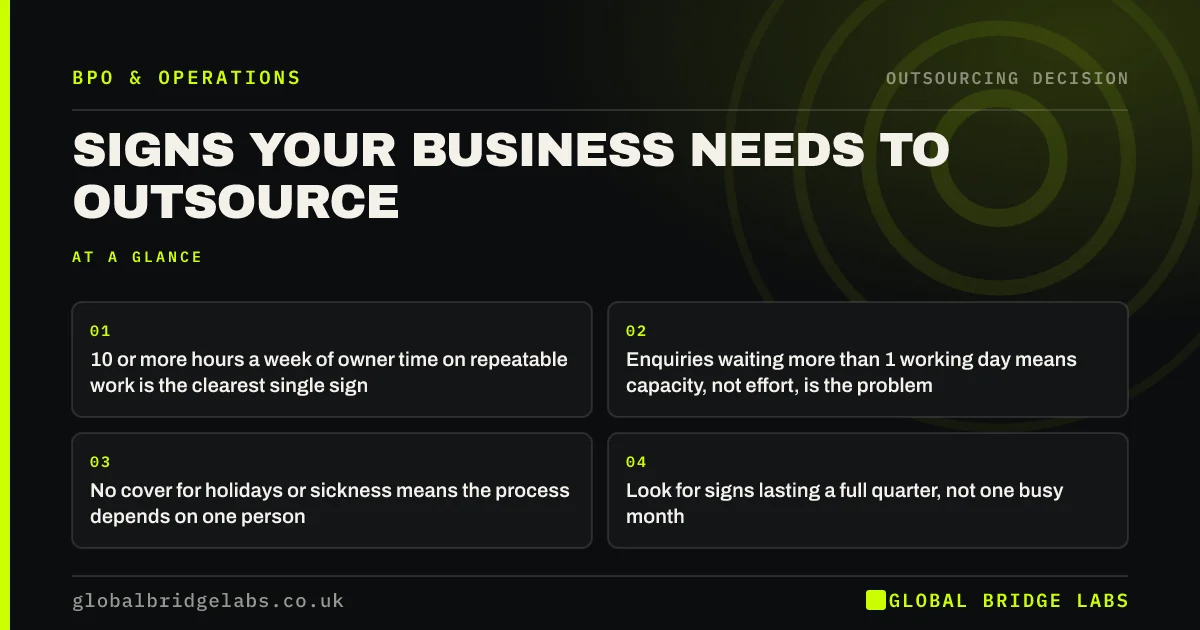
- Repeatable admin commonly takes 10 or more hours a week of owner time.
- Outsource the repeatable block; keep pricing, sales and key relationships.
Working evenings on admin? Message us on WhatsApp with what fills them.
Chat on WhatsApp →Why do business owners end up working too many hours?
Owners work too many hours because the business grows faster than its way of working. Tasks the owner did when there were five customers are still with the owner at fifty. None of them is hard; together they fill the evenings. It is a structure problem, and it rarely fixes itself with more effort.
The warning sign is that owner hours rise in step with revenue. In a healthy business, owner hours flatten while revenue grows, because repeatable work moves to other people or systems.
How many hours is too many for a business owner?
There is no single number, but a useful test is how many of the hours only the owner can do. If more than a quarter of a 55-hour week is repeatable admin, email or chasing, the owner is too many hours into work that should sit elsewhere. For employees, UK law sets a 48-hour weekly average unless they opt out voluntarily and in writing.
The 48-hour benchmark is useful for owners too. Working well beyond it for months usually shows up as slower decisions, missed follow-ups and less time with the customers who matter most.
How do you find the hours you could hand off?
Log every task for two weeks in 15-minute blocks, then sort each into three groups: only I can do this, someone trained could do this, and nobody needs to do this. The middle group is your outsourcing candidate list. Most owners find it is bigger than they expected, and the third group gives some time back immediately.
- Only me: pricing, key sales conversations, hiring, strategy.
- Someone trained: inbox triage, booking, invoicing, data entry, chasing.
- Nobody: duplicate reports, manual copies between systems, unnecessary approvals.
Send us your two-week log on WhatsApp and we will point out the biggest block to hand off.
Chat on WhatsApp →What is an owner's time actually worth?
An owner's time is worth what the business earns when the owner does owner work. A simple way to estimate it is annual gross profit divided by the owner's working hours. A business making £300,000 gross profit with an owner working 2,500 hours a year values each owner hour at £120, far above any admin rate.
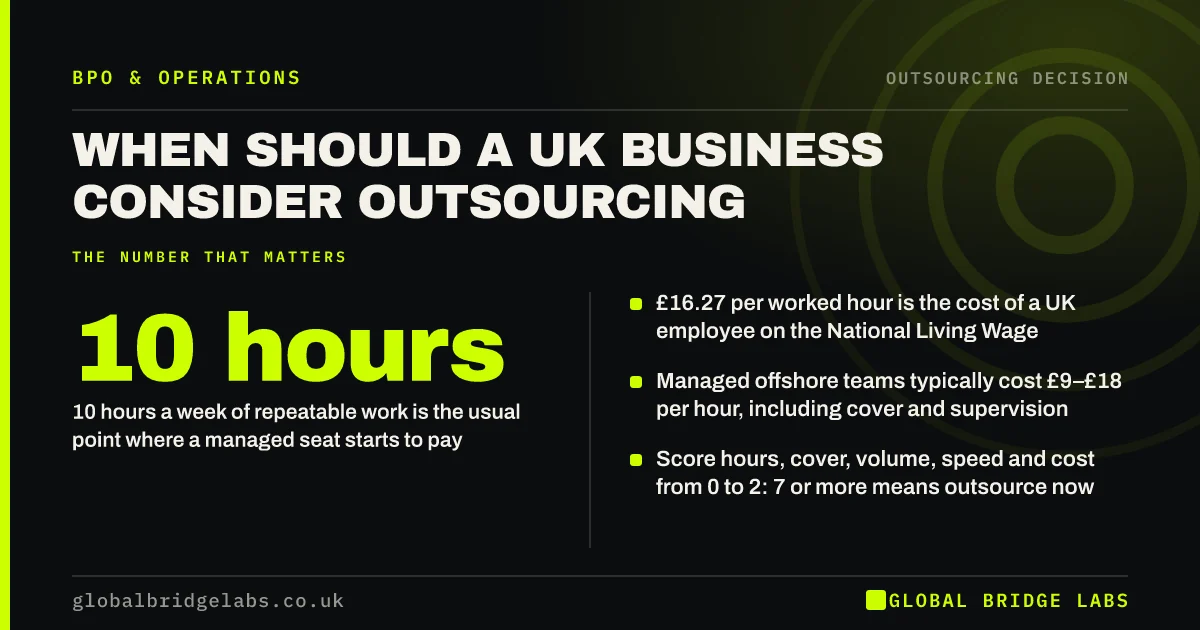
Compared with a managed offshore seat at an indicative £9–£18 per hour, every hour of repeatable work the owner keeps is an expensive hour.
Which owner tasks are usually outsourced first?
The first owner tasks to go are the ones with clear rules and a daily rhythm: inbox triage, returning routine calls, booking appointments, raising invoices and chasing payments. They interrupt the owner most often, so removing them frees whole blocks of time rather than scattered minutes.
- Inbox triage and first replies to routine enquiries.
- Call answering, messages and appointment booking.
- Raising invoices and chasing overdue payments.
- CRM updates, data entry and quote follow-ups.
When is outsourcing not the fix for long hours?
When the long hours are spent on work only the owner can do, such as specialist delivery or key client relationships. In that case the answer is a senior hire, a price rise or fewer, better customers. Outsourcing also will not help an owner who cannot let go of approvals; delegation has to come first.
How do you protect the hours you free up?
Freed hours disappear unless they are planned. Before handing work off, decide what the owner will do with the time and put it in the diary as fixed blocks: sales calls, pricing reviews, time with key customers, or simply finishing at 6pm. Without that, new small tasks fill the space within weeks.
Set one rule for the outsourced team that protects the owner's focus, such as batching non-urgent questions into a single daily message. Interruptions, not total hours, are what make an owner's day feel longer than it is.
- Block two half-days a week for sales, pricing or strategy.
- Batch questions from the team into one daily update.
- Review the owner's hours monthly for the first quarter.
- Say no to new admin that lands back on the owner's desk.
What does this look like in practice?
A pattern we see in UK trades and construction firms: the owner works 60 hours, of which 15 go on calls, quotes admin and invoicing after the site day ends. Moving calls and invoicing to a managed team, with the owner approving quotes only, usually brings the week back towards 45 hours within the first two months.
Across our client work, owners have got 31 hours a week back, and the hours came from repeatable work being written down and handed to a team rather than from working faster.
Owner hours checklist
Use this to turn long hours into a handover plan.
- Log two weeks of tasks in 15-minute blocks.
- Sort each task into only me, someone trained, or nobody.
- Stop the nobody tasks this week.
- Total the someone-trained hours by process.
- Write down the largest process in one page.
- Outsource it and block the freed hours for owner work.
Next step
Tell us what fills your evenings. We will tell you which block of work to hand off first and roughly how many hours it should return. 30 minutes, no pitch.
Message us on WhatsApp about your hours, or book a 30-minute consultation.
Chat on WhatsApp →Sources and further reading
- Maximum weekly working hours · GOV.UK
- National Minimum Wage and National Living Wage rates · GOV.UK
- Work-related stress and how to manage it · Health and Safety Executive
Frequently asked questions
How do I stop working so many hours as a business owner?
Log two weeks of tasks, separate work only you can do from repeatable work, stop anything nobody needs, and hand the largest repeatable block to a person or team with a written process. Protect the freed hours in your diary for sales, pricing and management.
Is it normal for small business owners to work 60 hours a week?
It is common, but it is usually a sign the business has outgrown its way of working. If a quarter or more of those hours are repeatable admin, email or chasing, the hours are a structure problem that outsourcing or delegation can fix.
What should a business owner outsource first?
The repeatable work that interrupts you most often: inbox triage, routine calls, booking, invoicing and payment chasing. Removing these frees whole blocks of time. Keep pricing, key sales conversations, hiring and strategy with you.
Written by

Global Bridge Labs (GBL) is a UK–Sri Lanka partner for social media, websites and BPO. Everything here comes from client delivery, not theory.