On this page
- 01Key takeaways
- 02Is there a best time to start outsourcing?
- 03How much lead time does outsourcing need?
- 04Which business events are good times to outsource?
- 05When is the worst time to outsource?
- 06Should seasonal businesses outsource before the peak?
- 07What should you prepare before the start date?
- 08Does the time of year affect outsourcing?
- 09What are the signs you have left it too late?
- 10What does this look like in practice?
- 11Timing checklist
- 12Next step
- 13Sources and further reading
- 14Frequently asked questions
Key takeaways
The best time to outsource is 6 to 8 weeks before you need the capacity, when you still have time to document the process and check early work. For seasonal businesses that means ahead of the peak; for growing ones it means straight after a contract is won or a hire plan is set, not in the middle of a crisis.
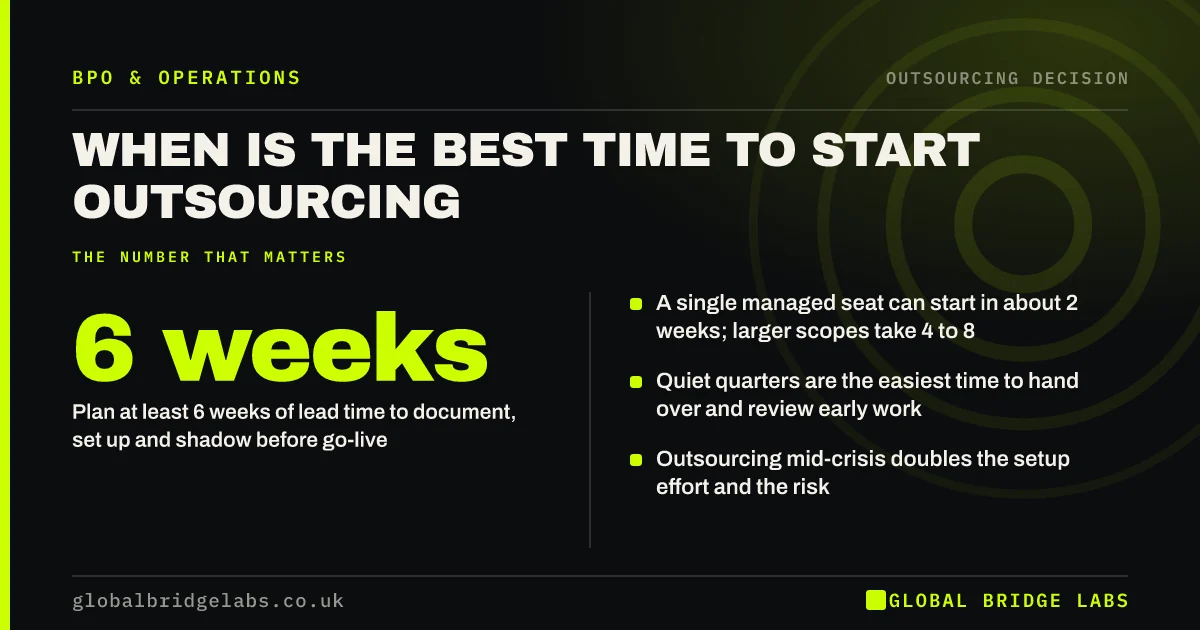
- Plan at least 6 weeks of lead time to document, set up and shadow before go-live.
- A single managed seat can start in about 2 weeks; larger scopes take 4 to 8.
- Quiet quarters are the easiest time to hand over and review early work.
- Outsourcing mid-crisis doubles the setup effort and the risk.
Planning ahead of a busy period? Message us on WhatsApp with your dates.
Chat on WhatsApp →Is there a best time to start outsourcing?
Yes: before you need it. Outsourcing takes a few weeks of setup, documentation and review, and that work goes best when the team has time to explain the process. The best time is when the need is predictable and still ahead of you, such as before a seasonal peak or once a new contract is signed.
How much lead time does outsourcing need?
A single seat on a documented process can start in about two weeks. Larger or less documented scopes take four to eight weeks. Add time for your internal checks, the processor contract and a period of shadowing, and six to eight weeks from decision to confident running is a sensible plan.
- Weeks 1 to 2: scope, contract and data protection paperwork.
- Weeks 2 to 4: document the process and set up access.
- Weeks 4 to 6: shadowing and supervised work.
- Weeks 6 to 8: staged go-live with weekly reviews.
Which business events are good times to outsource?
Events that change volume permanently or predictably are the strongest triggers. They give you a date to plan towards and a clear reason to act.
- A new contract or client that adds sustained volume.
- A seasonal peak that repeats every year.
- A resignation in an admin or support role.
- Opening a new location or launching a product.
- An investment round with a hiring plan attached.
- Extending opening hours or adding a contact channel.
Facing one of these events now? Tell us the date on WhatsApp and we will map a timeline.
Chat on WhatsApp →When is the worst time to outsource?
The worst time is at the peak of a crisis, with a backlog, a burnt-out team and no written process. The team has no time to explain the work, so the provider learns by trial and error while customers wait. If you are already there, start smaller: take the most urgent, simplest slice first.
Should seasonal businesses outsource before the peak?
Yes, ideally two months before it. Onboard the team in the quiet months so they know your products and policies when volume arrives. Retail and e-commerce brands aiming at Black Friday and Christmas should start in September; hospitality businesses should start well before summer or the festive season.
What should you prepare before the start date?
Prepare the process, the access and the baseline. The provider can train people, but only you can explain how your business handles its common cases, give secure access to your systems, and say what good looks like. Getting these ready before the start date is what makes a two-week setup possible.
- A written process covering the ten most common cases and who decides exceptions.
- Individual logins with multi-factor authentication for each system.
- A processor contract and, for offshore teams, a transfer safeguard.
- Two weeks of baseline data: volumes, reply times, errors.
- A named internal owner with time blocked for weekly reviews.
Does the time of year affect outsourcing?
It affects your side more than the provider's. January and September are common planning points for UK SMEs, and many firms align changes with the start of the financial year in April, when employment costs such as the National Living Wage also change. Pick a start date when your internal owner is available and not on holiday.
What are the signs you have left it too late?
You have left it late when the team has no time to explain the work, the backlog grows every week, and customers chase before you reply. Outsourcing is still possible at that point, but the scope has to be narrower and the first weeks rougher. If two of these signs are present, start now rather than waiting for a better moment.
- The backlog has grown for four or more weeks.
- Routine overtime has lasted more than two months.
- Nobody has time to write the process down.
- Customers are chasing before they receive a first reply.
What does this look like in practice?
A pattern we see in UK e-commerce brands: the team plans outsourced customer email in September, trains the seat in October on returns and delivery policy, and goes into November with written macros and a weekly review. Brands that start in mid-November spend the peak teaching the process instead of serving customers.
Timing checklist
Use this to pick your start date.
- Identify the date you need the capacity.
- Count back 6 to 8 weeks for setup and shadowing.
- Check your internal owner is available through setup.
- Allow time for the processor contract and access.
- Start with one process, then add others after 8 to 12 weeks.
Next step
Tell us when you need the capacity and what the work is. We will give you a realistic start date and a week-by-week plan.
Message us on WhatsApp with your date, or book a 30-minute consultation.
Chat on WhatsApp →Sources and further reading
- National Minimum Wage and National Living Wage rates · GOV.UK
- Contracts and liabilities between controllers and processors · Information Commissioner's Office
- UK Customer Satisfaction Index · Institute of Customer Service
Frequently asked questions
When is the right time to outsource?
When the need is real and predictable but has not yet peaked. Allow 6 to 8 weeks from decision to confident running. Good triggers include a new contract, a seasonal peak, a resignation or a new location. The worst time is mid-crisis with no written process.
How long does it take to start outsourcing?
A single managed seat on a documented process can start in about two weeks. Larger or less documented scopes take four to eight weeks. Plan six to eight weeks to reach confident, reviewed running, including shadowing and a staged go-live.
Should I outsource during a busy period?
Only if you must, and then start with the simplest, most urgent slice of work. Outsourcing during a peak means the team has little time to explain the process. Planning ahead of the next peak is almost always the better route.
Written by

Global Bridge Labs (GBL) is a UK–Sri Lanka partner for social media, websites and BPO. Everything here comes from client delivery, not theory.