On this page
- 01Key takeaways
- 02Myth 1: do you need a perfect PageSpeed score?
- 03Myth 2: will faster hosting fix a slow website?
- 04Myth 3: is the homepage the page that matters?
- 05Myth 4: does one plugin make a website fast?
- 06Myth 5: does a fast website convert by itself?
- 07Which speed advice is actually true?
- 08What does this look like in practice?
- 09Speed myth checklist
- 10Next step
- 11Sources and further reading
- 12Frequently asked questions
Key takeaways
Most website speed myths share one fault: they replace the customer's experience with a number or a product. Chasing a perfect score, buying faster hosting or installing a plugin feels like progress and often changes nothing a visitor can feel. The businesses that get value from speed work start with the pages that earn money and stop when the wait is no longer noticed.
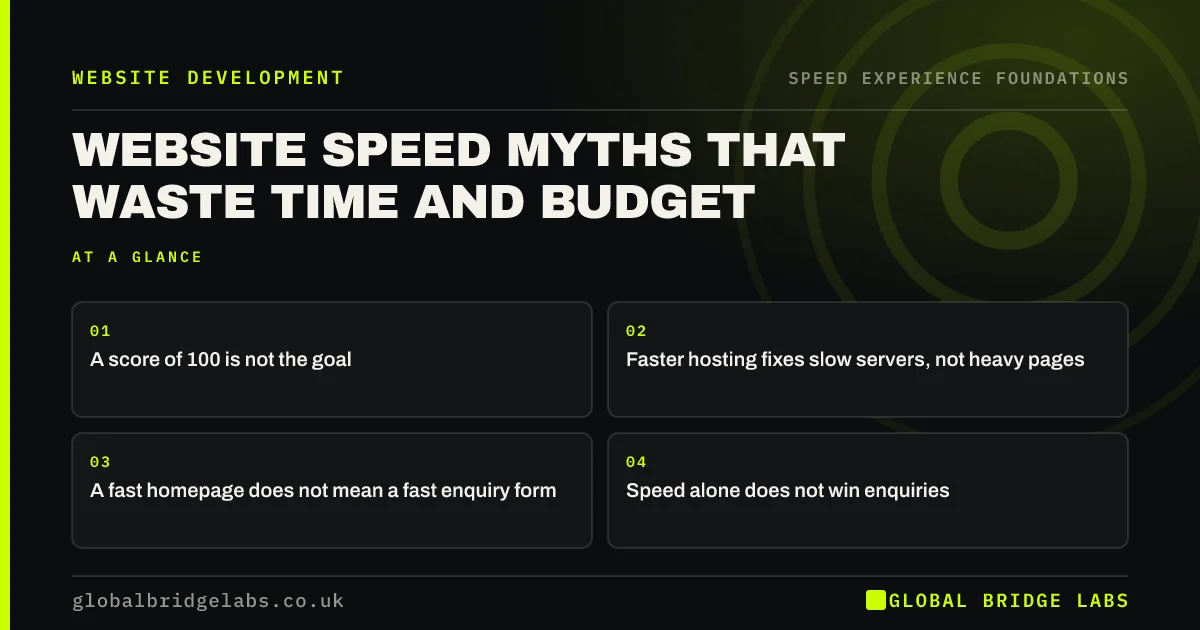
- A score of 100 is not the goal. Passing on real phones for key pages is.
- Faster hosting fixes slow servers, not heavy pages.
- A fast homepage does not mean a fast enquiry form.
- Speed alone does not win enquiries. It stops you losing them.
Been told you need a rebuild for speed? Send us the URL on WhatsApp for a second opinion.
Chat on WhatsApp →Myth 1: do you need a perfect PageSpeed score?
No. The PageSpeed Insights performance score is a lab estimate from one simulated visit. Google's ranking systems use field data from real visitors, not that score. A page scoring 70 that passes Core Web Vitals for real users is in a better position than one scoring 95 in the lab with poor field data.
The last ten points are also the most expensive. They usually mean removing things that earn money, such as a booking tool or tracking you rely on.
Myth 2: will faster hosting fix a slow website?
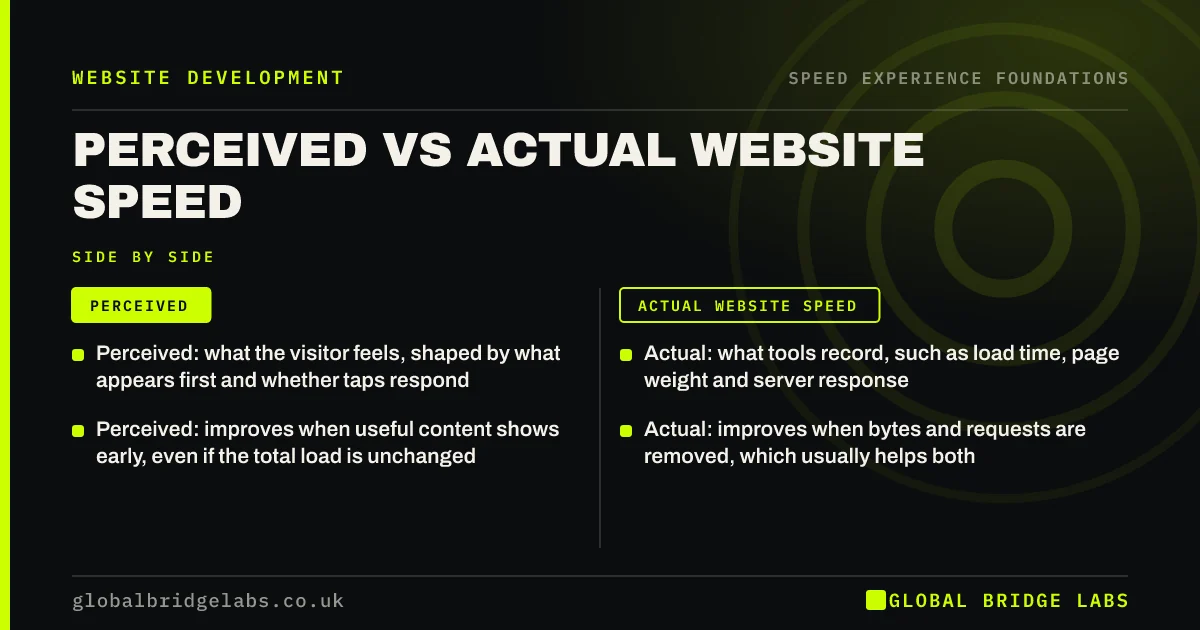
Only if the server is the slow part. Hosting controls how quickly the first response arrives, known as time to first byte. It does nothing about a four-megabyte hero image or twelve third-party scripts, which run on the visitor's phone. Diagnose first. If the server responds within about 0.8 seconds, the problem is the page.
Myth 3: is the homepage the page that matters?
Rarely. Visitors from search and adverts usually land on a service, product or campaign page, and the action they take happens on a form, booking tool or checkout. Those pages are often slower than the homepage, because nobody tested them. Speed work that stops at the homepage optimises the page your customers are least likely to land on.
Myth 4: does one plugin make a website fast?
A caching or optimisation plugin can help a great deal, and it cannot fix everything. It can store finished pages, compress files and delay images. It cannot make a bloated theme light, shorten a slow third-party script or decide which of your fifteen plugins should not be there. Treat plugins as one tool, configured and tested, not a switch.
Want to know which fixes would move your site? Ask us on WhatsApp.
Chat on WhatsApp →Myth 5: does a fast website convert by itself?
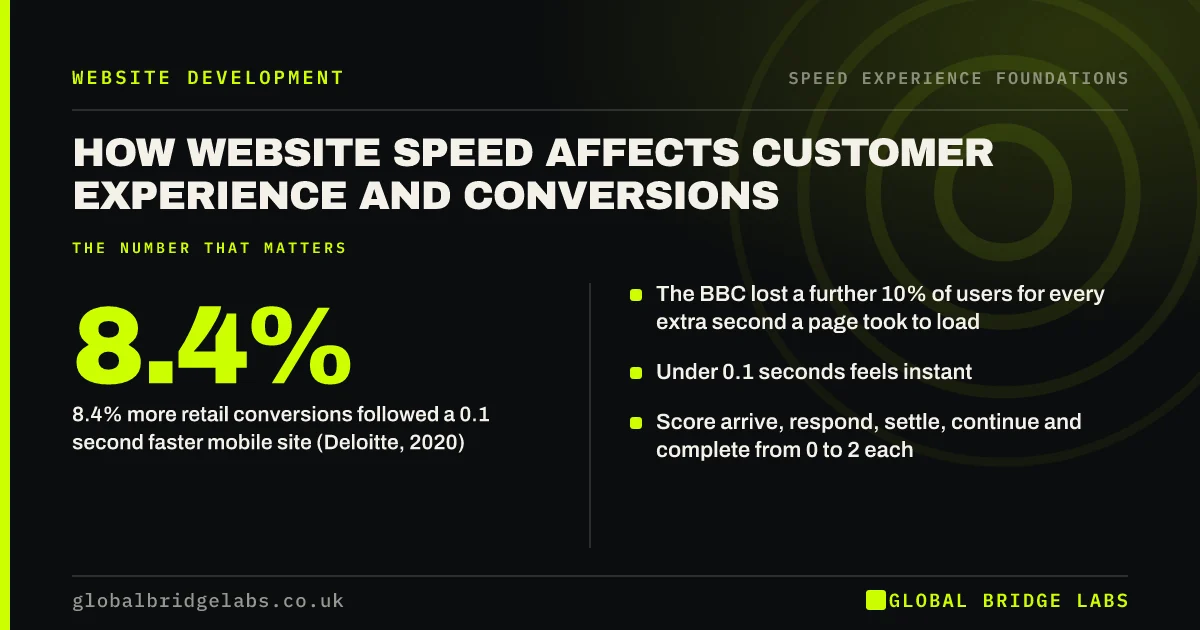
No. Speed removes a reason to leave. It does not supply a reason to enquire. A page that loads in one second with a vague headline, no proof and a long form will still convert poorly. Deloitte's 2020 study linked a 0.1 second improvement to 8.4% more retail conversions, on sites that already had something worth buying.
Which speed advice is actually true?
Some widely repeated advice holds up. Mobile matters more than desktop, because that is where most visitors and the weakest connections are. Images are usually the largest single saving. Third-party scripts are the most common reason a page ignores taps. And speed decays: a site that was fast at launch slows with every addition unless someone is watching.
- Test on a real phone over mobile data.
- Fix the first screen of your landing pages first.
- Count and question every third-party script.
- Re-test after each change to the site.
What does this look like in practice?
A pattern we see after a disappointing speed project: the business paid for a move to premium hosting and a score-chasing exercise on the homepage. The score rose. Enquiries did not, because paid traffic lands on service pages with a slider and the form still hangs after Send.
Starting from the pages that receive first visits and the step where customers act gives a shorter, cheaper list. Across client work at Global Bridge Labs (GBL), we have seen a 2.4x enquiry rate from conversion changes like these.
Speed myth checklist
- Judge speed by field data and a real phone, not one score.
- Find the cause before paying for hosting or plugins.
- Test landing pages and forms, not only the homepage.
- Stop when visitors no longer notice the wait.
- Spend the next pound on clarity and proof.
Next step
If you have been sold a number instead of an outcome, we will look at what your customers experience and tell you which work is worth doing.
Message us on WhatsApp for a plain-English speed review, or book a 30-minute consultation.
Chat on WhatsApp →Sources and further reading
- About PageSpeed Insights · Google for Developers
- Understanding page experience in Google Search results · Google Search Central
- Time to First Byte (TTFB) · web.dev (Google)
- Milliseconds make millions: mobile site speed and conversion · Deloitte
Frequently asked questions
Do I need a 100 PageSpeed score?
No. The score is a lab estimate from one simulated visit. What matters is that real visitors on phones get a good experience on the pages that bring enquiries, which shows in field data for Core Web Vitals. Chasing the last points usually costs more than it returns.
Will better hosting make my website faster?
It will if your server is slow to respond, which you can see as a high time to first byte. It will not fix heavy images, bloated themes or third-party scripts, which run on the visitor's device. Find the cause before changing host.
Is website speed the most important factor for conversions?
No. Speed is a threshold. A slow site loses visitors before they can decide, so it must be fixed first. Beyond that, a clear offer, proof and an easy way to enquire matter more than further speed gains.
Does a fast website stay fast?
Not without attention. New plugins, tracking tags, images and campaign pages add weight over time. Re-test key pages after each change and review the site every quarter, or the gains from a speed project will be gone within a year.
Written by

Global Bridge Labs (GBL) is a UK–Sri Lanka partner for social media, websites and BPO. Everything here comes from client delivery, not theory.