On this page
- 01Key takeaways
- 02How does website speed affect conversion?
- 03What does the evidence show?
- 04How fast is fast enough?
- 05Which speed fixes are worth paying for?
- 06When does more speed stop helping?
- 07What does this look like in practice?
- 08Speed and conversion checklist
- 09Next step
- 10Sources and further reading
- 11Frequently asked questions
Key takeaways
Yes, website speed affects conversion rate, especially on mobile. Faster pages keep more visitors and give them less reason to give up before acting. Published case studies show clear effects, but speed is a threshold, not a race: once key pages load quickly on mobile data, clarity and proof matter far more than shaving off further milliseconds.
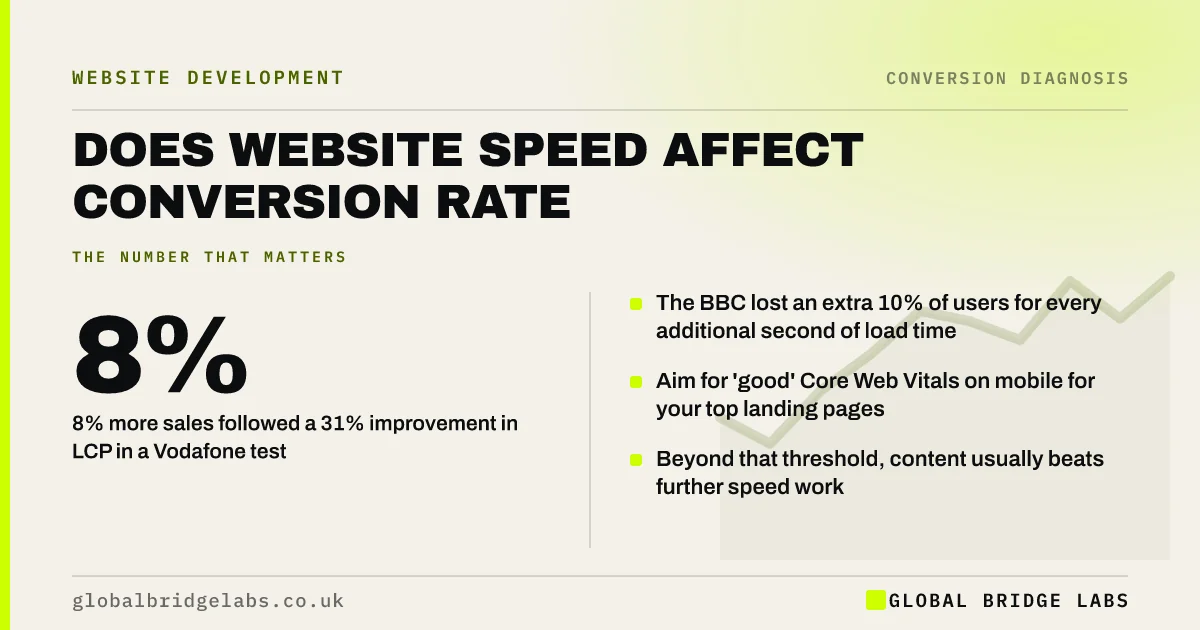
- 8% more sales followed a 31% improvement in LCP in a Vodafone test.
- The BBC lost an extra 10% of users for every additional second of load time.
- Aim for 'good' Core Web Vitals on mobile for your top landing pages.
- Beyond that threshold, content usually beats further speed work.
Want to know whether speed is costing you enquiries? Send us the URL on WhatsApp.
Chat on WhatsApp →How does website speed affect conversion?
Speed affects conversion by changing how many visitors stay long enough to act, and how easy acting feels. Slow pages lose visitors before the content appears. Slow responses to taps make forms and menus feel broken. Both cut the number of people who reach the enquiry or checkout.
What does the evidence show?
Google's web.dev publishes case studies linking speed to business results. Vodafone ran a controlled test where a 31% improvement in Largest Contentful Paint (LCP) increased sales by 8%. web.dev also reports that the BBC found it lost an additional 10% of users for every extra second its site took to load.
These are large sites with enough traffic to measure small effects. The direction applies to small sites too, but the size of the effect will differ.
How fast is fast enough?
Fast enough means passing Google's Core Web Vitals thresholds on mobile for the pages that bring enquiries: LCP within 2.5 seconds, Interaction to Next Paint (INP) within 200 milliseconds, and Cumulative Layout Shift (CLS) below 0.1. Test in PageSpeed Insights using field data where available.
Want your top landing pages speed-tested on mobile? Ask us on WhatsApp.
Chat on WhatsApp →Which speed fixes are worth paying for?
Prioritise fixes that affect the first screen of your top landing pages on mobile. These usually give the biggest improvement for the least cost.
- Compress and correctly size images, especially the hero image.
- Remove or replace video headers on mobile.
- Cut unused plugins, scripts and tracking tags.
- Use good hosting with caching and a content delivery network.
- Load chat widgets and pop-ups after the main content.
When does more speed stop helping?
Once pages pass Core Web Vitals comfortably, further speed work gives smaller returns than fixing clarity, proof and the enquiry route. A page that loads in 1.2 seconds with a vague headline will convert worse than one that loads in 2 seconds and answers the buyer. Speed removes a barrier. It does not persuade.
What does this look like in practice?
A UK garden centre's homepage took several seconds to show anything on mobile because of an autoplay video and a large slider. We replaced both with a single compressed image and the week's offers as text. Mobile engagement rose, and click-and-collect orders from mobile improved over the following weeks. The design barely changed. The first screen simply arrived sooner.
Speed and conversion checklist
- Test top landing pages in PageSpeed Insights on mobile.
- Fix the hero image and any video header first.
- Remove unused plugins, scripts and tags.
- Delay chat widgets and pop-ups.
- Aim to pass Core Web Vitals, then move on to content.
- Re-test after every significant site change.
Next step
Speed is worth fixing until it stops being a barrier. We will tell you whether your site is past that point or whether speed is still costing you enquiries.
Message us on WhatsApp for a speed and conversion check, or book a 30-minute consultation.
Chat on WhatsApp →Sources and further reading
- Vodafone: a 31% improvement in LCP increased sales by 8% · web.dev
- Why does speed matter? · web.dev
- Understanding Core Web Vitals and Google search results · Google Search Central
- PageSpeed Insights · Google
Frequently asked questions
Does page speed affect conversion rate?
Yes. Faster pages keep more visitors and make acting easier, particularly on mobile. Case studies on web.dev show measurable gains, such as Vodafone's 8% sales increase after improving LCP by 31%. Once pages pass Core Web Vitals, content usually matters more than further speed gains.
How fast should a website load to convert?
Aim for Google's 'good' Core Web Vitals on mobile: Largest Contentful Paint within 2.5 seconds, Interaction to Next Paint within 200 milliseconds and Cumulative Layout Shift below 0.1. Focus on the pages that bring enquiries first. Test them in PageSpeed Insights using field data, and re-test after every significant change to the site.
What slows down a small business website most?
Large uncompressed images, video headers, too many plugins and tracking scripts, heavy page builders and cheap hosting without caching. Chat widgets and pop-ups that load early also slow the first screen on mobile. Fix the hero image and any video header first, because they usually decide how quickly the first screen appears.
Is it worth rebuilding a website for speed?
Only if fixes on the current platform cannot reach acceptable speeds, for example when a heavy page builder or theme is the cause. Most sites can reach 'good' Core Web Vitals through image, script and hosting improvements at far lower cost.
Written by

Global Bridge Labs (GBL) is a UK–Sri Lanka partner for social media, websites and BPO. Everything here comes from client delivery, not theory.