On this page
- 01Key takeaways
- 02What does slow to respond mean?
- 03Why does responsiveness matter to customers?
- 04What makes a site slow to respond?
- 05How do you make a site respond faster?
- 06When is a rebuild the only fix?
- 07What does this look like in practice?
- 08Responsiveness checklist
- 09Next step
- 10Sources and further reading
- 11Frequently asked questions
Key takeaways
A website that is slow to respond to taps feels broken, even if it loaded quickly. The visitor presses the menu, a filter or a button and nothing happens for a noticeable moment. The cause is nearly always too much script running on the phone at once. Google measures this as Interaction to Next Paint (INP). Reducing and delaying scripts is the fix, and it is felt on every page.
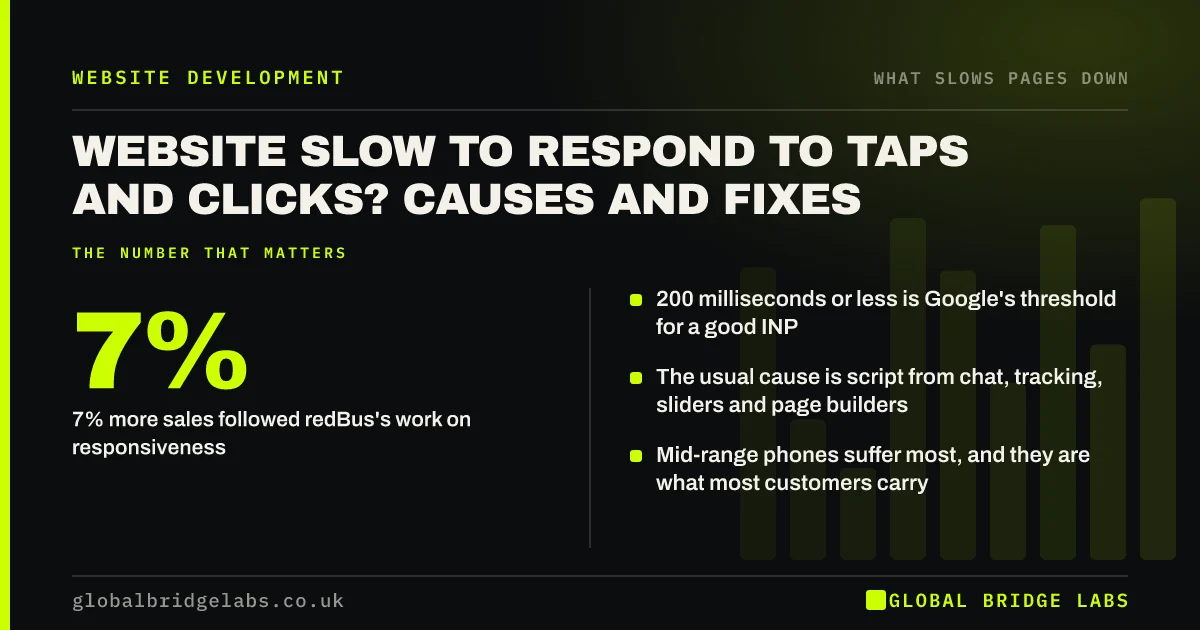
- 200 milliseconds or less is Google's threshold for a good INP.
- 7% more sales followed redBus's work on responsiveness.
- The usual cause is script from chat, tracking, sliders and page builders.
- Mid-range phones suffer most, and they are what most customers carry.
Do your buttons feel sticky on a phone? Send us the URL on WhatsApp.
Chat on WhatsApp →What does slow to respond mean?
A page is slow to respond when there is a visible delay between a visitor's action, such as a tap, click or key press, and the screen showing any reaction.
Interaction to Next Paint measures that delay across a whole visit and reports one of the slowest interactions. A result of 200 milliseconds or less is good. Above 500 milliseconds is poor. INP became a Core Web Vital in March 2024, replacing an earlier measure that only looked at the first interaction.
Why does responsiveness matter to customers?
Responsiveness matters because it is what makes a visitor feel in control. The Nielsen Norman Group puts 0.1 seconds as the limit for an action to feel instant. A tap that takes half a second to register breaks that, and the natural reaction is to tap again, which often triggers the action twice.
The bus ticketing site redBus reported that improving INP increased its sales by about 7%. The work targeted the search and booking steps, where customers interact most.
What makes a site slow to respond?
A browser can only do one main job at a time. If it is busy running script when the visitor taps, the tap waits. The more script a page runs, and the slower the phone, the longer the wait.
- Third-party scripts: chat, adverts, tracking and review widgets.
- Page builders and themes that load large script bundles.
- Sliders and animation libraries running continuously.
- Very long pages with thousands of elements.
- Handlers that do heavy work before showing any feedback.
How do you make a site respond faster?
Give the browser less to do, and make it show feedback before it does the rest.
- 1. Remove scripts that are not used.
- 2. Delay non-essential scripts until after the page is usable.
- 3. Show an immediate visual change on every tap.
- 4. Break up long script tasks so taps can be handled in between.
- 5. Simplify very long or deeply nested pages.
- 6. Test on a mid-range Android phone, not a new flagship.
- Website animations: when motion makes a site feel slow
- Which devices should you test your website on?
Want the scripts behind your slow taps identified? Ask us on WhatsApp.
Chat on WhatsApp →When is a rebuild the only fix?
A rebuild becomes the realistic fix when the delay comes from the platform itself. Some page builders and themes ship so much script that no amount of tuning brings response times into the good range. Diagnose before deciding. If removing third-party scripts on a test copy does not help, the theme or builder is the likely cause.
What does this look like in practice?
A pattern we see on sites that pass their loading tests: the page appears quickly, and for the next three seconds the menu button does nothing, because chat, a slider and several tags are all starting up. Visitors tap twice, the menu opens and closes, and they conclude the site is faulty.
Delaying those scripts until the page is idle gives the first taps a clear run. Global Bridge Labs (GBL) tests the first tap on every key page for this reason.
Responsiveness checklist
- Tap the menu the moment each key page appears.
- Check INP in PageSpeed Insights field data.
- List scripts that start during the first few seconds.
- Delay or remove the non-essential ones.
- Add a pressed state to every button.
- Re-test on a mid-range phone.
Next step
A site that answers every tap at once feels fast even on a slow connection. We will test yours on an ordinary phone and find what is holding it up.
Message us on WhatsApp for a responsiveness check, or book a 30-minute consultation.
Chat on WhatsApp →Sources and further reading
- Interaction to Next Paint (INP) · web.dev (Google)
- Optimise Interaction to Next Paint · web.dev (Google)
- How redBus improved Interaction to Next Paint and increased sales by 7% · web.dev (Google)
- Response times: the 3 important limits · Nielsen Norman Group
Frequently asked questions
Why is my website slow to respond when I click?
The browser is busy running script and cannot handle the click until it finishes. Chat widgets, tracking tags, sliders and heavy themes are the usual sources. Removing unused scripts and delaying the rest gives the browser room to respond.
What is a good Interaction to Next Paint?
200 milliseconds or less is rated good by Google, measured at the 75th percentile of real visits. Between 200 and 500 milliseconds needs improvement, and above 500 is poor. INP has been a Core Web Vital since March 2024.
Why does my website feel fine on my phone but slow for customers?
You may have a faster phone. Script that runs smoothly on a recent flagship can take several times longer on a mid-range device, which is what many customers use. Test on an ordinary phone and check field data.
Can hosting fix a website that is slow to respond to taps?
Rarely. Hosting affects how quickly the page arrives. Responsiveness to taps depends on how much script runs on the visitor's device. The fix is on the page: fewer and later scripts, and immediate feedback on every action.
Written by

Global Bridge Labs (GBL) is a UK–Sri Lanka partner for social media, websites and BPO. Everything here comes from client delivery, not theory.