On this page
- 01Key takeaways
- 02What is perceived performance?
- 03Why can a website test fast and still feel slow?
- 04What shapes how fast a page feels?
- 05How do you make a website feel faster?
- 06When do perception tricks backfire?
- 07What does this look like in practice?
- 08Perceived speed checklist
- 09Next step
- 10Sources and further reading
- 11Frequently asked questions
Key takeaways
Perceived speed is how fast a website feels to the person using it. Actual speed is what a tool measures. Customers act on the first and never see the second. A page can pass every test and still feel slow if it shows nothing useful early, ignores taps or shifts as it loads, so both need attention, in that order.
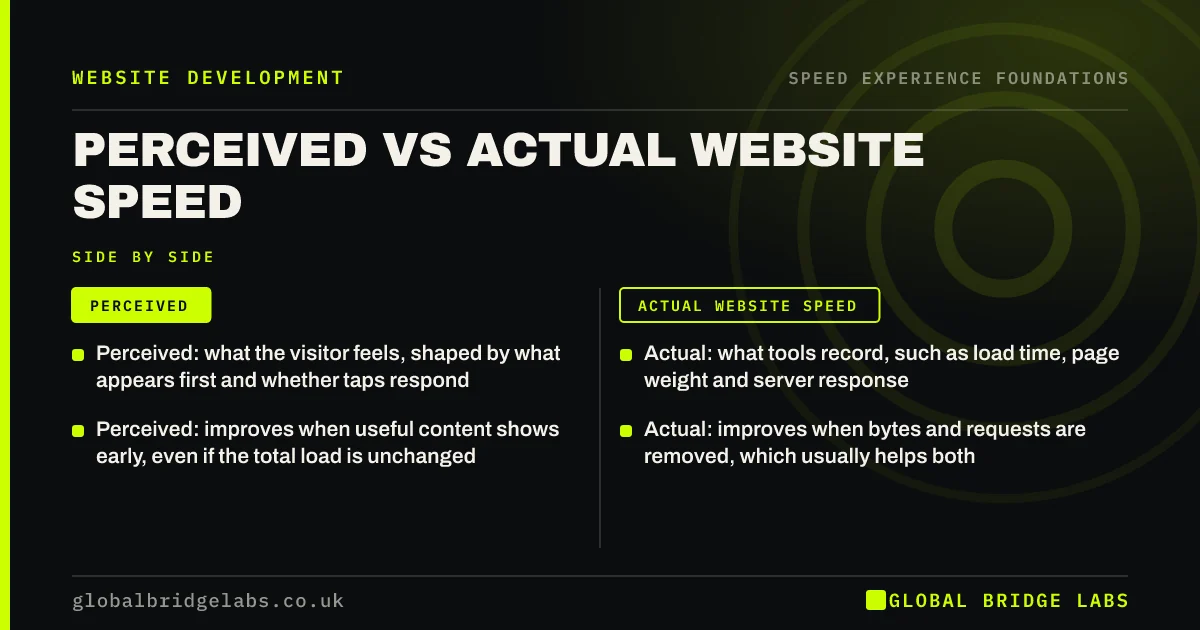
- Perceived: what the visitor feels, shaped by what appears first and whether taps respond.
- Actual: what tools record, such as load time, page weight and server response.
- Perceived: improves when useful content shows early, even if the total load is unchanged.
- Actual: improves when bytes and requests are removed, which usually helps both.
Does your site test well but feel slow? Send us the URL on WhatsApp and we will tell you why.
Chat on WhatsApp →What is perceived performance?
Perceived performance is a visitor's subjective sense of how quickly a website responds, based on what they see and feel rather than on measured load time.
It matters because nobody browses with a stopwatch. Two pages that finish loading in the same four seconds can feel completely different. One shows the headline and a button after one second and fills in the rest quietly. The other stays blank for three and a half seconds and then appears all at once. The first feels quick. The second feels broken.
Why can a website test fast and still feel slow?
Because most single-number tests reward finishing, not usefulness. A site can score well in a lab test and still feel slow for three reasons: the first screen appears late even though everything arrives soon after, taps are ignored while scripts run, or the layout jumps as late content loads.
The reverse also happens. A long page with many images below the fold can have a heavy total weight and feel quick, because the visitor only ever waits for the part they can see. This is why Google moved from a single load time to separate measures for appearing, responding and staying still.
What shapes how fast a page feels?
Four things shape perceived speed more than total load time. Each is something a visitor can sense without knowing what caused it.
- Early content: text and the main button appear before images and extras.
- Feedback: a pressed button changes at once, even if the result takes longer.
- Stability: content does not move after it has appeared.
- Progress: a wait with a visible indicator feels shorter than a silent one.
- Order: the page fills from the top down, not from the edges in.
How do you make a website feel faster?
Make the first screen cheap and everything else patient. The headline, opening sentence and main call to action should not depend on a slider, a video or a third-party script. Content below the fold can load as the visitor scrolls. Buttons and forms should acknowledge a tap immediately, then show progress if the work takes longer than a second.
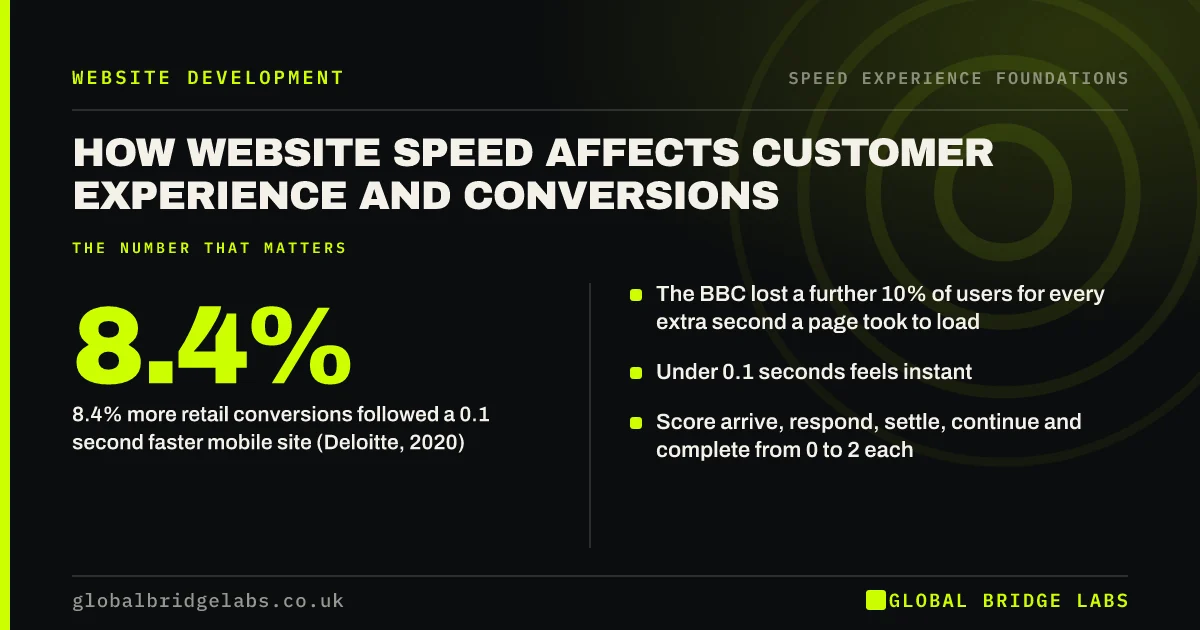
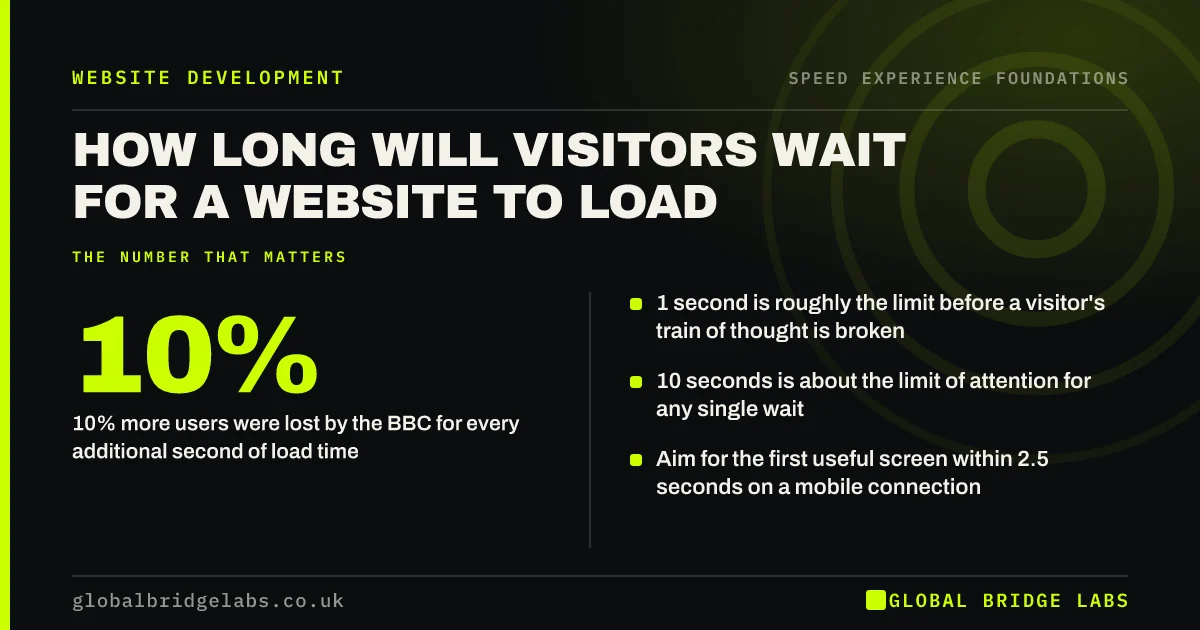
The Nielsen Norman Group's response time limits give useful targets: about 0.1 seconds for something to feel instant, 1 second before the visitor's train of thought is interrupted, and 10 seconds as the limit of attention. Feedback inside the first limit buys patience for the others.
- Load the first screen's text and image before anything else.
- Reserve space for images, adverts and embeds so nothing shifts.
- Show a pressed state on every button and a progress message on every form.
- Delay chat, reviews and pop-ups until the page has settled.
- Lazy loading: faster pages or missing content?
- Third-party scripts: the hidden reason your site is slow
Want your first screen reviewed on a real phone? Ask us on WhatsApp.
Chat on WhatsApp →When do perception tricks backfire?
Perception tricks backfire when they hide a real delay instead of shortening it. A loading animation that plays for three seconds on a page that could have shown text in one makes things worse. Skeleton screens, the grey placeholder blocks common in apps, help only if real content replaces them quickly.
Faking readiness is the worst case. A page that looks finished but ignores taps for two seconds teaches visitors that your buttons do not work. If you must choose, an honest progress message beats a polished illusion.
What does this look like in practice?
A pattern we see in service businesses: the developer reports a strong test score, and the owner still hears that the site is slow. On a phone, the page is blank until a large hero image arrives, then a cookie banner pushes the headline down just as the visitor reaches for the menu.
Showing the headline as text first, giving the image a fixed space and moving the banner to an overlay changes how the page feels without changing its total weight by much. Across client work at Global Bridge Labs (GBL), we have seen a 2.4x enquiry rate from conversion changes of this kind.
Perceived speed checklist
- Open the page on a phone and note what appears first.
- Tap the menu and main button as soon as they show.
- Watch for anything that moves after you start reading.
- Submit a form and check for immediate feedback.
- Remove loading animations that delay real content.
- Compare how it feels with what the test tools say.
Next step
If your reports say fast and your customers say slow, believe the customers. We will find the gap between the two and tell you which changes close it.
Message us on WhatsApp for a perceived speed review, or book a 30-minute consultation.
Chat on WhatsApp →Sources and further reading
- Response times: the 3 important limits · Nielsen Norman Group
- User-centric performance metrics · web.dev (Google)
- Measure performance with the RAIL model · web.dev (Google)
Frequently asked questions
What is the difference between perceived and actual speed?
Actual speed is what a tool measures, such as load time or page weight. Perceived speed is how quickly the site feels to a visitor, which depends on how soon useful content appears, whether taps respond and whether the page stays still. Customers only ever experience the perceived version.
Why does my website feel slow when the speed test says it is fast?
Usually because the first screen appears late, taps are ignored while scripts run, or the layout shifts as content loads. Lab tests also run on a simulated device that may not match your customers' phones. Check field data and test on a real mid-range phone over mobile data.
Do loading animations make a website feel faster?
Only when the wait is unavoidable and the animation appears immediately. A progress indicator makes a necessary delay feel shorter. An animation that plays before content which could have been shown at once makes the site slower, and visitors notice.
Which matters more for conversions, perceived or actual speed?
Perceived speed, because it is what visitors react to. In practice the two improve together: removing weight and scripts makes pages both measure and feel faster. Where they differ, prioritise what the visitor sees first and how quickly the page responds to a tap.
Written by

Global Bridge Labs (GBL) is a UK–Sri Lanka partner for social media, websites and BPO. Everything here comes from client delivery, not theory.