On this page
- 01Key takeaways
- 02How do animations slow a website?
- 03Which animations cause the most trouble?
- 04Which motion helps the experience?
- 05What about visitors who dislike motion?
- 06When is richer animation justified?
- 07What does this look like in practice?
- 08Animation speed checklist
- 09Next step
- 10Sources and further reading
- 11Frequently asked questions
Key takeaways
Animation makes a website feel slow when it stands between the visitor and the content. Text that fades in section by section, a loading animation before the page appears and scroll effects that stutter on a phone all add waiting that the connection did not cause. Motion that responds to an action, such as a button changing when pressed, does the opposite. Keep the second kind and cut the first.
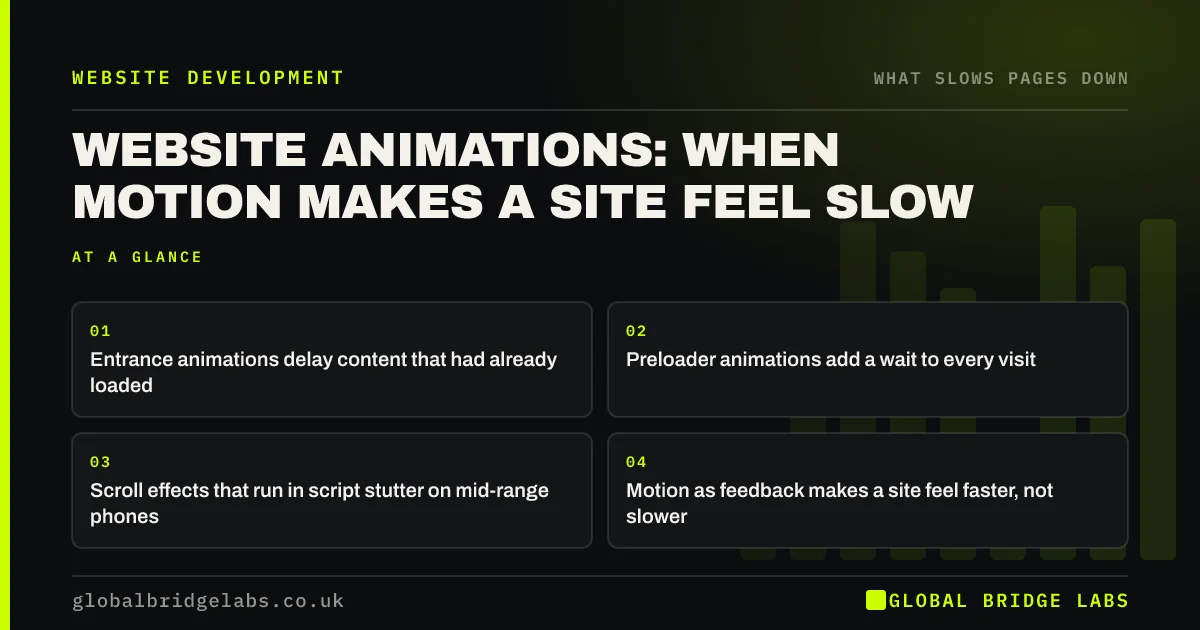
- Entrance animations delay content that had already loaded.
- Preloader animations add a wait to every visit.
- Scroll effects that run in script stutter on mid-range phones.
- Motion as feedback makes a site feel faster, not slower.
Does your site feel sluggish even though it loads quickly? Send us the URL on WhatsApp.
Chat on WhatsApp →How do animations slow a website?
Animations slow a website in two distinct ways. The first is weight: animation libraries are extra code to download and run. The second is time: an effect that takes 800 milliseconds to reveal a paragraph has added 800 milliseconds to reading it, on every section, however fast the page arrived.
Google's web.dev guidance on animation notes that some properties are cheap for a browser to animate and others force it to recalculate the layout of the page on every frame. The second kind is what makes scrolling judder.
Which animations cause the most trouble?
A few patterns account for most complaints.
- Preloaders: a logo animation shown before the page, sometimes on a fixed timer.
- Scroll reveals: every block fades or slides in as it enters the screen.
- Parallax: backgrounds that move at a different rate to the content.
- Animated counters and typing effects that withhold the information.
- Page transitions that play between every click.
- Auto-advancing carousels.
Which motion helps the experience?
Motion helps when it answers the visitor. A button that depresses, a menu that slides open in a fraction of a second and a form field that shows a tick all confirm that the site has registered an action. These are short, triggered by the user and cheap for the browser.
A useful rule: animation should explain what just happened, last no more than about a third of a second and never delay content.
- Pressed and hover states on buttons.
- Menus and accordions opening quickly.
- Progress indicators on forms and uploads.
- A brief highlight when something is added to a basket.
Want a list of the animations worth keeping on your site? Ask us on WhatsApp.
Chat on WhatsApp →What about visitors who dislike motion?
Some people feel unwell or distracted by movement on screen, and phones and computers offer a setting to reduce it. A well-built site respects that setting and switches off non-essential motion.
There is also an accessibility requirement. The Web Content Accessibility Guidelines (WCAG) 2.2 require that moving content which starts automatically and lasts more than five seconds can be paused, stopped or hidden. Auto-playing sliders and looping animations often fail it.
When is richer animation justified?
Richer animation is justified when it demonstrates the product or is part of what the business sells, as with a design studio or an interactive product tour. Build it so that the page is complete and usable without it, and test it on an ordinary phone. Animation added to make a simple service site feel modern usually ages quickly and costs speed every day.
What does this look like in practice?
A pattern we see on theme-built sites: every section is set to fade in on scroll, and a logo preloader plays for two seconds on each page. The site scores reasonably in tests, because the content has technically loaded. Visitors experience a site that makes them wait for every paragraph.
Switching off the preloader and the entrance effects takes minutes and is often the most noticeable speed improvement a site can make. Global Bridge Labs (GBL) checks how a site feels as well as how it measures.
Animation speed checklist
- Remove preloaders and timed loading screens.
- Turn off scroll-reveal effects on text.
- Stop carousels advancing automatically.
- Keep feedback animations under about a third of a second.
- Respect the device's reduced-motion setting.
- Scroll the site on a mid-range phone and watch for stutter.
Next step
If your site loads quickly and still feels slow, animation is a likely cause. We will go through it on a phone and mark what to keep and what to switch off.
Message us on WhatsApp for an animation and speed review.
Chat on WhatsApp →Sources and further reading
- How to create high-performance CSS animations · web.dev (Google)
- Understanding SC 2.2.2: Pause, Stop, Hide · W3C Web Accessibility Initiative
- Understanding SC 2.3.3: Animation from Interactions · W3C Web Accessibility Initiative
Frequently asked questions
Do animations slow down a website?
They can, in two ways. Animation libraries add code to download and run, and effects that reveal content gradually add waiting time even when the page has loaded. Short animations that respond to a tap are cheap and make a site feel more responsive.
Should my website have a loading animation?
Rarely. A preloader shown before the page adds a wait to every visit, and on a fast connection it delays content that was ready. Show the page itself as early as possible and reserve progress indicators for actions that really take time.
Are scroll animations bad for user experience?
Used on every section, yes. Visitors scrolling to find something have to wait for each block to appear. On mid-range phones the effects can also stutter. Use them sparingly, if at all, and never on body text.
Do website animations cause accessibility problems?
They can. Some people are distracted or made unwell by motion. WCAG 2.2 requires that automatically moving content lasting more than five seconds can be paused, stopped or hidden, and sites should respect the device's reduced-motion setting.
Written by

Global Bridge Labs (GBL) is a UK–Sri Lanka partner for social media, websites and BPO. Everything here comes from client delivery, not theory.