On this page
- 01Key takeaways
- 02What is a website redesign scorecard?
- 03How do you score each area?
- 04What evidence do you need for each score?
- 05How do you read the total?
- 06What do typical scores and costs look like?
- 07What can the scorecard not tell you?
- 08Who should score the site?
- 09What does this look like in practice?
- 10Run the scorecard in one hour
- 11Next step
- 12Sources and further reading
- 13Frequently asked questions
Key takeaways
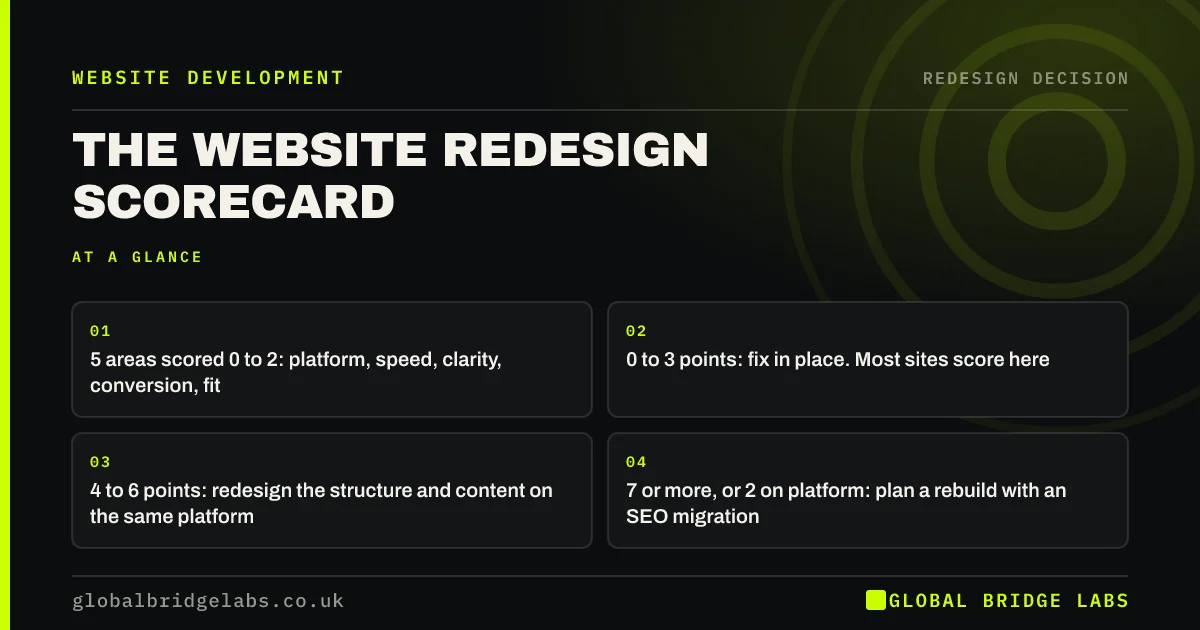
The GBL Redesign Scorecard rates five areas (platform, speed, clarity, conversion and fit) from 0 to 2. A total of 0 to 3 means fix in place, 4 to 6 means redesign, and 7 or more, or a 2 on platform, means rebuild. It takes an hour and stops the decision being made on taste.
- 5 areas scored 0 to 2: platform, speed, clarity, conversion, fit.
- 0 to 3 points: fix in place. Most sites score here.
- 4 to 6 points: redesign the structure and content on the same platform.
- 7 or more, or 2 on platform: plan a rebuild with an SEO migration.
Want us to score your site with you? Message us on WhatsApp.
Chat on WhatsApp →What is a website redesign scorecard?
A website redesign scorecard is a short, structured assessment that rates a site's problems by area and by severity, so the decision to fix, redesign or rebuild is based on evidence rather than on whether someone is tired of the colours.
The GBL Redesign Scorecard uses five areas because they map to the three options: platform and speed problems point to a rebuild, clarity and fit problems point to a redesign, and conversion problems can usually be fixed in place.
How do you score each area?
Score every area 0, 1 or 2. Zero means healthy. One means there is a problem you can fix on the current site. Two means the problem is blocked by the platform or the site's structure and cannot be fixed without deeper change.
- Platform: are core software, theme and plugins supported and updatable?
- Speed: do key pages pass Core Web Vitals on mobile, and if not, is the cause fixable?
- Clarity: can a stranger say what you do, for whom and where within five seconds?
- Conversion: can a visitor enquire easily on mobile, and does every enquiry arrive?
- Fit: does the structure match the services, buyers and brand you have today?
What evidence do you need for each score?
Every score needs one piece of evidence you could show someone else. That rule is what makes the scorecard useful in a meeting with partners or a board.
- Platform: the version numbers, and the supplier's support dates.
- Speed: a PageSpeed Insights report for the homepage and top service page on mobile.
- Clarity: three people outside the business describing the homepage after five seconds.
- Conversion: a test enquiry on a phone, and 12 months of enquiry numbers.
- Fit: a list of services sold now, compared with the pages on the site.
How do you read the total?
Add the five scores for a total out of 10, then apply one override: a 2 on platform means rebuild whatever the total, because an insecure or unsupported foundation undermines every other fix.
- 0 to 3: fix in place. Start with the highest-scoring area.
- 4 to 6: redesign. Keep the platform if it scores 0 or 1, rework structure and content.
- 7 to 10: rebuild. Plan the SEO migration before any design work starts.
- Platform scores 2: rebuild, even if the total is low.
Scored 4 or more? We will tell you on WhatsApp what we would change first.
Chat on WhatsApp →What do typical scores and costs look like?
Most UK small business sites we audit score between 2 and 5. The typical market cost of acting on the result follows the score: optimisation work often costs £500 to £3,000, a redesign on an existing platform around £3,000 to £12,000, and a full rebuild £5,000 to £20,000 or more.
The scorecard's value is in keeping sites in the first band out of the third. Spending rebuild money on a site that scores 3 rarely produces more enquiries than fixing the three worst problems.
What can the scorecard not tell you?
It cannot tell you whether the market or the offer is the problem. If the site scores well and enquiries are still low, look at pricing, competition, reviews and where your traffic comes from before touching the website.
It is also a snapshot. Re-score every six months, or after any significant business change, so the decision stays current.
Who should score the site?
Two people, independently, then compare. The owner knows the business and the person who handles enquiries knows what buyers ask. Where their scores differ by more than one point in an area, that area needs more evidence before any decision is made.
An outside view helps with clarity and fit, because insiders cannot unsee what they know about the business. Borrow three people who match your buyers for the five-second test, and if you use a supplier to score the site, ask them to show the evidence for every number rather than accepting a total.
- Score independently first, then compare.
- Investigate any area where scores differ by 2 points.
- Use outsiders for clarity and fit.
- Keep the evidence with the scores for the next review.
What does this look like in practice?
A typical case: a UK logistics SME asked for a new website because it looked dated. The scorecard came out at platform 0, speed 1, clarity 2, conversion 1, fit 0, a total of 4.
That pointed to a redesign of the homepage and service pages on the existing platform, plus image compression, rather than the rebuild that had been budgeted. The saving paid for a year of monthly improvement work.
Run the scorecard in one hour
Follow these steps in order and write the evidence down as you go.
- Record platform, theme and plugin versions and check their support status.
- Run PageSpeed Insights on mobile for the homepage and top service page.
- Show the homepage to three outsiders for five seconds each.
- Send a test enquiry from a phone and confirm it arrives.
- List services sold today against pages on the site.
- Score each area 0 to 2, add them up and apply the platform override.
Next step
If you want a second opinion on the scores, we will run the GBL Redesign Scorecard on your site with you in 30 minutes and show you the evidence behind every number.
Message us on WhatsApp and ask for the redesign scorecard, or book a 30-minute consultation.
Chat on WhatsApp →Sources and further reading
- PageSpeed Insights · Google
- Understanding Core Web Vitals and Google search results · Google Search Central
- About key events · Google Analytics Help
Frequently asked questions
How do I assess whether my website needs a redesign?
Score five areas from 0 to 2: platform, speed, clarity, conversion and fit. A total of 0 to 3 means fix in place, 4 to 6 means redesign, and 7 or more means rebuild. A score of 2 on platform means rebuild regardless, because an unsupported foundation undermines every other fix.
What criteria should I use to evaluate my website?
Use criteria you can evidence: platform support status, mobile Core Web Vitals, whether strangers understand the homepage in five seconds, whether a test enquiry arrives, and whether the page structure matches the services you sell today. Avoid criteria based on taste alone.
How long does a website assessment take?
A useful self-assessment takes about an hour using free tools: PageSpeed Insights, a test enquiry, three outside opinions of the homepage and a list of your current services. A professional audit adds analytics review and technical checks and typically takes one to three days.
What if my website scores well but enquiries are still low?
Then the website is probably not the main problem. Check the offer, pricing, reviews, competition and the quality of traffic reaching the site. A redesign will not fix a weak offer or the wrong audience, and it risks the parts of the site that already work.
Written by

Global Bridge Labs (GBL) is a UK–Sri Lanka partner for social media, websites and BPO. Everything here comes from client delivery, not theory.