On this page
- 01Key takeaways
- 02Is there a right redesign cycle for a business website?
- 03What should trigger a redesign instead of the calendar?
- 04What does continuous improvement look like between redesigns?
- 05How long do websites typically last before a redesign?
- 06When is redesigning too often a problem?
- 07Who should own the website between redesigns?
- 08What does this look like in practice?
- 09Redesign timing checklist
- 10Next step
- 11Sources and further reading
- 12Frequently asked questions
Key takeaways
Most UK small business websites need a full redesign every 4 to 6 years, but the calendar should never be the trigger. Redesign when evidence says the structure no longer fits the business, and improve the site continuously in between, because monthly fixes beat a big relaunch every few years.
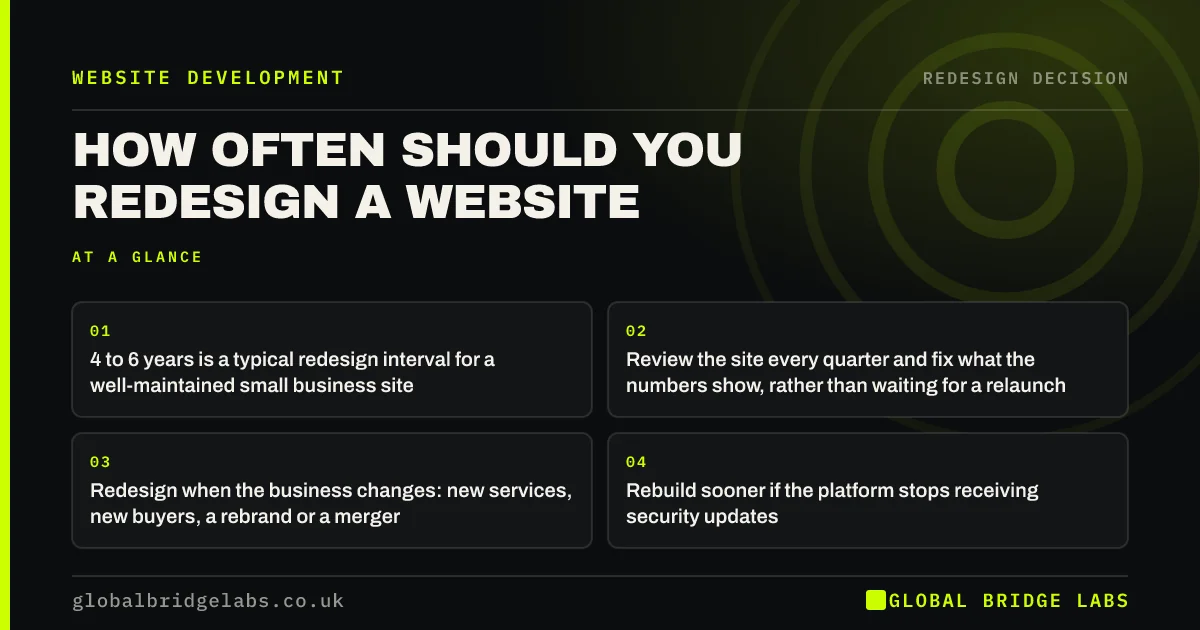
- 4 to 6 years is a typical redesign interval for a well-maintained small business site.
- Review the site every quarter and fix what the numbers show, rather than waiting for a relaunch.
- Redesign when the business changes: new services, new buyers, a rebrand or a merger.
- Rebuild sooner if the platform stops receiving security updates.
- A redesign every 2 years usually signals that nobody is improving the site in between.
Want to know whether your site is due? Send us the URL on WhatsApp.
Chat on WhatsApp →Is there a right redesign cycle for a business website?
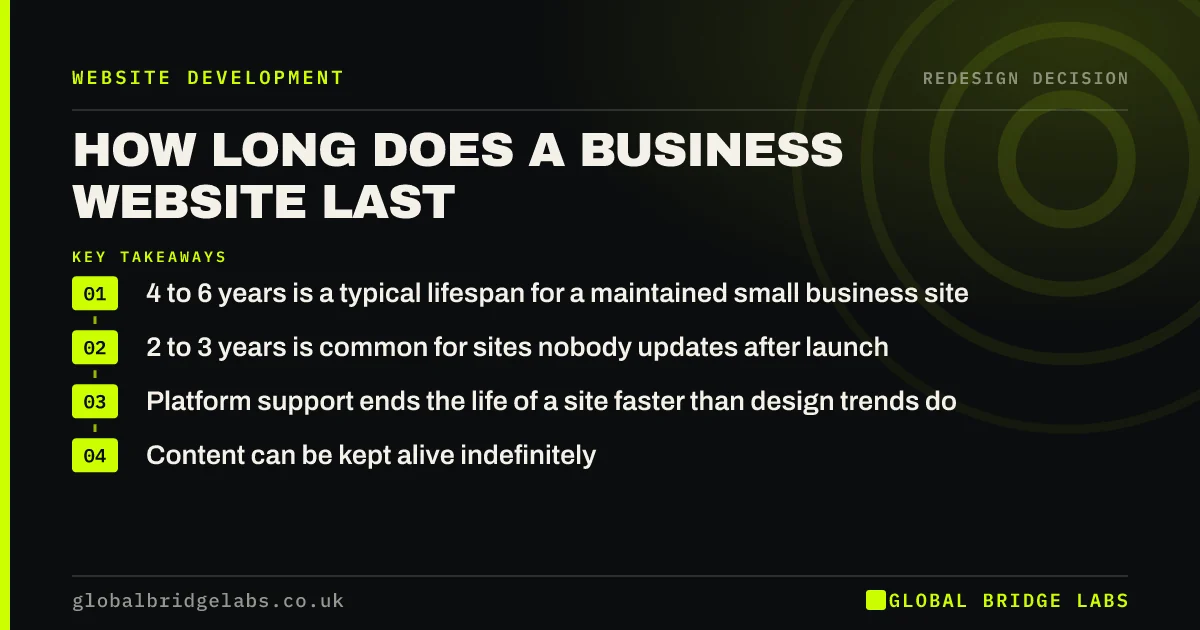
No fixed cycle is right for every business. A well-built small business website on a supported platform usually serves for 4 to 6 years before its structure stops fitting the business. The trigger for a redesign should be evidence of that mismatch, not the number of years since launch.
The old advice of redesigning every two or three years came from a time when sites were static and hard to edit. Modern platforms let you change copy, add pages and improve forms every month, so the gap between redesigns can be longer if the site is actually being looked after.
What should trigger a redesign instead of the calendar?
A redesign is due when the site's structure, not just its content, stops matching the business. The most reliable triggers are business changes and sustained drops in the numbers that matter, such as qualified enquiries, that fixes in place have not recovered.
- The services, prices or target buyers have changed and the navigation cannot hold them.
- Qualified enquiries have fallen for two consecutive quarters despite focused fixes.
- The brand has changed and the site now contradicts your print, vans or social profiles.
- Competitors now look markedly more credible to the buyers you want.
- The platform or theme cannot support a feature the business needs, such as booking.
What does continuous improvement look like between redesigns?
Continuous improvement means a short, regular review that turns data into small changes. For a small business that is 30 minutes a month on enquiries and key pages, and half a day a quarter on a proper check of speed, content accuracy and conversion paths.
The effect compounds. A site that gets ten small improvements a year is usually in better shape after five years than a site that was redesigned twice and left alone in between.
- Monthly: check enquiries by source, test the contact form, update anything out of date.
- Quarterly: review Core Web Vitals, top landing pages, and one conversion path end to end.
- Yearly: review the service structure, pricing guidance and proof against the business plan.
How long do websites typically last before a redesign?
Typical intervals depend on the platform and how well the site is maintained. These are working ranges from our delivery and audit work across UK SMEs, not fixed rules.
- Hosted builder sites (Squarespace, Wix): 3 to 5 years, often limited by templates.
- Maintained WordPress sites: 4 to 6 years, often limited by theme and plugin age.
- Custom-built sites: 5 to 8 years, often limited by the cost of changing them.
- Unmaintained sites of any kind: 2 to 3 years before security or speed problems appear.
Want a view on how much life your current site has left? Ask us on WhatsApp.
Chat on WhatsApp →When is redesigning too often a problem?
Redesigning every one or two years usually wastes money and search visibility. Each relaunch risks changed URLs, lost content and a reset of what you had learned about what converts, and it rarely fixes the underlying problems of vague copy, missing proof and absent tracking.
If a business feels it needs a redesign every two years, the real issue is usually that nobody owns the site between projects. Fix that first with a named owner and a monthly review.
Who should own the website between redesigns?
One named person inside the business, with a small monthly budget and the authority to approve changes. Without an owner, small problems accumulate until the whole site feels broken and a redesign looks like the only answer. With an owner, those problems are fixed as they appear.
The owner does not need technical skills. Their job is to look at enquiries each month, test the contact route, keep prices and services current, and brief whoever makes the changes. In most UK SMEs this sits naturally with the person who answers enquiries or runs marketing.
- Give the owner a standing monthly budget, even a small one.
- Book a 30-minute monthly review in the diary.
- Keep a simple change log: date, change, reason.
- Report enquiries, not traffic, to the rest of the business.
What does this look like in practice?
A pattern we see in UK professional services firms: a site redesigned on a three-year cycle by different suppliers, each time with a new look, a new URL structure and no tracking carried across. Nobody can say whether any of the three versions produced more enquiries than the last.
The better route is to set a baseline, fix the conversion path in place, and only redesign when the service structure genuinely changes. Across our client work we have seen a 2.4x website enquiry rate, and the lift came from content, proof and tracking decisions rather than from a new look alone.
Redesign timing checklist
Answer these before booking a redesign on the strength of the calendar.
- Check whether enquiries have actually fallen, using at least 12 months of data.
- Confirm the platform still receives security updates.
- List business changes since the last redesign.
- Try the three biggest fixes in place first and measure for 8 weeks.
- Name an owner for the site between projects.
- Redesign only when the structure, not just the content, no longer fits.
Next step
If you are wondering whether your site is due a redesign, we will look at it with you for 30 minutes and tell you whether to redesign now, fix in place or leave it alone for another year.
Message us on WhatsApp for a straight answer on redesign timing, or book a 30-minute consultation.
Chat on WhatsApp →Sources and further reading
- Understanding Core Web Vitals and Google search results · Google Search Central
- Google Search Console · Google
- About key events · Google Analytics Help
Frequently asked questions
How often should a small business redesign its website?
Typically every 4 to 6 years, but only when evidence says the structure no longer fits the business. Between redesigns, review the site monthly and fix what the numbers show. A site improved continuously lasts longer and performs better than one redesigned on a fixed cycle and left alone.
Is it bad to redesign a website too often?
Usually, yes. Each relaunch risks changed URLs, lost content and a reset of what you know converts, and it rarely fixes vague copy or missing tracking. Frequent redesigns often mean nobody owns the site between projects, which is the problem to fix first.
How do I know my website is due for a redesign?
Look for structural mismatch: services or buyers have changed, a rebrand has happened, qualified enquiries have fallen for two quarters despite fixes, or the platform cannot support features you need. If the problems are copy, proof or forms, fix those in place instead.
Should I update my website every year?
Update content, proof and pricing guidance continuously, and review the whole site once a year against the business plan. That annual review decides whether the next year needs small fixes, a redesign of specific sections, or nothing beyond maintenance. Keep a dated log of those reviews so trends are visible.
Written by

Global Bridge Labs (GBL) is a UK–Sri Lanka partner for social media, websites and BPO. Everything here comes from client delivery, not theory.