On this page
- 01Key takeaways
- 02Why does the office limit a logistics firm?
- 03Which tasks should come off the planners?
- 04How do proactive updates cut calls?
- 05Why does paperwork speed affect cash?
- 06What does this capacity cost?
- 07When do you need more planners?
- 08What does this look like in practice?
- 09Logistics scaling checklist
- 10Next step
- 11Sources and further reading
- 12Frequently asked questions
Key takeaways
To scale a logistics business without more office staff, protect your planners. Their time is consumed by status calls, booking entry and paperwork chasing, none of which needs their expertise. A managed team handling customer updates, bookings, proof of delivery and invoicing lets the same planners run more vehicles and customers.
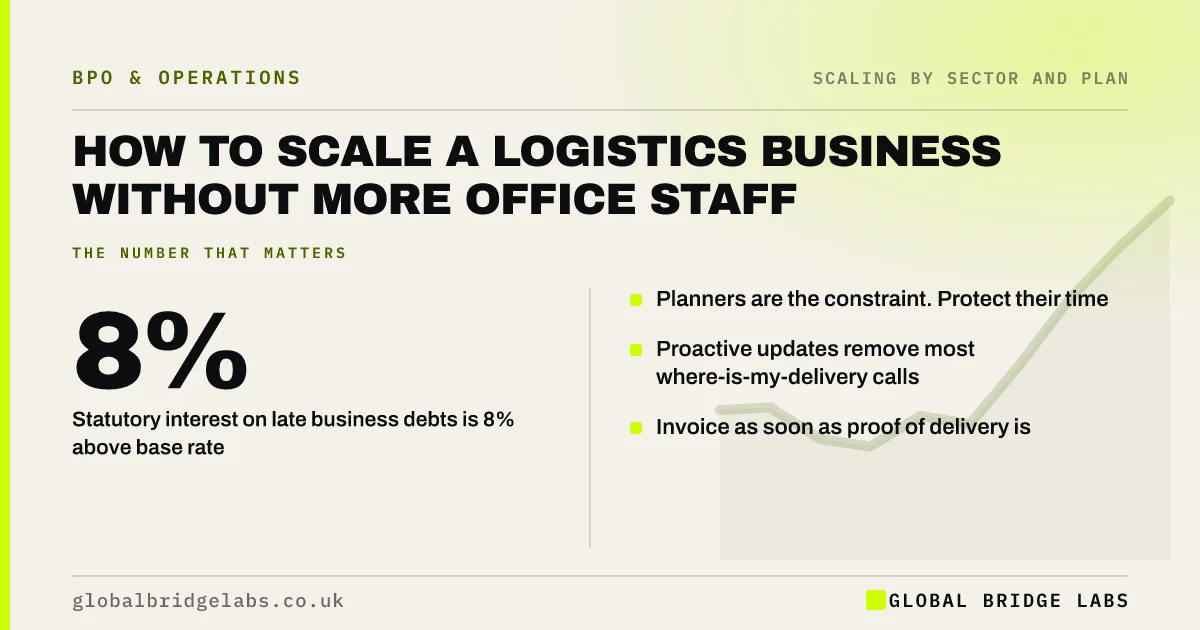
- Planners are the constraint. Protect their time.
- Proactive updates remove most where-is-my-delivery calls.
- Invoice as soon as proof of delivery is in.
- Statutory interest on late business debts is 8% above base rate.
Planners buried in calls and paperwork? Message us on WhatsApp with your daily job numbers.
Chat on WhatsApp →Why does the office limit a logistics firm?
The office limits a logistics firm because every job generates calls, entries and documents. Adding vehicles is straightforward compared with adding the planning and admin capacity to run them. When planners spend the day answering status calls, routes are planned in a hurry and expensive mistakes follow.
Which tasks should come off the planners?
Take off the planners anything that follows a rule and does not require routing judgement. That is most customer contact and nearly all the paperwork. Planners keep allocation, exceptions and driver communication.
- Booking entry from email, portal and phone.
- Delivery status updates and estimated times.
- Proof of delivery collection and matching.
- Invoicing and statement runs.
- Customer queries and claims paperwork.
How do proactive updates cut calls?
Proactive updates cut calls by answering the question before it is asked. A message when the job is booked, when it is out for delivery and when it is complete removes most routine enquiries. Where systems cannot send these automatically, a managed team can send them from the planning screen.
Why does paperwork speed affect cash?
Paperwork speed decides when you are paid. An invoice cannot go out until proof of delivery is matched, and customers will not pay without it. Every day a delivery note sits in a cab adds a day to your cash cycle. UK law allows statutory interest of 8% above the Bank of England base rate on late commercial payments, but prompt, complete invoicing does more.
Want to discuss your requirements for booking, updates and invoicing support? Message us on WhatsApp.
Chat on WhatsApp →What does this capacity cost?
As indicative market ranges, managed offshore teams cost £9–£18 per hour and onshore providers £20–£35 per hour. Logistics often needs cover early and late. Sri Lanka is five and a half hours ahead of GMT, which suits early-morning UK booking and overnight paperwork processing.
When do you need more planners?
You need more planners when the existing ones are spending their day planning and still cannot cover the fleet, or when you add a new depot, service type or operating window. Those are judgement roles and should be hired. Support them from the first day so they are planning, not answering phones.
What does this look like in practice?
A pattern we see in UK haulage and courier firms with 15 to 40 vehicles: two planners take a call every few minutes asking where a delivery is. Routing happens between calls. Moving status enquiries and proof of delivery matching to a managed team gives planners uninterrupted time, and invoices go out days sooner.
Logistics scaling checklist
Review these before adding vehicles.
- Count calls to planners by reason for a week.
- Measure days from delivery to invoice.
- Set up booking, dispatch and delivery notifications.
- Define which queries go to planners.
- Move booking entry and paperwork to support.
- Invoice daily from matched delivery notes.
- Track planner hours on planning.
Next step
Tell us your fleet size, daily jobs and how many people are in the office. We will show where planner time is going and what support would free it.
Message us on WhatsApp for a logistics office review, or book a 30-minute consultation.
Chat on WhatsApp →Sources and further reading
- Late commercial payments: charging interest and debt recovery · GOV.UK
- UK Customer Satisfaction Index · Institute of Customer Service
- Maximum weekly working hours · GOV.UK
Frequently asked questions
How do you scale a logistics company?
Scale a logistics company by increasing the number of jobs each planner can manage. Automate or delegate status updates, booking entry and paperwork, invoice promptly from proof of delivery, and keep planners focused on allocation and exceptions. Then add vehicles and drivers into a stable office process.
What can a transport business outsource?
A transport business can outsource customer service and delivery status enquiries, booking entry, proof of delivery matching, invoicing, credit control, claims paperwork and data entry. Route planning, driver management and compliance decisions normally stay in-house with experienced staff.
How can I reduce calls asking where a delivery is?
Send updates before customers ask: a confirmation at booking, a notification when the vehicle is on its way with an estimated time, and a completion message with proof of delivery. Give customers a way to check status themselves, and route remaining calls away from planners.
Why is my logistics business short of cash despite being busy?
Often because invoicing lags behind delivery. If proof of delivery is collected late, invoices go out late and payment follows later still, while fuel and wages are paid weekly. Matching paperwork daily and invoicing immediately shortens the gap.
Written by

Global Bridge Labs (GBL) is a UK–Sri Lanka partner for social media, websites and BPO. Everything here comes from client delivery, not theory.