On this page
- 01Key takeaways
- 02What is workforce planning?
- 03Why plan if you only hire now and then?
- 04How do you build the plan?
- 05Which roles should you hire?
- 06Which capacity should you buy?
- 07What belongs in the automate column?
- 08When does a bought role become a hire?
- 09What does this look like in practice?
- 10Workforce planning checklist
- 11Next step
- 12Sources and further reading
- 13Frequently asked questions
Key takeaways
Workforce planning for a small business is deciding, ahead of time, what capacity the business will need and how each part will be supplied. A one-page plan sorts future work into three columns: roles to hire, capacity to buy and tasks to automate. It replaces hiring by reaction with hiring by design.
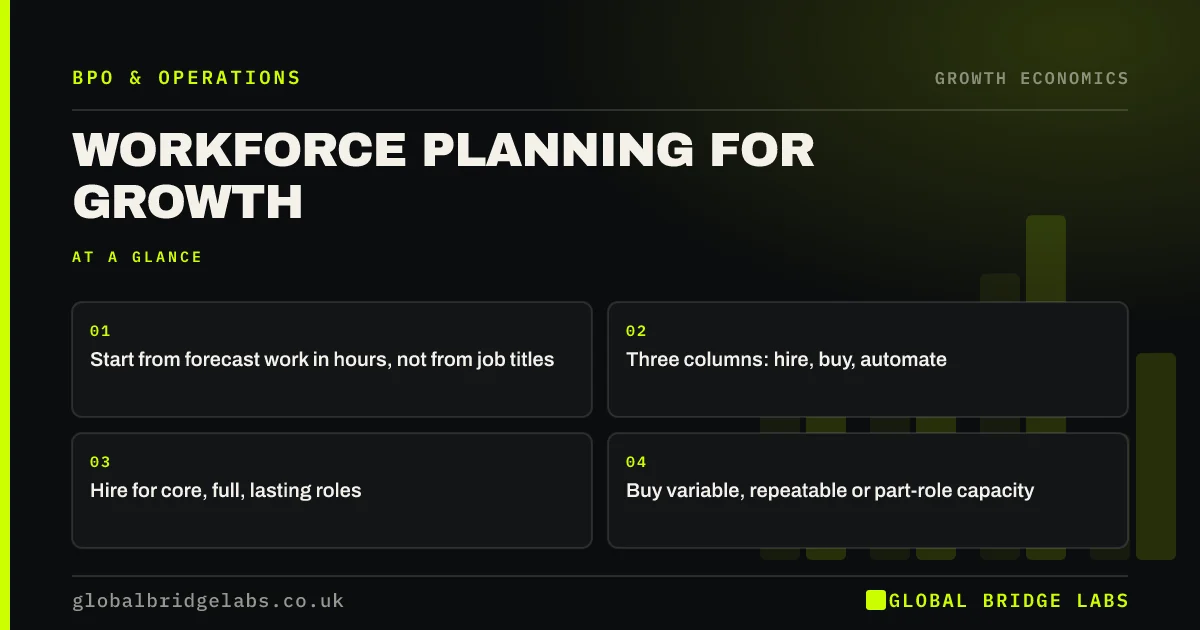
- Start from forecast work in hours, not from job titles.
- Three columns: hire, buy, automate.
- Hire for core, full, lasting roles.
- Buy variable, repeatable or part-role capacity.
Want a one-page workforce plan built from your growth targets? Message us on WhatsApp.
Chat on WhatsApp →What is workforce planning?
Workforce planning is the process of working out what skills and capacity an organisation will need over a future period and deciding how to obtain them. In a small business it is a simple annual exercise: forecast the work, compare it with current capacity, and choose how to fill each gap.
Why plan if you only hire now and then?
Plan because each hire in a small business is a large decision. One role can be 5% to 10% of the cost base. Recruiting commonly takes 4 to 12 weeks, so reacting means being short for a quarter. A plan also stops support roles accumulating one reasonable request at a time.
How do you build the plan?
Build the plan from the revenue target backwards. Estimate the volume of orders, clients or projects behind the target. Convert that into hours for each function. Subtract the capacity you have. What remains is the gap, expressed as hours of a particular kind of work.
- 1. Set the 12-month revenue target.
- 2. Translate it into volumes by quarter.
- 3. Convert volumes into hours by function.
- 4. Subtract current capacity.
- 5. Sort each gap into hire, buy or automate.
Which roles should you hire?
Hire roles that are core to what customers pay for, that will be fully used every week, and that you expect to need for years. Leadership, sales, senior delivery and roles requiring presence belong here. These people carry the knowledge and relationships that make the business distinct.
- Core to the product or client relationship.
- Full-time workload from day one.
- Needed for the long term.
- Requires presence or deep context.
Which capacity should you buy?
Buy capacity that is repeatable, variable in volume, less than a full role, or needed sooner than recruitment allows. Customer contact, order and booking admin, invoicing, data work and production tasks fit. So do senior skills needed for a few days a month, which can be bought as fractional roles.
- The make or buy decision for business services
- Fractional teams: senior skills without a full-time salary
Want to discuss your requirements for the buy column? Send us your gaps on WhatsApp.
Chat on WhatsApp →What belongs in the automate column?
Automate steps that are entirely rules-based and happen often: confirmations, reminders, data transfer between systems, standard reports. Automation reduces the hours in the other two columns. It rarely removes a whole role, which is why it sits alongside hiring and buying and not in place of them.
When does a bought role become a hire?
A bought role becomes a hire when the work has been steady and close to full-time for two or three quarters and has become central to the business. Buying first lets you prove the role. Converting too early returns you to fixed cost on unproven demand.
What does this look like in practice?
A pattern we see in UK firms writing their first plan: the starting list has six hires. After converting to hours, it becomes two hires, about 70 hours a week of bought capacity across three processes, and two automations. Total cost is lower, and the two hires are more senior than originally planned.
Workforce planning checklist
Complete this once a year and review it quarterly.
- Revenue target translated into volumes.
- Hours required by function and quarter.
- Current capacity by function.
- Each gap marked hire, buy or automate.
- Loaded cost for hires and quotes for bought capacity.
- Lead times: recruitment, setup, implementation.
- A review date each quarter.
Next step
Send us your revenue target and current team by function. We will draft the three columns with you and cost each option.
Message us on WhatsApp for a workforce plan outline, or book a 30-minute consultation.
Chat on WhatsApp →Sources and further reading
- Vacancies and jobs in the UK (latest bulletin) · Office for National Statistics
- Employing staff for the first time · GOV.UK
- Earnings and hours worked, occupation by four-digit SOC: ASHE Table 14 · Office for National Statistics
Frequently asked questions
What is workforce planning in simple terms?
Workforce planning is working out what work the business will need done in the future, comparing that with the people and skills it has now, and deciding how to fill the gap. The options are hiring, training, using outside providers or automating tasks.
How does a small business create a staffing plan?
Start from the revenue target and estimate the volume of work behind it. Convert that into hours for each function, subtract the capacity you already have, and decide for each gap whether to hire, buy capacity from a provider or automate. Cost each option and set lead times.
How far ahead should a small business plan staffing?
Plan 12 months ahead in outline and one quarter ahead in detail. Recruitment commonly takes one to three months, so decisions for next quarter's capacity need making now. Review the plan every quarter against actual sales and adjust.
Should I hire or outsource for a new role?
Hire if the role is core, will be fully used and is needed for the long term. Outsource if the work is repeatable, variable, less than a full role or needed quickly. When unsure, buy the capacity first and convert to a hire once the role has proved itself.
Written by

Global Bridge Labs (GBL) is a UK–Sri Lanka partner for social media, websites and BPO. Everything here comes from client delivery, not theory.