On this page
- 01Key takeaways
- 02What is a seat in outsourcing?
- 03How do you calculate the seats you need?
- 04Why is one seat rarely enough?
- 05What does a small outsourced team cost?
- 06Should you start smaller than the calculation?
- 07When is the calculation misleading?
- 08What does this look like in practice?
- 09Team size checklist
- 10Next step
- 11Sources and further reading
- 12Frequently asked questions
Key takeaways
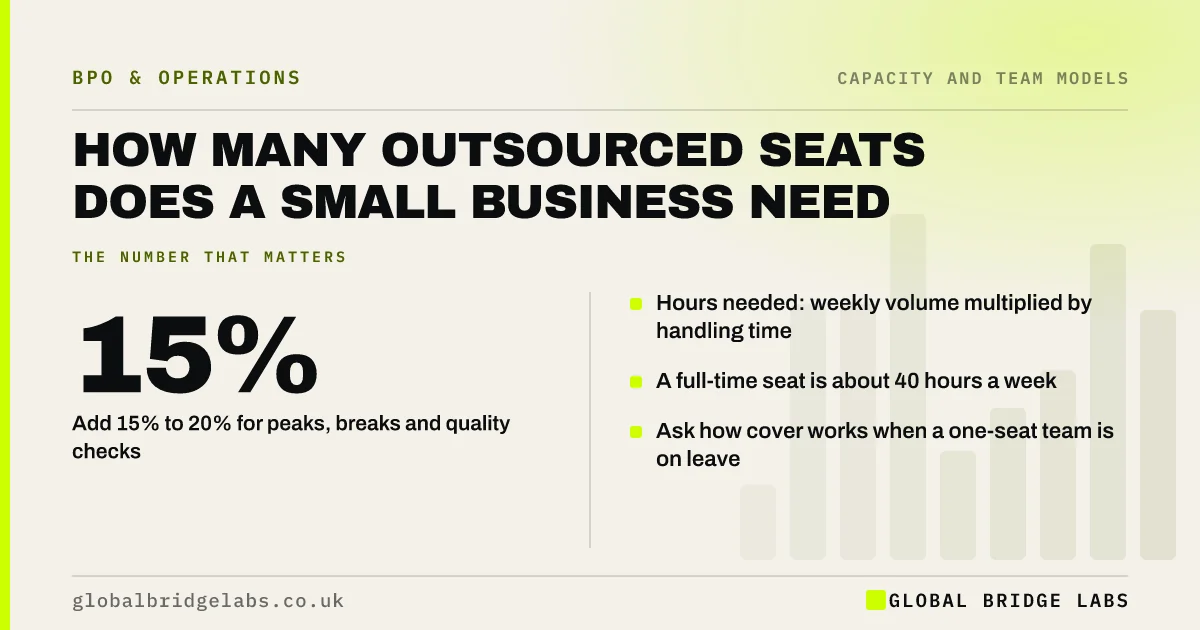
To decide how big an outsourced team should be, multiply weekly volume by average handling time, add about 15% to 20% for peaks and breaks, and divide by the hours in a seat. Most UK small businesses start with one part-time or full-time seat and add a second for cover once the process is stable.
- Hours needed: weekly volume multiplied by handling time.
- Add 15% to 20% for peaks, breaks and quality checks.
- A full-time seat is about 40 hours a week. A part-time seat is 15 to 20.
- Ask how cover works when a one-seat team is on leave.
Want your seat count worked out? Message us on WhatsApp with volumes and handling times.
Chat on WhatsApp →What is a seat in outsourcing?
A seat is one unit of outsourced capacity, usually one person working a set number of hours a week on your work. A full-time seat is typically about 40 hours. A shared or part-time seat is a fraction of that. Seats are the commonest way providers price and size managed teams.
How do you calculate the seats you need?
Calculate seats from the work, not from a guess. Count how many items arrive in a typical week, time a sample to find the average handling time, and multiply. Add an allowance for peaks and breaks, then divide by seat hours. Do it for each process, because handling times differ widely.
- 1. Weekly volume: for example 500 emails.
- 2. Handling time: for example 5 minutes each.
- 3. Hours: 500 multiplied by 5, divided by 60, is about 42.
- 4. Add 15%: about 48 hours.
- 5. Seats: 48 divided by 40 is 1.2, so one full-time and one part-time.
Why is one seat rarely enough?
One seat is a single point of failure unless the provider guarantees cover. People take holiday and fall ill wherever they work. Ask whether a trained backup steps in, and whether that person has handled your work recently. Two part-time seats can give better coverage across the day than one full-time seat.
What does a small outsourced team cost?
Cost follows hours. At an indicative £12 per hour, within the £9–£18 market range for managed offshore teams, a 20-hour seat is about £1,040 a month and a 40-hour seat about £2,080. Onshore providers are indicatively £20–£35 per hour. These are market illustrations, not GBL prices.
Want to discuss your requirements and the hours they imply? Send us the details on WhatsApp.
Chat on WhatsApp →Should you start smaller than the calculation?
Often, yes. Starting at about two thirds of the calculated hours on the simplest slice of the work lets the process settle before full volume arrives. Your team keeps the rest for a few weeks. Add the remaining hours once quality checks pass, usually within the first month or two.
When is the calculation misleading?
The calculation misleads when handling times vary a lot or when work arrives in bursts. Ten complex cases can take as long as a hundred simple ones. If demand is concentrated in a few hours of the day, you may need two people at once for a short period even though total hours suggest one.
What does this look like in practice?
A pattern we see with UK firms asking for a quote: the request is for a full-time person because that is what a hire would be. Counting the work shows 22 hours a week, concentrated in the mornings. A part-time morning seat with a trained backup covers it, and the remaining budget stays unspent.
Team size checklist
Gather these before asking for a quote.
- Weekly volume for each process.
- Average handling time from a timed sample.
- The busiest hours of the day and days of the week.
- The share of complex cases.
- The response time you want to promise.
- How cover should work during absence.
Next step
Send us your weekly volumes and a rough handling time for each process. We will calculate the hours and suggest a starting team shape.
Message us on WhatsApp for a seat calculation, or book a 30-minute consultation.
Chat on WhatsApp →Sources and further reading
- National Minimum Wage and National Living Wage rates · GOV.UK
- Holiday entitlement · GOV.UK
Frequently asked questions
How many outsourced staff does a small business need?
Most small businesses need between half a seat and three seats to begin with. Work it out from the task: weekly volume multiplied by handling time, plus 15% to 20% for peaks, divided by seat hours. Starting with one process and one seat, then adding, is the usual route.
Can I outsource just a few hours a week?
Yes, though most managed providers set a minimum, often 15 to 20 hours a week. For only a few hours, a freelance virtual assistant or an automated tool may fit better. Below about five hours a week, the time spent briefing and checking can outweigh the benefit.
What is a dedicated seat versus a shared seat?
A dedicated seat is one person working only on your business for the contracted hours. A shared seat is a person or pool handling several clients, with you paying for the time or contacts used. Dedicated seats give deeper knowledge of your work. Shared seats cost less for low volumes.
How do I know if my outsourced team is too small?
An outsourced team is too small if response times are slipping, a backlog carries over week to week, or quality drops at busy times. Compare actual volume and handling time with the original calculation. If volume has grown by more than the allowance, add hours.
Written by

Global Bridge Labs (GBL) is a UK–Sri Lanka partner for social media, websites and BPO. Everything here comes from client delivery, not theory.