On this page
- 01Key takeaways
- 02How does outsourced customer service differ from in-house?
- 03What does in-house customer service cost?
- 04What does outsourced customer service cost?
- 05Is outsourced customer service lower quality?
- 06When should customer service stay in-house?
- 07When is outsourcing customer service the better choice?
- 08What about customer data?
- 09How do you move customer service over without disruption?
- 10What does this look like in practice?
- 11Customer service cost checklist
- 12Next step
- 13Sources and further reading
- 14Frequently asked questions
Key takeaways
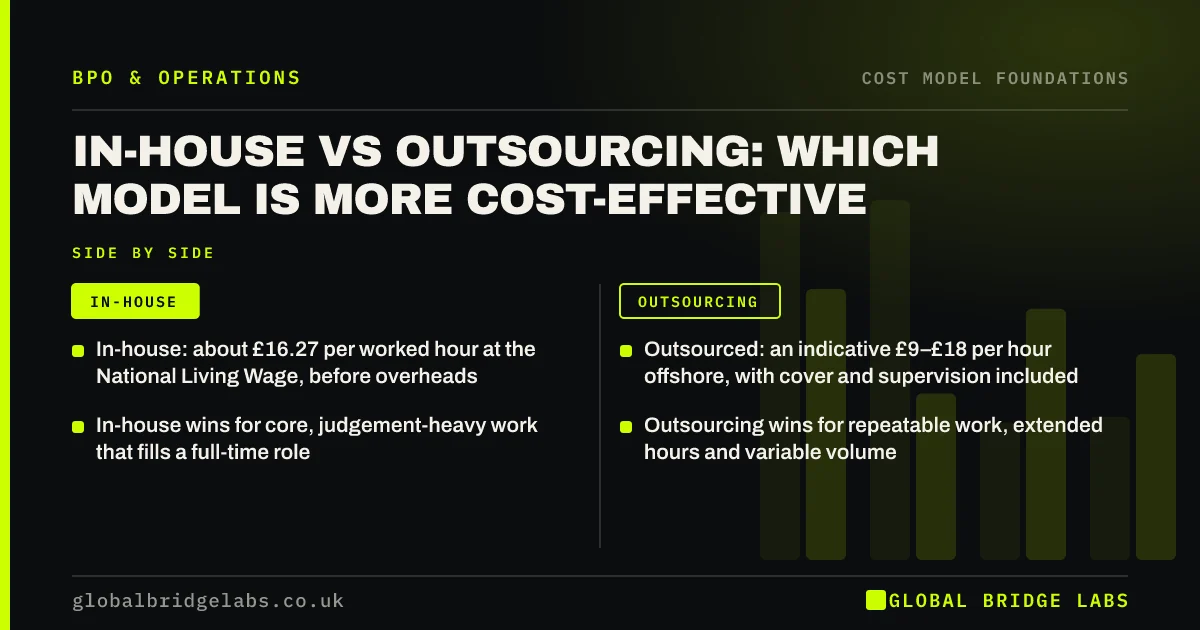
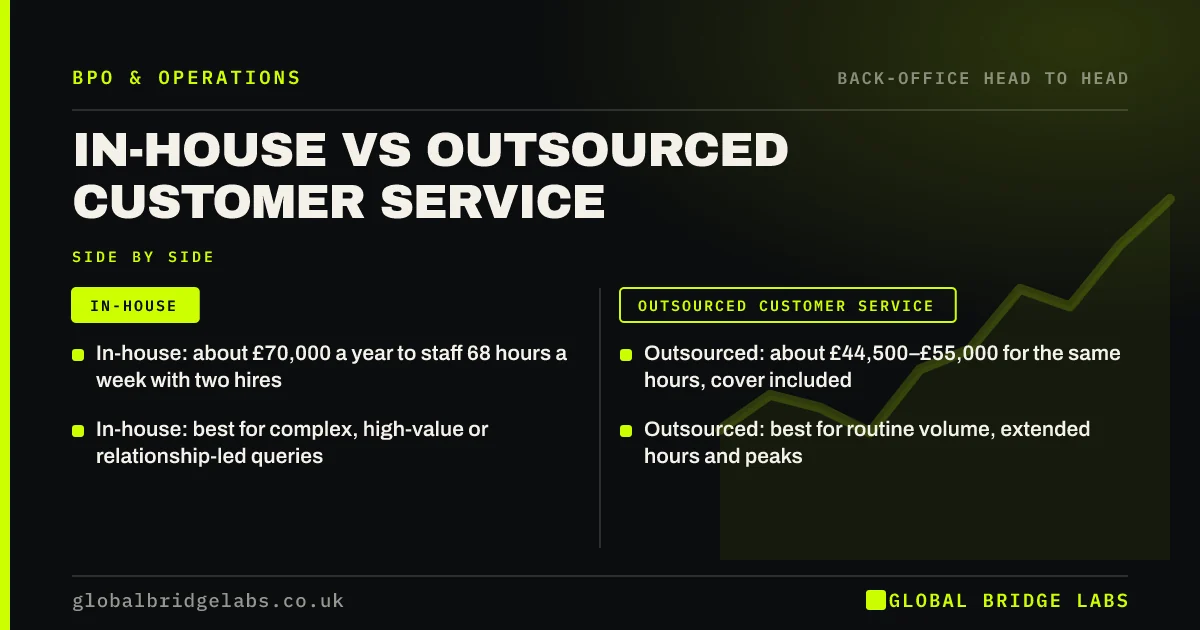
In-house vs outsourced customer service is mostly a question of hours. Covering 68 hours a week in-house needs about two full-time hires, roughly £70,000 a year with overheads and management. Outsourcing the same hours at an indicative £12–£15 per hour costs about £44,500–£55,000, with holiday and sickness cover included.
- In-house: about £70,000 a year to staff 68 hours a week with two hires.
- Outsourced: about £44,500–£55,000 for the same hours, cover included.
- In-house: best for complex, high-value or relationship-led queries.
- Outsourced: best for routine volume, extended hours and peaks.
Want your customer service costed both ways? Message us on WhatsApp with your hours and volumes.
Chat on WhatsApp →How does outsourced customer service differ from in-house?
In-house customer service is run by your own employees, managed by you. Outsourced customer service is delivered by a provider's team, working in your systems and to your written process, against agreed service levels. The customer should not be able to tell the difference; the business sees it in cost, cover and how quality is managed.
What does in-house customer service cost?
Staffing 8:00 to 20:00 on weekdays and 9:00 to 17:00 on Saturdays is 68 hours a week, about 3,536 hours a year. Two full-time agents on £26,000 cost about £59,500 a year in employment costs and deliver about 3,480 worked hours. Add overheads of about £7,200 and management of about £3,700, and the total is roughly £70,400.
That still leaves gaps at lunch and during overlapping holidays, and no one to absorb a busy Monday.
What does outsourced customer service cost?
At an indicative £12–£15 per hour for a managed offshore team, 3,536 hours cost about £42,400–£53,000 a year. Add about 1 hour a week of your own oversight, £2,080, and the total is about £44,500–£55,100. Recruitment, training, supervision, quality checks and cover sit inside the rate.
That is a saving of about £15,000–£26,000 a year, or 22% to 37%, on this example.
Want this run with your own contact volumes? Send them to us on WhatsApp and we will discuss your requirements.
Chat on WhatsApp →Is outsourced customer service lower quality?
Not when it is set up properly. Quality depends on a written process, good training, supervision and a scorecard reviewed monthly. A managed team with quality sampling is often more consistent than a small in-house team without one. Quality drops when a provider is given no process and nobody measures the result.
When should customer service stay in-house?
Keep it in-house when service is your main differentiator, when most contacts need product expertise or judgement, or when volumes are small and steady enough that one person is fully used. Luxury, high-ticket and highly technical products often fall here.
When is outsourcing customer service the better choice?
Outsource when you need longer hours than one person can cover, when volume swings with seasons or campaigns, or when routine questions take most of the team's time. A hybrid often works best: the provider handles first-line contacts and out-of-hours, your team handles escalations.
What about customer data?
An outsourced provider handling customer data is a processor under UK GDPR, so you need a written processor contract, and an offshore team needs a valid transfer safeguard. Give individual logins and only the access needed. These are routine steps, not blockers.
How do you move customer service over without disruption?
Move one channel or one contact type first, usually email or chat, while the in-house team keeps the rest. Give the provider your templates, tone guide and the 20 most common questions with answers, and have the in-house lead review a sample of replies daily for the first two weeks. Add phones and weekends once quality matches the baseline.
- Week 1 to 2: one channel, daily sample reviews.
- Week 3 to 6: add contact types and extended hours.
- Week 7 onwards: monthly scorecard and weekly escalation review.
What does this look like in practice?
A pattern we see in UK e-commerce brands: two in-house agents cover weekdays, and weekend messages wait until Monday. Moving first-line email and chat to a managed team with weekend cover, and keeping one in-house lead for escalations, lowers cost and removes the Monday backlog.
Customer service cost checklist
Use these steps to compare.
- Set the hours you need covered each week.
- Count contacts by channel and handling time.
- Cost in-house hires, overheads and management.
- Get outsourced quotes for the same hours and service levels.
- Decide what stays in-house as escalation.
- Pilot first-line contacts for 60 to 90 days.
Next step
Send us your hours, channels and monthly contact volumes. We will cost in-house and outsourced customer service side by side in a 30-minute call.
Message us on WhatsApp for a customer service cost comparison, or book a 30-minute consultation.
Chat on WhatsApp →Sources and further reading
- Rates and thresholds for employers 2026 to 2027 · HM Revenue & Customs
- Workplace pensions: what you, your employer and the government pay · GOV.UK
- Contracts and liabilities between controllers and processors · Information Commissioner's Office
- International transfers of personal data · Information Commissioner's Office
Frequently asked questions
Is it cheaper to outsource customer service?
For extended hours and routine volume, usually. Staffing 68 hours a week in-house needs about two full-time hires, roughly £70,000 a year with overheads and management, while a managed offshore team at £12–£15 per hour costs about £44,500–£55,000 with holiday and sickness cover included.
What customer service should stay in-house?
Complex, high-value or relationship-led contacts, complaints above an agreed level, and any part of service that is the main reason customers choose you. Routine questions, order and delivery updates, and out-of-hours contacts are the usual candidates to move to an outsourced team.
How do I keep quality high with outsourced customer service?
Give the provider a written process and tone guide, agree service levels for response and resolution, sample conversations for quality every week, and review a scorecard monthly. Keep an in-house escalation route for exceptions, and turn repeated mistakes into updates to the process documentation.
Will customers know that service is outsourced?
They should not notice a difference. The team works in your systems, under your business name, using your templates and tone of voice. What customers usually notice is faster replies and longer hours. Be honest if asked directly, and make sure escalations reach your team quickly.
Written by

Global Bridge Labs (GBL) is a UK–Sri Lanka partner for social media, websites and BPO. Everything here comes from client delivery, not theory.