On this page
- 01Key takeaways
- 02What makes offshore teams hard to manage?
- 03Who should own what?
- 04How should daily communication work?
- 05How do time zones affect management?
- 06How do you give feedback that lands?
- 07What should the weekly review cover?
- 08How much of your time does it take?
- 09What mistakes should you avoid?
- 10What does this look like in practice?
- 11Checklist: manage an offshore team
- 12Next step
- 13Sources and further reading
- 14Frequently asked questions
Key takeaways
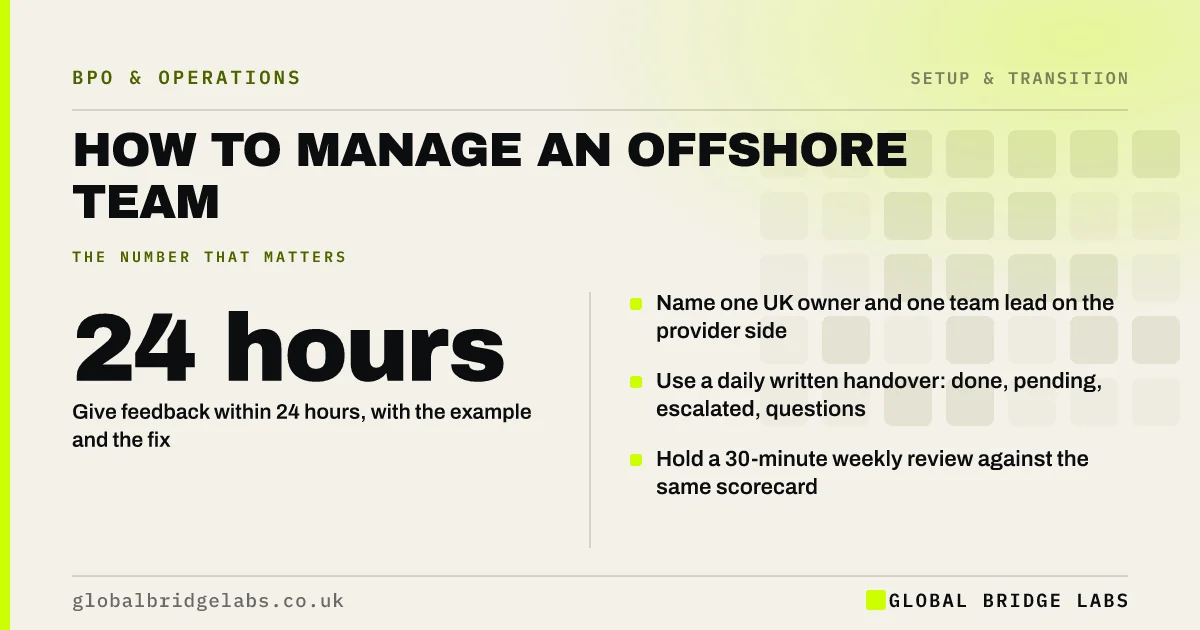
How to manage an offshore team comes down to five habits: one owner on each side, a written process, a daily handover note, a weekly review against the same scorecard, and specific feedback given quickly. Managed well, an offshore team feels like part of the business; managed loosely, it feels like a black box.
- Name one UK owner and one team lead on the provider side.
- Use a daily written handover: done, pending, escalated, questions.
- Hold a 30-minute weekly review against the same scorecard.
- Give feedback within 24 hours, with the example and the fix.
- Share context: why the work matters, not just what to do.
Managing an offshore team that is not quite working? Message us on WhatsApp and tell us what is going wrong.
Chat on WhatsApp →What makes offshore teams hard to manage?
Offshore teams are hard to manage when communication is left to chance. Time-zone differences shorten the overlap, written messages lose tone, and the team often lacks context about customers and priorities. None of this is about ability; it is about structure.
With business process outsourcing (BPO), the provider manages the team day to day. Your job is to manage the relationship: standards, context, escalations and review.
Who should own what?
Clear ownership prevents most problems. On your side, one owner sets standards, answers escalations and attends reviews. On the provider side, one team lead manages the people, the schedule and quality. Everyone else routes through them.
- UK owner: priorities, policy decisions, escalations, procedure approval.
- Team lead: rota, coaching, QA, reporting, day-to-day questions.
- Team members: the work, flagged exceptions and suggestions.
How should daily communication work?
Use a short written handover at the end of each shift: what was done, what is pending, what was escalated and any questions. Post it in a shared channel. It takes five minutes and removes most of the "what happened yesterday?" conversations.
Keep an escalation route for anything urgent during the shift, such as a named phone or chat contact with an agreed response time. Everything else can wait for the handover.
How do time zones affect management?
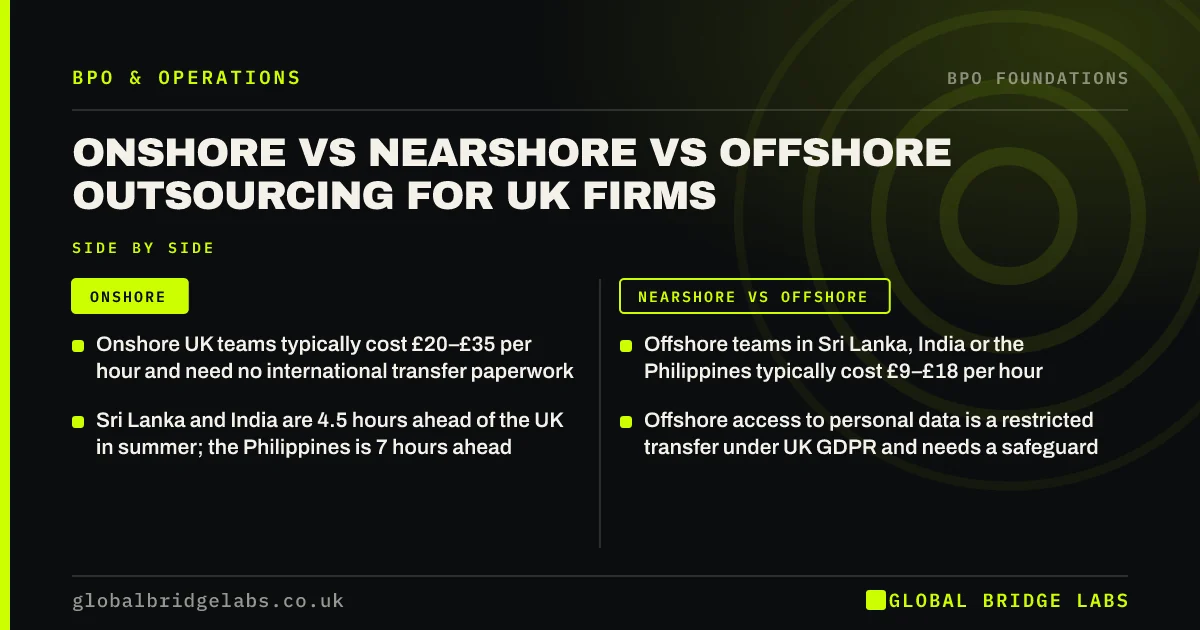
Time zones decide your overlap. Sri Lanka and India are 4.5 hours ahead of the UK in summer and 5.5 in winter, so a team covering UK hours works into its evening, and your mornings overlap with its afternoons. Schedule reviews and training in the overlap, not at the end of the team's shift.
The Philippines is 7 hours ahead in summer and 8 in winter, so UK-hours cover is a night shift there. Be mindful of the team's wellbeing when scheduling calls.
How do you give feedback that lands?
Give feedback quickly, specifically and with the fix. "This reply to the refund request on Tuesday was too formal; here is how we would say it" works. "Replies need to be better" does not. Share good examples as often as problems.
Be aware that in some workplace cultures, team members may be reluctant to say they do not understand or to disagree with a client. Ask open questions, invite challenge explicitly, and thank people for raising problems.
What should the weekly review cover?
Keep it to 30 minutes with a fixed agenda: scorecard against targets, sampled work, escalations and their causes, procedure changes, and upcoming changes in your business. Use the same template every week so trends are obvious.
How much of your time does it take?
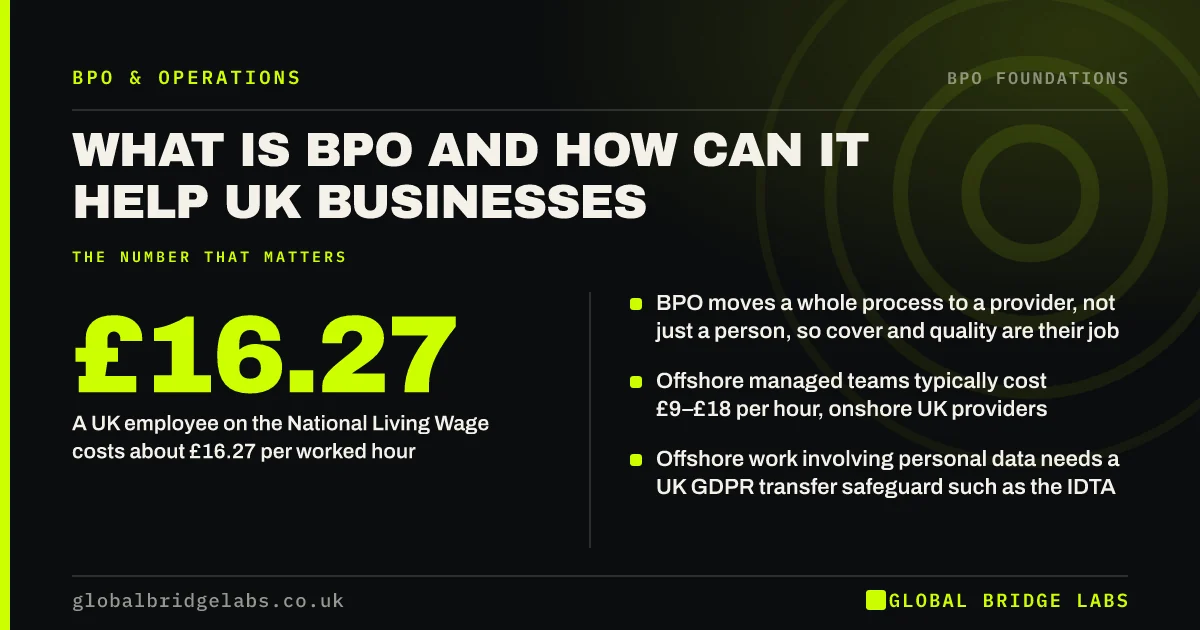
Budget two to four hours a week in the first three months, falling to about an hour a week once the process is stable. That time is an investment: the alternative is doing the work yourself. At the April 2026 National Living Wage, even the cheapest UK employee costs about £16.27 per worked hour after employer costs, and managed offshore teams typically cost £9–£18 per hour including their own supervision.
Want a managed team where supervision is included and you only own the relationship? Tell us about your process on WhatsApp and we will discuss your requirements.
Chat on WhatsApp →What mistakes should you avoid?
Avoid bypassing the team lead to instruct individuals, changing policies without updating the procedure, going quiet for weeks and then escalating a pile of issues, and treating the team as a cost line rather than colleagues. Include them in context: new products, big customers, busy periods coming.
What does this look like in practice?
At Global Bridge Labs (GBL), UK clients deal with a UK-facing account lead, while the team lead in our Colombo hub runs the rota, coaching and quality. Clients get a daily handover and a monthly one-page report on hours saved, cost per task, response times and quality.
Checklist: manage an offshore team
Put these habits in place.
- Name one owner on each side.
- Set up a daily written handover.
- Agree an urgent escalation route and response time.
- Hold a weekly 30-minute review with a fixed agenda.
- Give feedback within 24 hours with an example and a fix.
- Share business context and upcoming changes.
- Update procedures the same day policies change.
Next step
If you want an offshore team without the management headache, talk to us about a managed model where supervision is part of the service. 30 minutes, no pitch.
Message us on WhatsApp to talk it through, or book a 30-minute consultation.
Chat on WhatsApp →Sources and further reading
- International transfers of personal data · Information Commissioner's Office
- National Minimum Wage and National Living Wage rates · GOV.UK
- Rates and thresholds for employers 2026 to 2027 · HM Revenue & Customs
Frequently asked questions
How do you communicate effectively with an offshore team?
Route communication through one owner on each side, use a daily written handover, keep a clear urgent escalation route, and hold a short weekly review with a fixed agenda. Write instructions down, share context about why tasks matter, and invite questions explicitly.
How much time does managing an offshore team take?
With a managed BPO provider handling day-to-day supervision, expect two to four hours a week from your internal owner in the first three months and about an hour a week afterwards. Managing individual offshore freelancers directly takes considerably more.
What time do offshore teams work to cover UK hours?
Teams in Sri Lanka and India cover UK hours on an afternoon-to-evening shift, because they are 4.5 to 5.5 hours ahead. Teams in the Philippines cover UK hours on a night shift, because they are 7 to 8 hours ahead. Providers schedule rotas around your trading hours.
How do I build trust with an offshore team?
Treat them as colleagues: share context about your customers and plans, recognise good work, give fair and specific feedback, and keep promises about response times to their questions. Trust also comes from transparency, such as shared scorecards and open discussion of mistakes.
Written by

Global Bridge Labs (GBL) is a UK–Sri Lanka partner for social media, websites and BPO. Everything here comes from client delivery, not theory.