On this page
- 01Key takeaways
- 02What should you do first when an employee resigns?
- 03Should you replace the role like for like?
- 04When does outsourcing make sense after a resignation?
- 05How do you avoid a gap in service?
- 06How do the costs compare?
- 07When should you hire a replacement?
- 08What should the handover document include?
- 09What does this look like in practice?
- 10Resignation checklist
- 11Next step
- 12Sources and further reading
- 13Frequently asked questions
Key takeaways
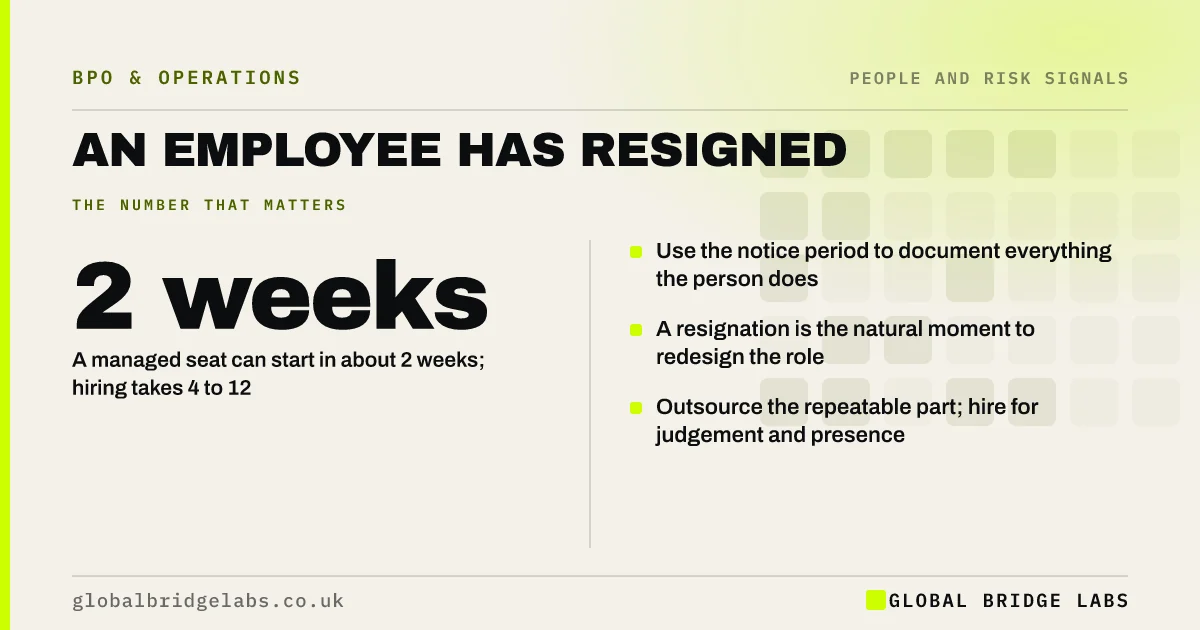
When an employee has resigned and you need cover, use the notice period to document their work, then decide whether to replace the role like for like, redesign it, or outsource the repeatable part. A resignation is one of the best moments to rethink a role, because the change is already happening. A managed seat can start in about 2 weeks.
- Use the notice period to document everything the person does.
- A resignation is the natural moment to redesign the role.
- A managed seat can start in about 2 weeks; hiring takes 4 to 12.
- Outsource the repeatable part; hire for judgement and presence.
Someone just handed in their notice? Message us on WhatsApp with what their role covers.
Chat on WhatsApp →What should you do first when an employee resigns?
Secure the knowledge. In the first week, list everything the person does, including the small recurring tasks nobody else sees, and ask them to write down or record how they do the important ones. Check which systems, passwords and customer relationships they hold. The notice period is your best chance to capture this.
- List all their recurring tasks, daily to yearly.
- Record how they do the critical ones.
- Move passwords and system access to shared business accounts.
- Introduce their key contacts to someone else.
Should you replace the role like for like?
Not automatically. Roles in small businesses drift over time, and the job being vacated may not be the job you need now. Look at the task list: which tasks need judgement or presence, which are repeatable, and which are no longer needed. The answer may be a smaller hire, an outsourced process, or both.
Want a second opinion on the role before you advertise? Send it to us on WhatsApp.
Chat on WhatsApp →When does outsourcing make sense after a resignation?
When much of the role is repeatable, remote-friendly work such as phones, inbox, booking, data entry or invoicing; when recruiting for it has been hard before; or when you need cover before a replacement could start. Outsourcing can take over the repeatable part during the notice period, with the leaver helping to train the new team.
How do you avoid a gap in service?
Plan cover to start before the leaver's last day. Recruiting typically takes 4 to 12 weeks, often longer than the notice period, so a gap is likely if you only advertise. A managed seat can usually start within about two weeks, and the overlap with the leaver is the best training you will get.
How do the costs compare?
A like-for-like replacement at the National Living Wage costs about £28,309 a year with on-costs, plus recruitment. Managed offshore support costs an indicative £9–£18 per hour, so a 20-hour-a-week seat at £12 per hour is about £12,500 a year. If only part of the role needs replacing in-house, splitting it often costs less overall.
When should you hire a replacement?
Hire when the role is mainly judgement, relationships or on-site work, when it is central to your team's culture, or when you want to build a future leader. Even then, use the resignation to remove tasks nobody needs and consider outsourcing the repeatable admin that made the role hard to hold.
What should the handover document include?
It should let a capable stranger run the role for a month without calling the leaver. Ask the leaver to write it in their final weeks, and review it with them. Recording short screen videos of tricky tasks is often faster than writing and just as useful.
- Every recurring task with its frequency and deadline.
- Step-by-step notes for the critical processes.
- Systems used and where access is held.
- Key contacts inside and outside the business.
- Open items and anything due in the next three months.
What does this look like in practice?
A pattern we see in UK professional services firms: a long-serving administrator resigns with a month's notice. The task list shows 60% of the role is phones, diary and document chasing. Those move to a managed team during the notice period, trained by the leaver, and the firm hires a part-time coordinator for the remaining in-office work.
Resignation checklist
Use this in the first week after a resignation.
- List every recurring task the person does.
- Record how they do the critical ones.
- Move passwords and access to shared accounts.
- Split tasks: judgement, repeatable, unnecessary.
- Decide: replace, redesign, outsource or combine.
- Start cover before the last day.
Next step
Send us the leaver's task list. We will tell you which parts could be outsourced and whether a replacement hire is still needed.
Message us on WhatsApp about the role, or book a 30-minute consultation.
Chat on WhatsApp →Sources and further reading
- National Minimum Wage and National Living Wage rates · GOV.UK
- Rates and thresholds for employers 2026 to 2027 · HM Revenue & Customs
- Holiday entitlement · GOV.UK
Frequently asked questions
What should I do when an employee resigns?
Use the notice period to list and document everything they do, move system access to shared accounts, and introduce their contacts to others. Then decide whether to replace the role like for like, redesign it, outsource the repeatable part, or combine these.
Should I replace a leaver or outsource the work?
Look at the tasks. Replace in-house for judgement, relationships and on-site work. Outsource repeatable, remote-friendly tasks such as phones, inbox, booking and data entry, especially if recruitment is hard or you need cover quickly.
How do I cover a role during the notice period?
Start cover before the last day so the leaver can help train it. A managed outsourced seat can usually start in about two weeks, faster than most recruitment, and the overlap captures knowledge that would otherwise be lost.
Written by

Global Bridge Labs (GBL) is a UK–Sri Lanka partner for social media, websites and BPO. Everything here comes from client delivery, not theory.