On this page
- 01Key takeaways
- 02When do part-time hiring and outsourcing compete?
- 03How do the costs compare?
- 04What rights does a part-time employee have?
- 05When is a part-time hire the better choice?
- 06When is outsourcing the better choice?
- 07How do control and quality compare?
- 08What happens when the volume changes?
- 09What does this look like in practice?
- 10Part-time or outsource checklist
- 11Next step
- 12Sources and further reading
- 13Frequently asked questions
Key takeaways
Outsourcing vs a part-time employee: for 10 to 20 hours a week of repeatable work, a part-time hire gives direct control and on-site presence, while an outsourced seat gives cover, flexibility and a faster start. Hire part-time if the work needs local knowledge or presence. Outsource if it needs cover or may grow or shrink.
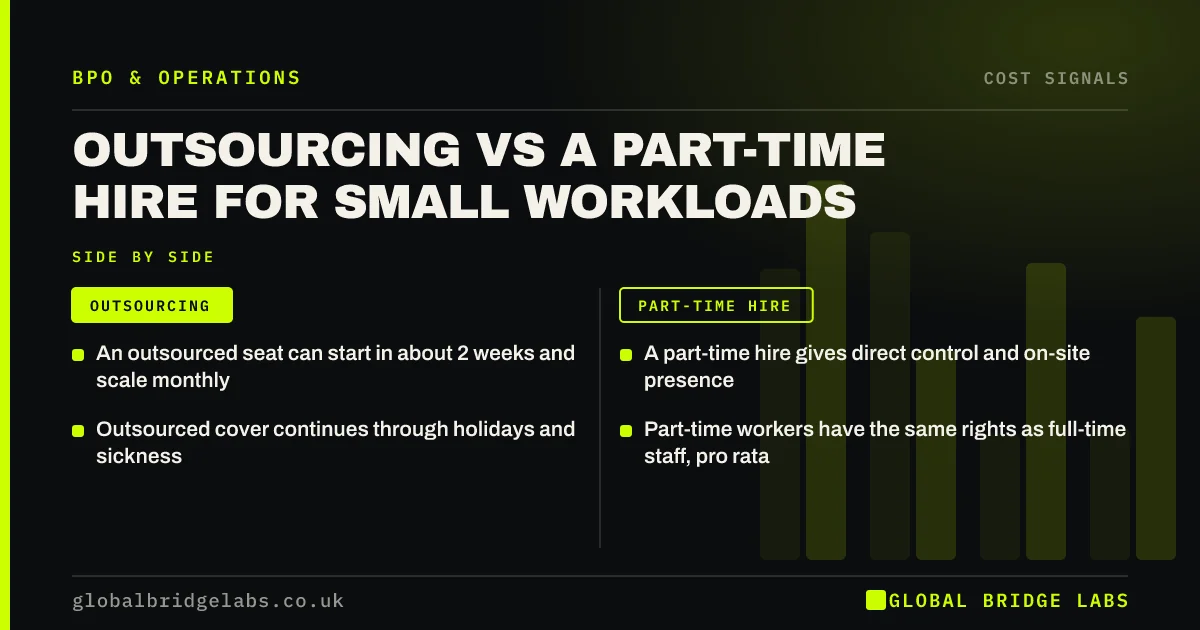
- An outsourced seat can start in about 2 weeks and scale monthly.
- A part-time hire gives direct control and on-site presence.
- Outsourced cover continues through holidays and sickness.
- Part-time workers have the same rights as full-time staff, pro rata.
Deciding on a part-time role? Message us on WhatsApp with the hours and tasks.
Chat on WhatsApp →When do part-time hiring and outsourcing compete?
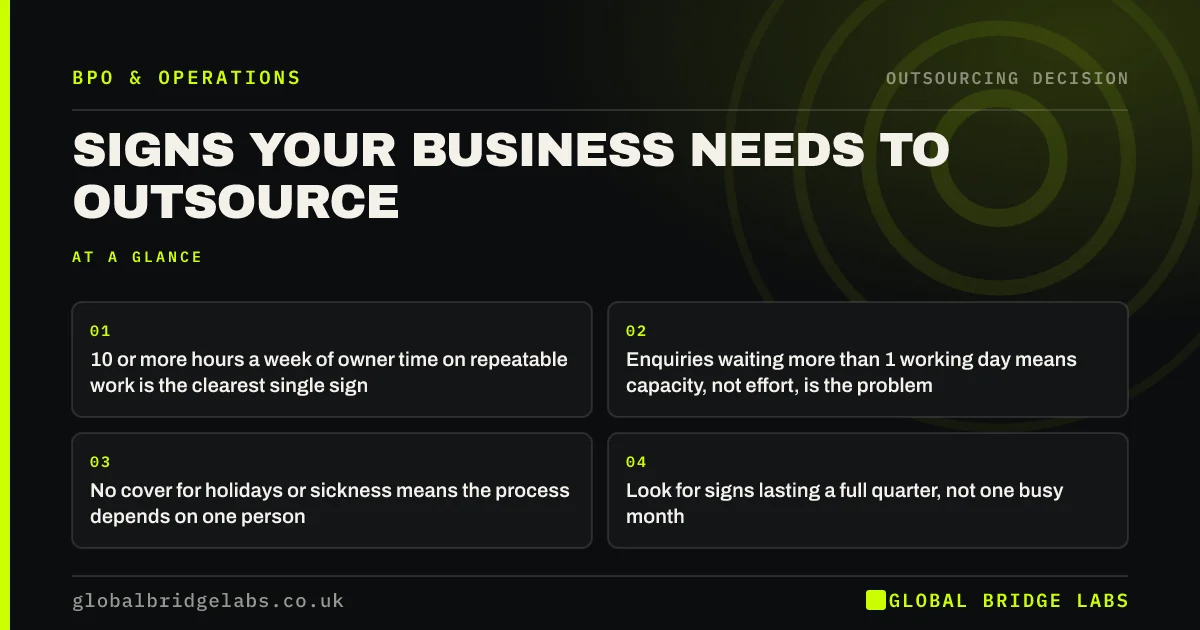
They compete when a business has 10 to 20 hours a week of repeatable work: too much for the owner, too little for a full-time hire. Typical examples are inbox and phones, bookkeeping support, order processing and CRM updates. Both options can work well; the right one depends on cover, presence and how stable the volume is.
How do the costs compare?
A part-time employee on the National Living Wage of £12.71 working 15 hours a week earns about £9,900 a year. Employer National Insurance applies above £5,000 a year, adding roughly £740. Add holiday cover, recruitment, equipment and management. An offshore seat for 15 hours a week at an indicative £12 per hour costs about £9,360 a year, with cover included.
The costs are close. The decision usually turns on cover and flexibility rather than on price alone.
Want both options costed for your role? Ask us on WhatsApp and we will discuss your requirements.
Chat on WhatsApp →What rights does a part-time employee have?
Part-time workers must be treated no less favourably than comparable full-time workers. They get the same hourly pay rate, pro-rata holiday of 5.6 weeks' worth of their working pattern, and the same access to pensions, training and promotion. A part-time hire is a real employment commitment, with notice and, after two years, redundancy rights.
When is a part-time hire the better choice?
Hire part-time when the work needs someone on site, local knowledge of customers, or relationships that build over years. It also suits a steady volume that will not change much and a business that can tolerate gaps when the person is on holiday. Many local businesses do well with a part-time administrator who knows every customer by name.
When is outsourcing the better choice?
Outsource when the work needs cover every working day, extended hours, or capacity that may grow or shrink. It also suits businesses that have struggled to recruit or keep part-time staff, or that need to start in weeks rather than months. The provider covers holidays, sickness and resignations.
How do control and quality compare?
A part-time employee is directly managed, so you control priorities hour by hour. An outsourced seat is managed through a written process, a scorecard and weekly reviews, so you control outcomes rather than activity. Direct control suits work that changes daily; outcome control suits stable, measurable work.
What happens when the volume changes?
This is where the two options differ most. A part-time employee's hours are set by contract; increasing them needs agreement and reducing them may need consultation. An outsourced seat on monthly terms can usually be increased or reduced with a month's notice. If the volume is likely to grow, shrink or swing with the seasons in the next year, that flexibility often decides the question.
- Growing volume: an outsourced seat can scale without a new recruitment round.
- Shrinking volume: outsourced hours can reduce without redundancy.
- Seasonal volume: outsourced hours can follow the season.
- Steady volume: a part-time hire is simpler and builds loyalty.
What does this look like in practice?
A pattern we see in UK clinics: a part-time receptionist covers mornings, and afternoons go to voicemail. Keeping the receptionist for in-person patients and outsourcing phone booking across the whole day fills both gaps. The receptionist focuses on the people in front of them, and the phones are covered even when they are off.
Part-time or outsource checklist
Answer these for the role you have in mind.
- How many hours a week, and how steady is the volume?
- Does the work need someone on site?
- Must it be covered during holidays and sickness?
- How quickly do you need someone to start?
- Have past part-time hires stayed?
- Who will manage the person or the provider?
Next step
Send us the hours and the tasks. We will tell you whether a part-time hire or an outsourced seat would serve you better, and why.
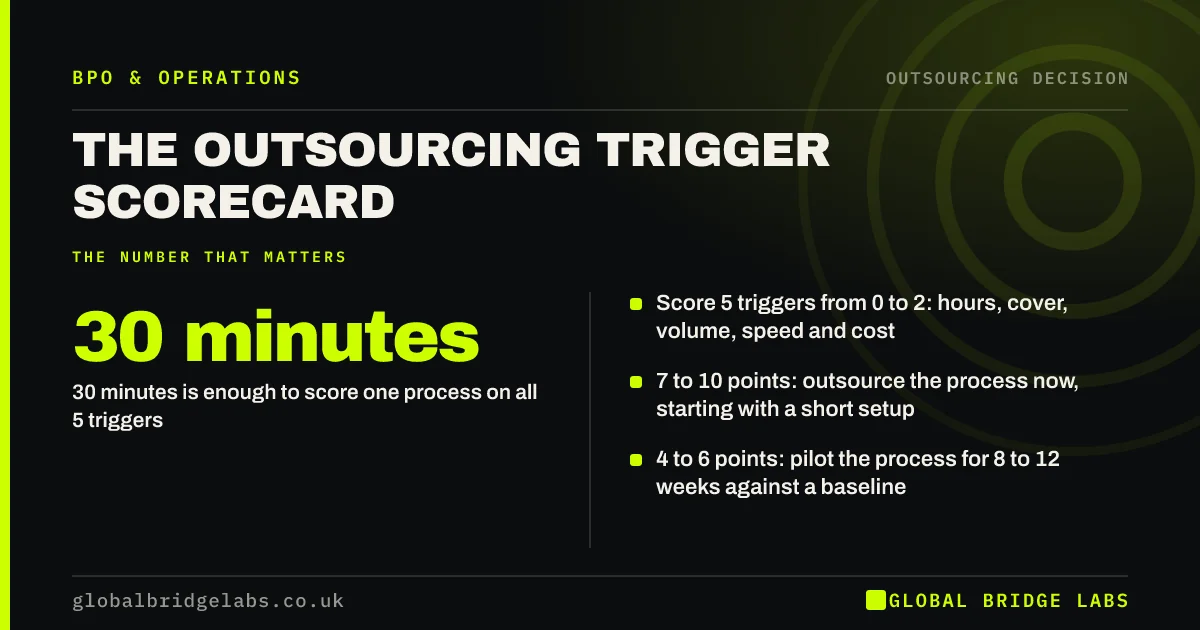
Message us on WhatsApp with your role, or book a 30-minute consultation.
Chat on WhatsApp →Sources and further reading
- Part-time workers' rights · GOV.UK
- National Minimum Wage and National Living Wage rates · GOV.UK
- Rates and thresholds for employers 2026 to 2027 · HM Revenue & Customs
- Holiday entitlement · GOV.UK
Frequently asked questions
Should I hire a part-time admin or outsource?
Hire part-time if the work needs someone on site or deep local customer knowledge, and gaps during holidays are acceptable. Outsource if the work needs daily cover, extended hours or flexible volume, or if recruiting part-time staff has proved difficult.
Is a part-time employee cheaper than outsourcing?
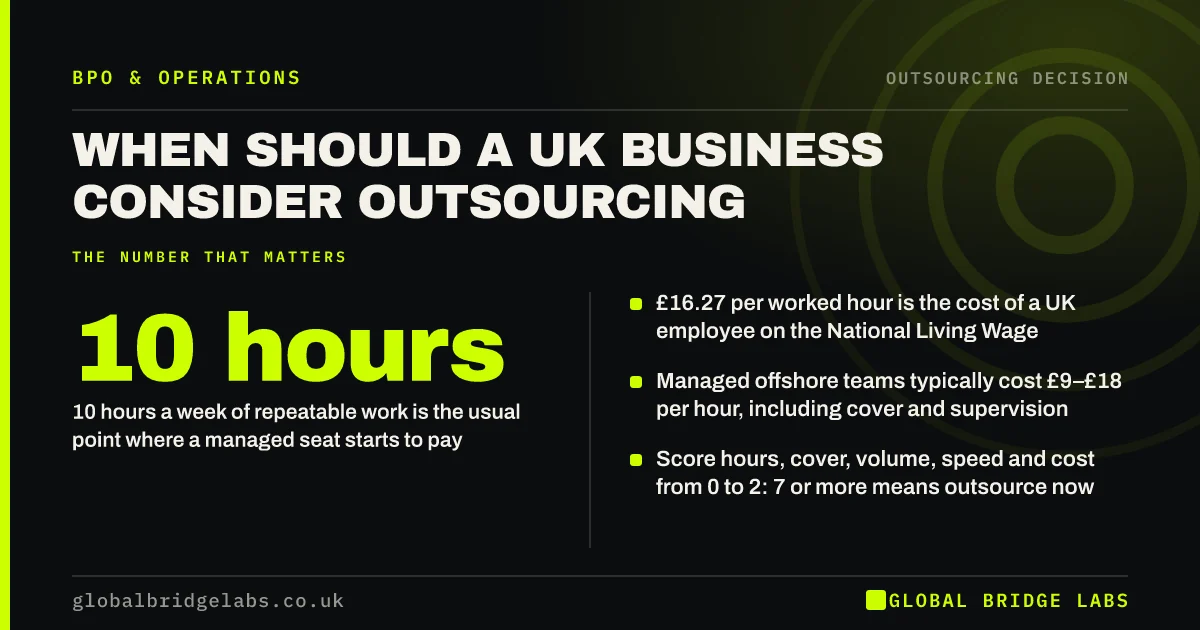
Often the hourly costs are similar. A part-time National Living Wage employee costs a little over £12.71 an hour plus on-costs and overheads; managed offshore teams cost an indicative £9–£18 per hour including cover. The difference is usually cover and flexibility, not price.
Do part-time employees get holiday?
Yes. Part-time workers get 5.6 weeks of paid holiday a year pro rata to their working pattern. Someone working three days a week gets 16.8 days. They also have the same rights as full-time staff to pensions, training and fair treatment.
Written by

Global Bridge Labs (GBL) is a UK–Sri Lanka partner for social media, websites and BPO. Everything here comes from client delivery, not theory.