On this page
- 01Key takeaways
- 02Why does speed matter for logistics websites?
- 03Why are tracking pages slow?
- 04What does slow tracking cost?
- 05How do you speed up quote forms?
- 06What about customer portals?
- 07What does this look like in practice?
- 08Logistics speed checklist
- 09Next step
- 10Sources and further reading
- 11Frequently asked questions
Key takeaways
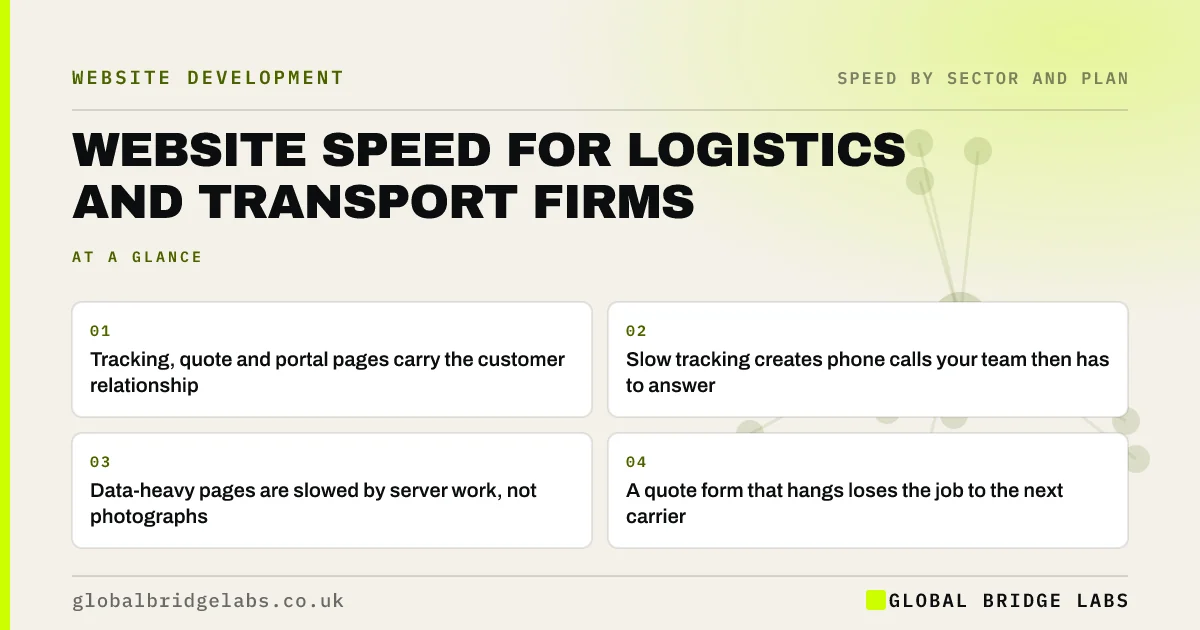
A logistics firm sells speed and reliability, so a slow website argues against its own pitch. The pages that matter most are not the homepage. They are the tracking page customers check repeatedly, the quote form a shipper fills in while comparing three carriers, and the portal regular customers log in to. Those are data-driven pages, and they are slow for server reasons more than for images.
- Tracking, quote and portal pages carry the customer relationship.
- Slow tracking creates phone calls your team then has to answer.
- Data-heavy pages are slowed by server work, not photographs.
- A quote form that hangs loses the job to the next carrier.
Want your tracking and quote pages timed on a phone? Send us the URL on WhatsApp.
Chat on WhatsApp →Why does speed matter for logistics websites?
Speed matters because the website is part of the service. A customer waiting for a delivery checks tracking several times. A shipper requesting a quote is usually asking two or three firms at once and will go with whoever responds clearly first. Drivers and subcontractors use the site on phones, in cabs and yards, often on a weak signal.
For a business whose promise is that things arrive on time, a page that does not is hard to explain.
Why are tracking pages slow?
Tracking pages are slow because each request asks a server to look something up, often in another system, before anything can be shown. The usual faults are a lookup that fetches the whole history when the customer wants the latest status, a page that reloads fully for each query, and a map that loads before the text.
- Show the current status as text first.
- Load history and the map afterwards, or on tap.
- Acknowledge the tracking number at once with a visible 'looking up' state.
- Let customers bookmark or share a direct tracking link.
What does slow tracking cost?
Slow or unreliable tracking turns self-service into phone calls. Each customer who cannot quickly see where a consignment is rings or emails to ask, and someone has to stop and look it up.
An illustrative sum: 40 'where is my delivery' contacts a week at four minutes each is over two and a half hours of staff time every week, most of it avoidable if the page answered promptly.
- Website speed and repeat customers: does it build loyalty?
- Customer service outsourcing for logistics firms
Want the tracking journey reviewed end to end? Ask us on WhatsApp.
Chat on WhatsApp →How do you speed up quote forms?
Quote forms in logistics are long by necessity: collection, delivery, dimensions, weight, dates. Speed here is about never making the shipper wait without explanation.
- 1. Make address and postcode lookups respond quickly, with manual entry as a fallback.
- 2. Validate fields as they are completed, not all at the end.
- 3. Show a clear calculating or sending state after submit.
- 4. Confirm receipt immediately, with a reference and a response time.
- 5. Keep what was typed if something fails.
What about customer portals?
Portals are used by your most valuable customers and are usually the least optimised part of the site, because public speed tests cannot see behind a login. Common faults are dashboards that load every consignment at once and reports generated on the spot.
Load the most recent items first, page the rest, and test while logged in on a phone. These pages cannot be cached like public ones, so the gains come from asking the server for less.
What does this look like in practice?
A pattern we see in haulage and courier firms: the brochure pages were redesigned recently and load well, while the tracking page still runs on an old integration that takes many seconds per lookup. Customers stop using it and phone instead.
Showing the latest status first and fetching the detail afterwards makes tracking usable again and takes pressure off the office. Global Bridge Labs (GBL) tests the working pages of a logistics site before the marketing ones.
Logistics speed checklist
- Track a real consignment on a phone over mobile data.
- Time the gap between entering a number and seeing a status.
- Complete the quote form and time the confirmation.
- Log in to the portal as a customer and time the dashboard.
- Count weekly calls that the website could have answered.
- Fix the page your regular customers use most.
Next step
Your website should move as reliably as your fleet. We will test the pages your customers depend on and show you where they wait.
Message us on WhatsApp for a logistics website speed review.
Chat on WhatsApp →Sources and further reading
- Time to First Byte (TTFB) · web.dev (Google)
- Response times: the 3 important limits · Nielsen Norman Group
- Optimise Interaction to Next Paint · web.dev (Google)
Frequently asked questions
Why is my tracking page slow?
Each lookup asks a server to fetch data, often from a separate system, before anything is shown. Fetching full history, reloading the whole page and loading a map first all add delay. Showing the current status as text first makes the page feel immediate.
Does website speed matter for a logistics company?
Yes. The site is part of the service, used repeatedly by customers tracking deliveries and by shippers comparing quotes. A slow site contradicts a promise of reliability and creates phone calls your team has to handle.
How do I speed up a freight quote form?
Make lookups quick with a manual fallback, validate fields as they are filled, show a clear state after submit and confirm receipt at once with a reference. Keep what the shipper typed if anything fails, so they never have to start again.
Can a customer portal be made faster?
Usually. Load the most recent items first and page the rest, avoid generating reports on every visit and test while logged in on a phone. Portals cannot be cached like public pages, so the gains come from reducing what the server is asked to do.
Written by

Global Bridge Labs (GBL) is a UK–Sri Lanka partner for social media, websites and BPO. Everything here comes from client delivery, not theory.