On this page
- 01Key takeaways
- 02What is a logistics company website for?
- 03Why do many logistics websites underperform?
- 04What should a logistics website include?
- 05How should the quote form work?
- 06How does the website support driver recruitment?
- 07When is a portal or integration worth it?
- 08What does this look like in practice?
- 09Logistics website checklist
- 10Next step
- 11Sources and further reading
- 12Frequently asked questions
Key takeaways
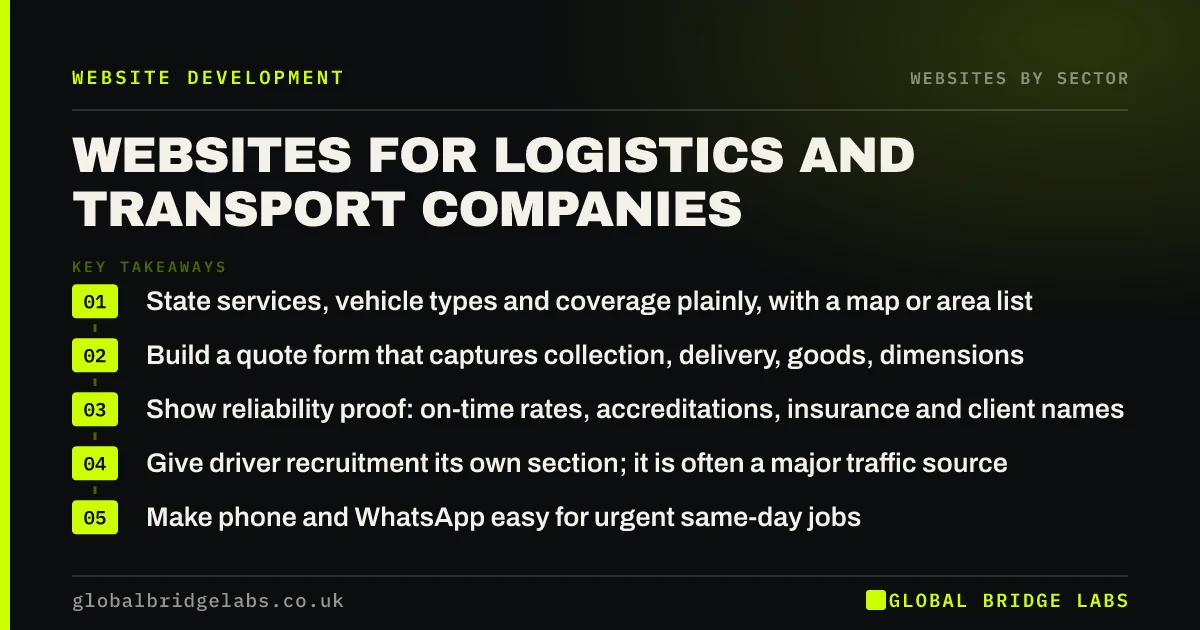
A logistics company website wins work by making services, coverage and reliability easy to verify, and by capturing quote requests with the details needed to price a job. It often has a second job too: recruiting drivers. Both audiences need their own clear route through the site.
- State services, vehicle types and coverage plainly, with a map or area list.
- Build a quote form that captures collection, delivery, goods, dimensions and dates.
- Show reliability proof: on-time rates, accreditations, insurance and client names.
- Give driver recruitment its own section; it is often a major traffic source.
- Make phone and WhatsApp easy for urgent same-day jobs.
Want your logistics site reviewed for quote conversion? Send us the URL on WhatsApp.
Chat on WhatsApp →What is a logistics company website for?
A logistics company website is a website for a business that moves or stores goods, such as hauliers, couriers, freight forwarders and warehousing firms, designed to win transport and storage contracts and to support recruitment and customer service.
Buyers range from a small business needing an urgent pallet delivery to a procurement team evaluating contract logistics. The site needs to serve quick transactional enquiries and slower, evidence-heavy evaluations.
The second group often checks the website after a sales call or a referral. They look for accreditations, insurance levels, fleet details, sector experience and signs of a well-run operation. A site that answers those questions without a phone call shortens the tender process and keeps you on the shortlist.
Why do many logistics websites underperform?
Many logistics websites use generic language, such as innovative logistics solutions, that could describe any operator. They hide the specifics buyers need: vehicle types, capacities, coverage, lead times, accreditations and how to get a price.
Quote forms are another weakness. Either they ask for too little, forcing a back-and-forth before pricing, or far too much, discouraging urgent customers.
- Services described in vague terms.
- No coverage information.
- Quote forms that do not capture what is needed to price.
- No proof of reliability.
- Driver applicants and customers sent through the same contact form.
What should a logistics website include?
Structure the site so each buyer type finds what they need in two clicks.
- Service pages: same-day, pallet, haulage, warehousing, each with vehicles and capacities.
- Coverage: regions, depots and international lanes.
- Sector pages where you have real expertise, such as construction or retail.
- A smart quote form with collection, delivery, goods, weight, dimensions and dates.
- Proof: accreditations, insurance, client logos with permission, case summaries.
- Tracking or customer portal link for existing clients.
- Careers section with driver roles, pay ranges, routes and a short application.
How should the quote form work?
Use a stepped form. Step one captures contact details and the job type. Step two asks the questions specific to that job type, with sensible defaults and drop-downs. Offer a phone and WhatsApp route for urgent jobs, and state your response time for quotes.
Track quote submissions by service and source in GA4, and record which become contracts. That shows which services and channels produce profitable work.
Want a quote form designed around your job types? Message us on WhatsApp.
Chat on WhatsApp →How does the website support driver recruitment?
Driver recruitment is a constant need for many operators, and careers pages often attract as much traffic as service pages. Give roles their own section, with pay ranges, routes, schedules, vehicle types and licence requirements, and a short mobile application form.
Keeping careers separate also keeps enquiry tracking clean. Mixing job applications with customer enquiries distorts every lead report.
When is a portal or integration worth it?
Customer portals, live tracking and booking integrations are worth building when you have repeat business customers who book regularly. They reduce calls and emails and make you harder to replace.
The trade-off is cost and maintenance. For firms with mostly one-off jobs, a good quote form and fast response time deliver more than a portal.
What does this look like in practice?
A pattern in logistics and transport: a site that says it offers bespoke transport solutions, a single contact form used by customers and job applicants alike, and quotes that need two or three calls to gather the details.
Splitting services into specific pages, adding a stepped quote form and a separate careers section clarifies both audiences. Quotes go out faster because the information arrives complete.
Logistics website checklist
Check these for customers and candidates.
- Name services with vehicles and capacities.
- Show coverage clearly.
- Use a stepped quote form.
- State quote response times.
- Show accreditations and insurance.
- Separate careers from customer enquiries.
- Link to tracking for existing clients.
- Track quotes to contracts.
Next step
If quotes take several calls to price, or job applicants and customers share one form, we will map a better structure with you in 30 minutes.
Message us on WhatsApp for a logistics website review, or book a 30-minute consultation.
Chat on WhatsApp →Sources and further reading
- Structuring forms · GOV.UK Service Manual
- About key events · Google Analytics Help
- SEO Starter Guide · Google Search Central
Frequently asked questions
What should a logistics company website include?
Specific service pages with vehicle types and capacities, coverage information, a stepped quote form that captures the details needed to price, proof such as accreditations and insurance, a link to tracking for existing customers, and a separate careers section for driver recruitment.
How do I get more quote requests from my transport website?
Make services and coverage specific, use a stepped quote form that is quick on mobile, offer phone and WhatsApp for urgent jobs, state your quote response time, show proof of reliability, and make sure each service page has its own clear call to action.
Should my haulage website have a careers page?
Yes. Driver recruitment is a constant need for many operators, and careers pages often attract significant traffic. Include pay ranges, routes, schedules and licence requirements, with a short mobile application form, kept separate from customer enquiries so lead tracking stays accurate.
Is a customer portal worth building for a logistics firm?
It is worth it when you have repeat business customers who book regularly, because it reduces calls and emails and increases retention. For firms handling mostly one-off jobs, a well-designed quote form and fast response time usually deliver more value for the cost.
Written by

Global Bridge Labs (GBL) is a UK–Sri Lanka partner for social media, websites and BPO. Everything here comes from client delivery, not theory.