On this page
- 01Key takeaways
- 02Why does speed affect trust at all?
- 03Which speed problems damage trust most?
- 04Does speed matter more for some brands?
- 05How do you repair the impression?
- 06When is speed not the trust problem?
- 07What does this look like in practice?
- 08Trust and speed checklist
- 09Next step
- 10Sources and further reading
- 11Frequently asked questions
Key takeaways
Yes. A slow website damages trust because visitors treat the site as evidence of how the business behaves. A page that stalls, ignores a tap or jumps as it loads suggests a company that is slow to answer, careless with detail or out of date. The judgement is quick, rarely conscious and made before any of your credentials have appeared on screen.
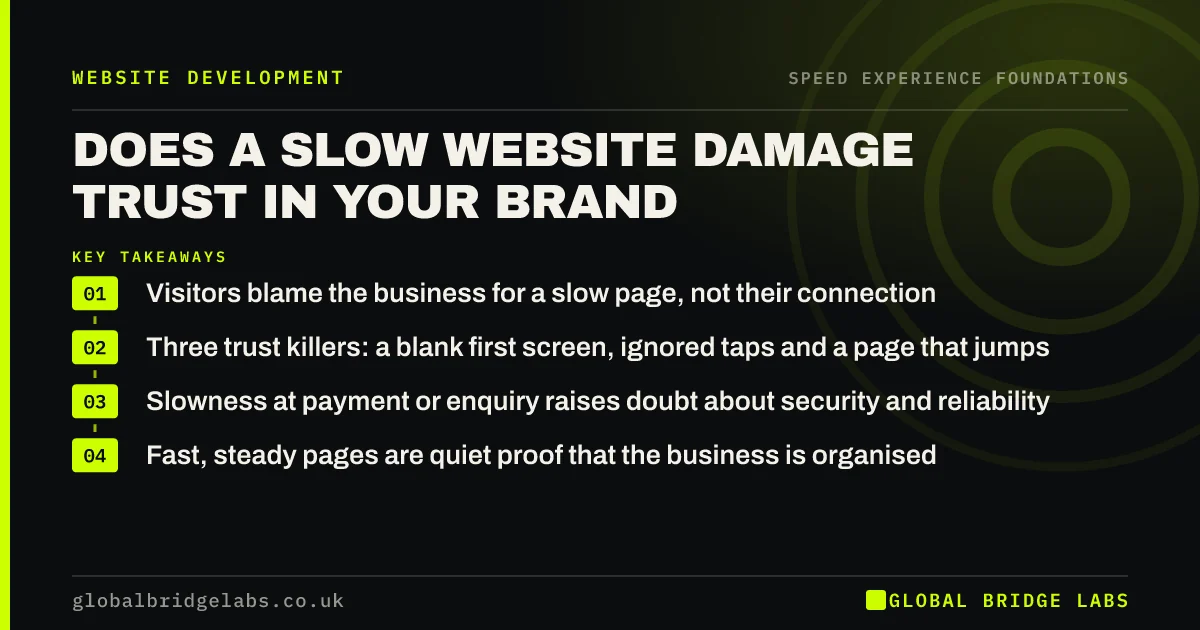
- Visitors blame the business for a slow page, not their connection.
- Three trust killers: a blank first screen, ignored taps and a page that jumps.
- Slowness at payment or enquiry raises doubt about security and reliability.
- Fast, steady pages are quiet proof that the business is organised.
Wondering what your site says about you before anyone reads it? Send us the URL on WhatsApp.
Chat on WhatsApp →Why does speed affect trust at all?
Speed affects trust because a first-time visitor has very little to go on. They cannot see your workmanship or your service. They can see how your website behaves, and they generalise from it. A site that responds promptly feels competent. One that makes them wait feels like a business that will make them wait.
The Nielsen Norman Group's research on response times notes that as delays grow, people stop feeling in control and begin to doubt whether the system is working. On a website, that doubt attaches to the brand.
Which speed problems damage trust most?
The problems that damage trust most are the ones that make a visitor feel the site is broken, not merely slow. They are also the ones automated scores tend to underweight.
- A blank or half-drawn first screen: the visitor wonders whether the site is live.
- A button that does nothing when tapped: they assume it is faulty.
- A layout that shifts and causes a mis-tap: the site feels careless.
- A form with no confirmation: they doubt the enquiry was sent.
- A stalled payment step: they worry about being charged twice.
Does speed matter more for some brands?
Speed matters most where the promise is reliability, care or competence. A solicitor, a clinic, a logistics firm or an electrician is selling the assurance that things will be handled properly. A sluggish site contradicts the message on the page. Premium brands are exposed in the same way: a high price implies polish, and a stuttering page breaks it.
It matters less where customers already know you. Someone referred by a friend will forgive a slow site, though they may still mention it.
- Website speed for professional services firms
- Raising prices? Your website has to justify them
- Website trust signals that make visitors enquire
Want a trust and speed review of your key pages? Ask us on WhatsApp.
Chat on WhatsApp →How do you repair the impression?
Repair the moments where the site feels broken before chasing overall load time. Get the name of the business, what it does and one way to make contact on screen quickly. Make every button respond visibly. Reserve space for images and banners so the page stays still. Confirm every form submission at once.
These are small changes. Their effect on how a business comes across is larger than their effect on any score.
When is speed not the trust problem?
Speed is not the trust problem when the site is quick and visitors still do not enquire. Missing reviews, no named people, stock photography, vague claims and no visible address or registration details undermine trust far more than a half-second delay. If your pages pass on a real phone, spend the effort on proof.
What does this look like in practice?
A pattern we see in professional services: the firm's site lists accreditations, awards and decades of experience, and all of it sits below a large image carousel that takes several seconds to appear on a phone. The visitor's first experience of a firm that promises responsiveness is waiting.
Putting the firm's name, specialism and a contact route into the first screen as plain text, and letting the imagery follow, changes the opening impression without removing anything. Across client work at Global Bridge Labs (GBL), we have seen a 2.4x enquiry rate from conversion changes like these.
Trust and speed checklist
- Check what the first screen shows after two seconds on a phone.
- Tap every button and confirm it reacts at once.
- Look for anything that moves after it appears.
- Submit the enquiry form and read the confirmation.
- Test the payment or booking step on mobile data.
- Then review proof: reviews, names, photos and details.
Next step
Your website makes a promise about how you work before a word is read. We will show you what it is currently promising and how to change it.
Message us on WhatsApp for a first-impression and speed review, or book a 30-minute consultation.
Chat on WhatsApp →Sources and further reading
- Website response times · Nielsen Norman Group
- Response times: the 3 important limits · Nielsen Norman Group
- Why does speed matter? · web.dev
Frequently asked questions
Does a slow website make a business look unprofessional?
Yes. Visitors with no other evidence judge the business by how the site behaves. Long waits, buttons that do not respond and pages that jump suggest a company that is disorganised or out of date, even when the content says otherwise.
Do customers blame the website or their internet connection?
Mostly the website. Other sites and apps on the same phone feel quick, so a slow one stands out. Visitors rarely think about hosting or page weight. They conclude that this business's site is slow and often extend that to the business.
Can a slow checkout make customers worry about security?
Yes. A pause after pressing Pay, with no feedback, makes people fear the payment failed or was taken twice. Many abandon or press the button again. Immediate feedback and a clear progress message at payment protect both trust and orders.
Will a faster website improve my reputation?
It removes a reason for doubt. A quick, steady site is quiet evidence of competence, and visitors stay long enough to see your reviews and credentials. It does not replace those. Reputation still depends on proof and on the service itself.
Written by

Global Bridge Labs (GBL) is a UK–Sri Lanka partner for social media, websites and BPO. Everything here comes from client delivery, not theory.