On this page
- 01Key takeaways
- 02What does running payroll involve?
- 03What does in-house payroll cost?
- 04What does outsourced payroll cost?
- 05What stays with you if you outsource payroll?
- 06When should payroll stay in-house?
- 07When is outsourcing payroll the better choice?
- 08What about payroll data protection?
- 09What does a payroll calendar look like?
- 10What does this look like in practice?
- 11Payroll checklist
- 12Next step
- 13Sources and further reading
- 14Frequently asked questions
Key takeaways
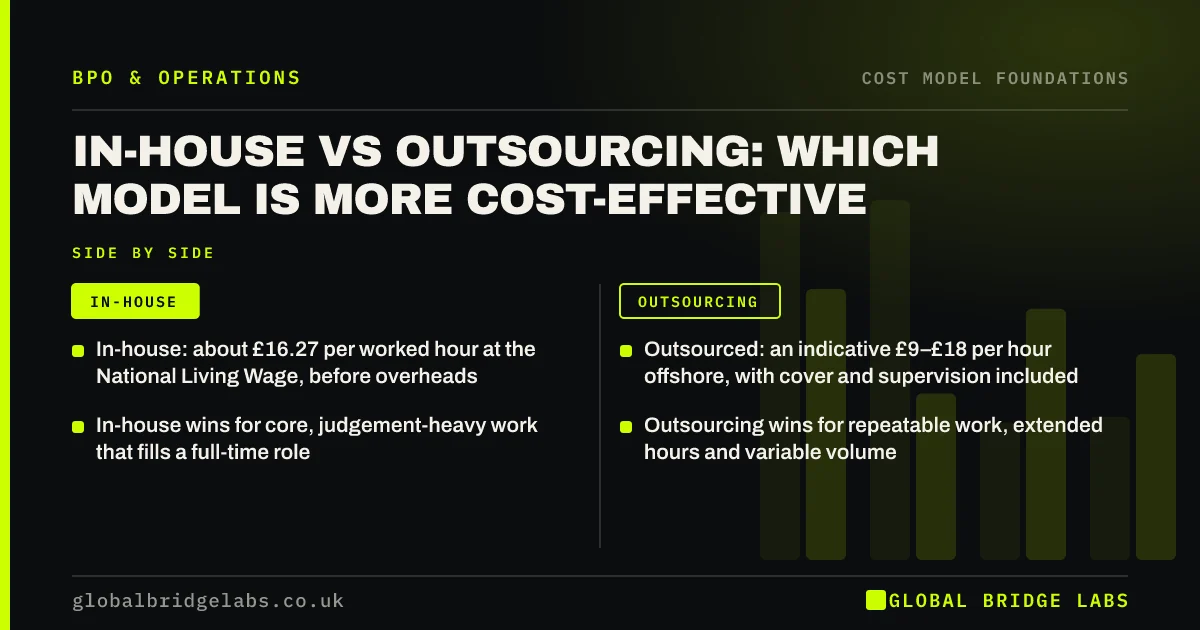
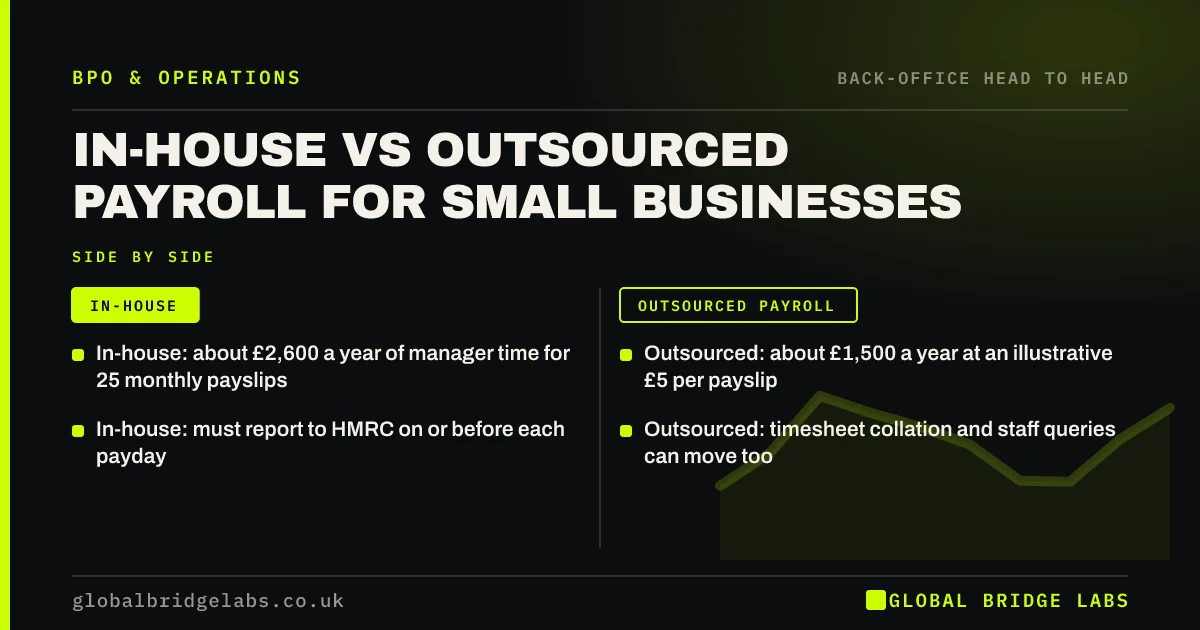
In-house vs outsourced payroll depends on headcount and complexity. For a 25-person business paid monthly, in-house payroll takes roughly 9 to 10 hours a month, about £2,600 a year of an office manager's time plus software. A bureau at an illustrative £5 per payslip costs about £1,500. Payroll admin, such as timesheets and queries, can be outsourced separately.
- In-house: about £2,600 a year of manager time for 25 monthly payslips.
- Outsourced: about £1,500 a year at an illustrative £5 per payslip.
- In-house: must report to HMRC on or before each payday.
- Outsourced: timesheet collation and staff queries can move too.
Want your payroll costed both ways? Message us on WhatsApp with your headcount.
Chat on WhatsApp →What does running payroll involve?
Running payroll means calculating pay and deductions, paying staff, and reporting pay and deductions to HMRC through Real Time Information (RTI) on or before each payday. It also covers pension auto-enrolment, statutory payments such as sick and maternity pay, starters and leavers, and payslips. Mistakes lead to unhappy staff and HMRC corrections.
What does in-house payroll cost?
For 25 monthly-paid staff, collecting hours, checking changes, running payroll, submitting to HMRC and answering questions takes around 9 to 10 hours a month. At £23.20 per worked hour for a £35,000 office manager, that is about £2,600 a year. Add payroll software, unless you qualify for HMRC's free tools, and pension provider admin.
What does outsourced payroll cost?
Payroll bureaus typically charge per payslip or per pay run, with extras for starters, leavers and year-end. At an illustrative £5 per payslip, 25 monthly payslips cost about £1,500 a year. Quotes vary with frequency, complexity and service level, so compare them on the same scope.
Want payroll quotes compared on the same scope? Send us your details on WhatsApp.
Chat on WhatsApp →What stays with you if you outsource payroll?
The legal responsibility stays with you as the employer. You still approve pay, provide accurate hours and changes on time, and fund the payments. A good split is: you approve, the bureau calculates and submits, and an admin team collects timesheets and answers routine staff questions.
When should payroll stay in-house?
For very small, stable payrolls where the owner runs it in under an hour a month using simple software. Also when pay is so variable, with complex shift premiums, that the time spent explaining it to a bureau would exceed the time saved.
When is outsourcing payroll the better choice?
When headcount is growing, when only one person knows how payroll works, when shift and overtime data takes hours to collate, or when errors have caused complaints. Outsourcing the collation and admin often saves more time than outsourcing the calculation itself.
What about payroll data protection?
Payroll data includes bank details, National Insurance numbers and sometimes health information for sick pay, so it needs care. Any provider is a processor under UK GDPR and needs a written contract; limit access and use secure file transfer, never email attachments.
What does a payroll calendar look like?
A simple monthly calendar keeps payroll on time whoever runs it. Agree dates with the bureau or in-house team and stick to them, because late changes cause most payroll errors.
- Day 1 to 5 before payday: hours, overtime and changes submitted.
- Day 3 before payday: draft payroll checked and approved.
- Payday: staff paid and HMRC report submitted on or before it.
- After payday: pension contributions sent and queries answered.
What does this look like in practice?
A pattern we see in UK hospitality businesses: rotas, tips and overtime are collated by hand from several sites before payroll. Moving the collation and staff queries to a managed admin team, with a bureau running the payroll, cuts the manager's month-end work to approval.
Payroll checklist
Use these steps to compare.
- Log hours spent on payroll each month.
- Separate collation, calculation and queries.
- Get bureau quotes on the same scope.
- Decide who approves pay before each run.
- Put a processor contract in place.
Next step
Tell us your headcount, pay frequency and where the time goes. We will cost payroll in-house and outsourced in a 30-minute call.
Message us on WhatsApp for a payroll comparison, or book a 30-minute consultation.
Chat on WhatsApp →Sources and further reading
- Running payroll · GOV.UK
- Workplace pensions: what you, your employer and the government pay · GOV.UK
- Rates and thresholds for employers 2026 to 2027 · HM Revenue & Customs
- Contracts and liabilities between controllers and processors · Information Commissioner's Office
Frequently asked questions
Is it cheaper to outsource payroll?
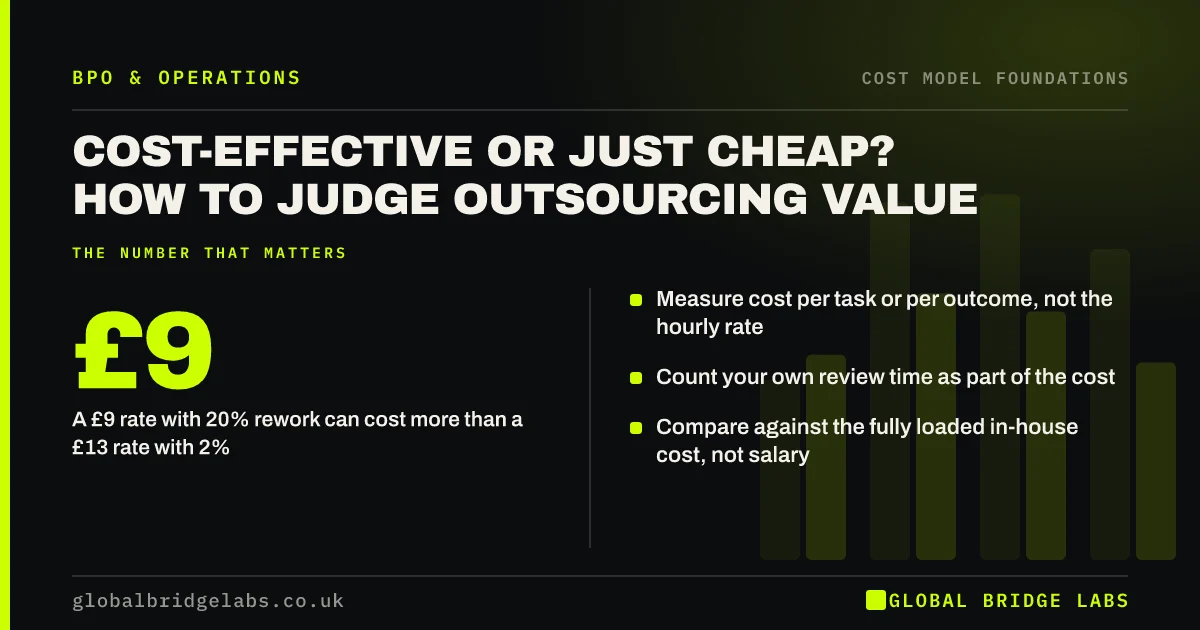
For most businesses with more than a handful of staff, yes, once the time spent is valued properly. For 25 monthly payslips, in-house time costs about £2,600 a year for an office manager, against about £1,500 at an illustrative bureau price of £5 per payslip.
Who is responsible for payroll if I outsource it?
You remain responsible as the employer for paying staff correctly and for reporting to HMRC on time. The bureau acts on your behalf, so you must provide accurate hours and changes by the agreed dates and approve pay before each run is finalised.
What must a UK employer report to HMRC?
Employers report pay and deductions to HMRC on or before each payday through Real Time Information, and pay what they owe to HMRC by the deadlines. GOV.UK's running payroll guidance sets out each step, including starters, leavers and end-of-year tasks.
What payroll tasks can an admin team handle?
Collecting timesheets and overtime, checking them against rotas, recording starters and leavers, answering routine staff questions about payslips and holiday, and chasing missing information before the cut-off. The bureau or payroll software then calculates pay and submits to HMRC. You still approve every run.
Written by

Global Bridge Labs (GBL) is a UK–Sri Lanka partner for social media, websites and BPO. Everything here comes from client delivery, not theory.