On this page
- 01Key takeaways
- 02What does accounts payable involve?
- 03How do you calculate cost per invoice?
- 04What does outsourced AP cost?
- 05Which AP tasks should stay in-house?
- 06How do you prevent supplier fraud?
- 07Does outsourcing AP help you pay on time?
- 08When should AP stay in-house?
- 09Which AP measures show it is working?
- 10What does this look like in practice?
- 11Accounts payable checklist
- 12Next step
- 13Sources and further reading
- 14Frequently asked questions
Key takeaways
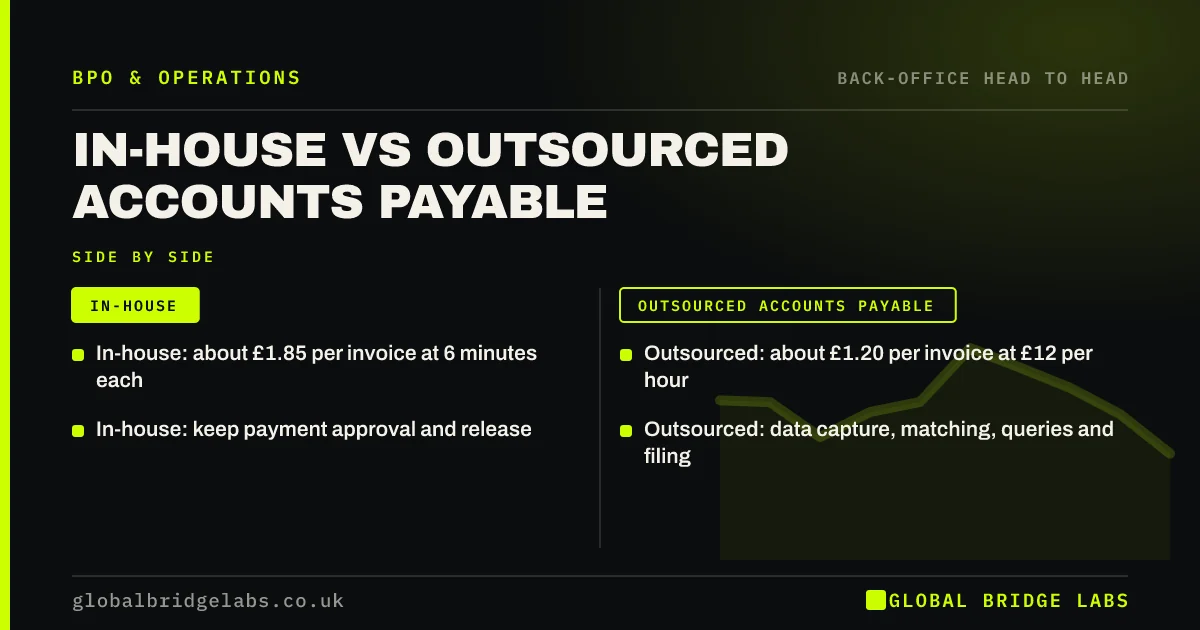
Accounts payable outsourcing vs in-house comes down to cost per invoice and control. Processing 600 invoices a month in-house at about 6 minutes each costs roughly £1.85 per invoice for a £28,000 employee. Outsourced at an indicative £12 per hour, it is about £1.20, saving around £4,600 a year, with approvals kept in-house.
- In-house: about £1.85 per invoice at 6 minutes each.
- Outsourced: about £1.20 per invoice at £12 per hour.
- In-house: keep payment approval and release.
- Outsourced: data capture, matching, queries and filing.
Want your cost per invoice worked out? Message us on WhatsApp with your volumes.
Chat on WhatsApp →What does accounts payable involve?
Accounts payable (AP) is the process of receiving, checking, recording and paying supplier invoices. It covers capturing invoice data, matching to purchase orders or delivery notes, chasing approvals, answering supplier queries and preparing payment runs. Most of it is rules-based, which makes it a strong outsourcing candidate.
How do you calculate cost per invoice?
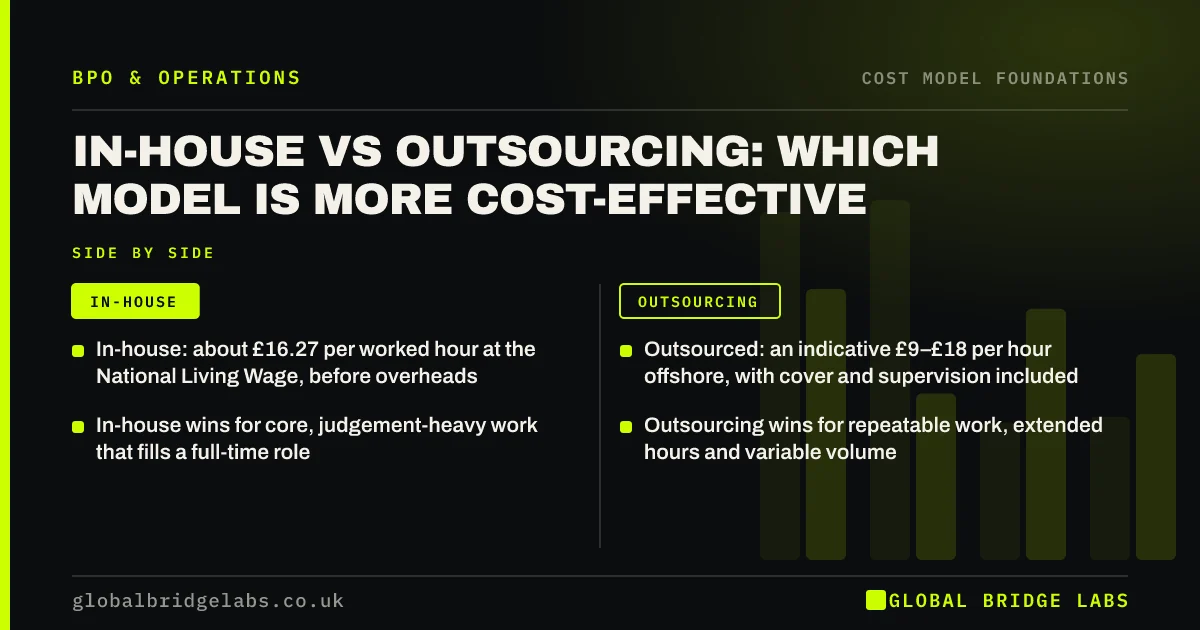
Multiply the minutes per invoice by the loaded cost per minute of whoever does it, then add exceptions and supplier queries. For 600 invoices a month at 6 minutes each, that is 60 hours a month, or 720 hours a year. At £18.45 per worked hour for a £28,000 employee, that is about £13,300, or £1.85 per invoice.
What does outsourced AP cost?
The same 720 hours at an indicative £12 per hour cost about £8,640 a year, or £1.20 per invoice, a saving of about £4,600. Per-invoice pricing is also common for stable volumes. Your approvers still spend time approving, so that part of the cost does not change.
Want per-hour and per-invoice pricing compared? Send us your monthly volume on WhatsApp.
Chat on WhatsApp →Which AP tasks should stay in-house?
Keep approval and payment release in-house. Outsource the capture, matching, coding suggestions, filing and supplier query handling. This separation of duties is good practice anyway: the person who prepares a payment should not be the person who releases it.
- In-house: approving invoices and releasing payments.
- In-house: approving any change to supplier bank details.
- Outsourced: capture, matching and coding.
- Outsourced: supplier statements and queries.
How do you prevent supplier fraud?
Invoice and bank-detail fraud targets small businesses. Verify any change of supplier bank details by phoning a known number, never one in the email, and require two people to approve the change. The National Cyber Security Centre's small business guide covers the basics of phishing and account security.
Does outsourcing AP help you pay on time?
Usually, because invoices are captured and chased for approval daily rather than when someone has time. Paying on time protects supplier relationships and avoids late payment interest, which suppliers can claim under UK late payment legislation on business-to-business debts.
When should AP stay in-house?
When volumes are small, under a hundred invoices a month, or when invoices need detailed site knowledge to match, such as construction variations. In those cases, the saving is small and the queries would come back to you anyway.
Which AP measures show it is working?
Track a few measures monthly after outsourcing accounts payable. They show whether invoices move quickly and accurately, and whether suppliers are paid on time.
- Cost per invoice processed.
- Days from invoice receipt to approval.
- Share of invoices paid by the due date.
- Exceptions and errors per 100 invoices.
What does this look like in practice?
A pattern we see in UK logistics firms: fuel, subcontractor and maintenance invoices arrive by email and post, and the finance lead spends days matching them. A managed team captures and matches invoices daily, and the finance lead only approves exceptions and payment runs.
Accounts payable checklist
Use these steps to compare.
- Count invoices per month and time per invoice.
- Calculate in-house cost per invoice.
- Get per-hour and per-invoice quotes.
- Keep approvals and payment release in-house.
- Set a bank-detail change verification rule.
- Track cost per invoice and payment days monthly.
Next step
Send us your monthly invoice volume and current process. We will calculate cost per invoice both ways in a 30-minute call.
Message us on WhatsApp for an AP cost comparison, or book a 30-minute consultation.
Chat on WhatsApp →Sources and further reading
- Late commercial payments: charging interest and debt recovery · GOV.UK
- Small Business Guide: cyber security · National Cyber Security Centre
- Rates and thresholds for employers 2026 to 2027 · HM Revenue & Customs
Frequently asked questions
What does it cost to process an invoice in-house?
Multiply minutes per invoice by the loaded cost per minute of whoever does it. At 6 minutes per invoice and £18.45 per worked hour for a £28,000 employee, the cost is about £1.85 per invoice, before exceptions, supplier queries and the time approvers spend signing invoices off.
Is it safe to outsource accounts payable?
Yes, with the right controls. Keep approvals and payment release in-house, give the provider only the access it needs, and verify any change to supplier bank details by phone using a known number, with two people approving the change before any payment is made.
What AP volume makes outsourcing worthwhile?
Outsourcing usually pays once invoice processing takes several hours a week. Under about a hundred invoices a month, the saving is often too small to justify setup, unless the work currently sits with an expensive person such as a finance director or owner.
Can accounts payable be partly automated as well?
Yes. Invoice capture tools can read standard invoices and suggest coding, and an outsourced team checks exceptions, matches to orders and handles supplier queries. Combining the two often gives the lowest cost per invoice while keeping accuracy high on unusual invoices.
Written by

Global Bridge Labs (GBL) is a UK–Sri Lanka partner for social media, websites and BPO. Everything here comes from client delivery, not theory.