On this page
- 01Key takeaways
- 02What are the stages of the customer journey?
- 03What does the website need at the find stage?
- 04What does the website need at the orient stage?
- 05What does the website need at the compare stage?
- 06What does the website need at the commit stage?
- 07What does the website need at the return stage?
- 08Do customers always go through the stages in order?
- 09What does this look like in practice?
- 10Stage-by-stage checklist
- 11Next step
- 12Sources and further reading
- 13Frequently asked questions
Key takeaways
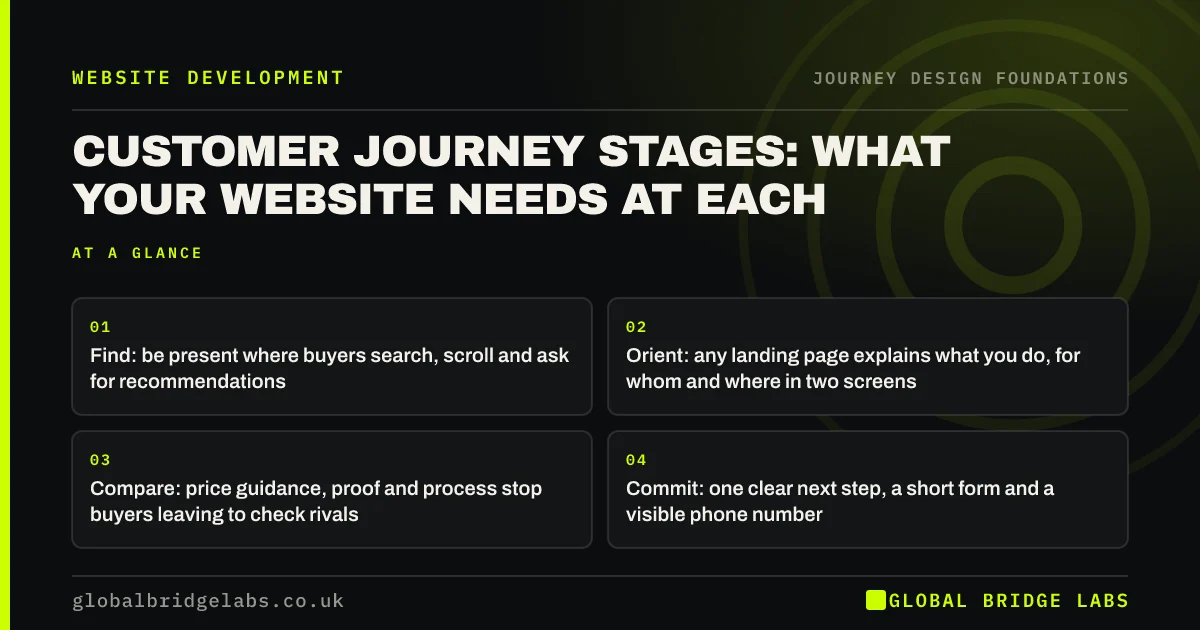
Customer journey stages are the broad steps a buyer passes through: becoming aware of a need, researching, comparing, deciding and life after the purchase. For website planning, Global Bridge Labs (GBL) uses five practical stages: find, orient, compare, commit and return. Each stage needs different pages and answers, and most sites serve one or two well and neglect the rest.
- Find: be present where buyers search, scroll and ask for recommendations.
- Orient: any landing page explains what you do, for whom and where in two screens.
- Compare: price guidance, proof and process stop buyers leaving to check rivals.
- Commit: one clear next step, a short form and a visible phone number.
- Return: confirmation, aftercare and re-ordering keep customers coming back.
Want to know which stage your site neglects? Send us your URL on WhatsApp.
Chat on WhatsApp →What are the stages of the customer journey?
The classic customer journey stages are awareness, consideration, decision, retention and advocacy. They describe the buyer's mindset: noticing a need, weighing options, choosing, staying and recommending. Different models use different names, but the sequence is broadly the same, and the stages overlap and repeat rather than running in a straight line.
For website design, mindset labels are less useful than tasks. Our five stages translate them into what the website must do: help buyers find you, orient them when they land, help them compare, make it easy to commit, and look after them when they return.
What does the website need at the find stage?
At the find stage the website needs pages that match how buyers describe their problem: service pages for each main need, location pages where you serve several areas, and articles answering common questions. Off the site, it needs a complete Google Business Profile and consistent listings. A buyer who cannot find you never starts the rest of the journey.
What does the website need at the orient stage?
At the orient stage, every likely landing page needs to tell a new visitor what you do, who it is for, where you work and what to do next, within the first two screens on a phone. Visitors arrive on inner pages from search and social, so this is not only a homepage job. Clear headings and a visible next step matter more than design flourishes.
What does the website need at the compare stage?
At the compare stage buyers need the answers they would otherwise get from a competitor: price guidance, proof from similar customers, how the process works, how long it takes and why you rather than the alternatives. Missing answers send buyers back to search, where a competitor may answer first. This is the stage most small business sites under-serve.
What does the website need at the commit stage?
At the commit stage the website needs to remove effort and doubt. That means one clear next step on each page, a short form, a tappable phone number, booking where it fits, and a line on what happens after the buyer gets in touch. Uncertainty about the next step is a common reason buyers delay.
What does the website need at the return stage?
At the return stage, the website serves people who have already enquired or bought: a confirmation page that sets expectations, help and FAQs, ways to re-order or rebook, and a simple route to leave a review or refer a friend. These pages rarely get design attention, yet they shape whether the customer comes back and who they tell.
Do customers always go through the stages in order?
No. Buyers loop: they compare, go back to search, return days later on another device, and sometimes skip straight to commit because a friend recommended you. Google's research into what it called the messy middle described buyers moving back and forth between exploring and evaluating. Design every stage so a buyer can enter at any point and still find the next step.
What does this look like in practice?
A pattern we see in many small business reviews: strong find and commit stages, with good search visibility and a clear contact form, and a hollow compare stage. Visitors read a service page, find no price guidance, no examples and no process, and leave to check competitors.
Adding a compare layer, with fee ranges, two short case studies and a 'how it works' section, often does more than a new homepage. Across our client work we have seen a 2.4x enquiry rate from conversion changes of this kind. Global Bridge Labs (GBL) scores each stage before suggesting any redesign.
Stage-by-stage checklist
- Find: list the searches and referrals that should lead to each service page.
- Orient: check your top ten landing pages on a phone, first two screens only.
- Compare: add price guidance, proof and process to each main service.
- Commit: one next step per page, a short form and a tappable number.
- Return: rewrite the confirmation page and add aftercare and review links.
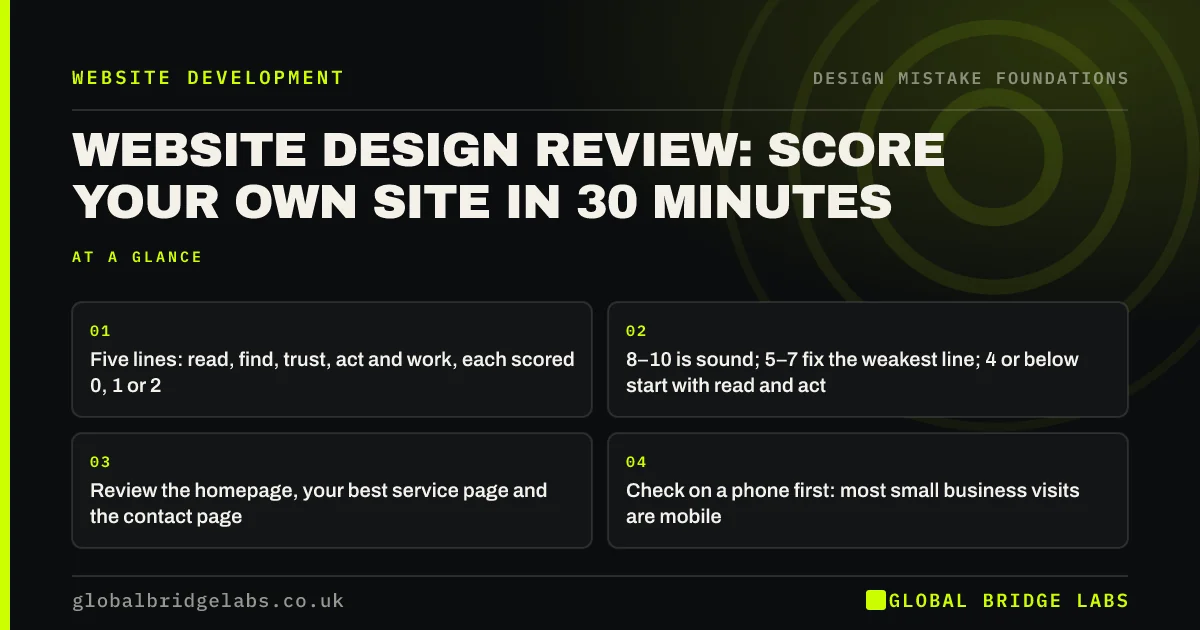
- Score each stage 0 to 2 and fix the lowest first.
Next step
Most websites are strong at one or two stages and weak at the rest. We will score yours across all five and tell you which stage is costing you most.
Message us on WhatsApp for a stage-by-stage review, or book a 30-minute consultation.
Chat on WhatsApp →Sources and further reading
- Journey mapping 101 · Nielsen Norman Group
- How long do users stay on web pages? · Nielsen Norman Group
- Funnel exploration · Google Analytics Help
Frequently asked questions
What are the 5 stages of the customer journey?
The common model is awareness, consideration, decision, retention and advocacy. For website design, Global Bridge Labs uses five practical equivalents: find, orient, compare, commit and return. They describe what the website must do at each point rather than only how the buyer feels.
Which customer journey stage matters most for a website?
The stage where your buyers currently drop out matters most. For many small businesses that is the compare stage, because service pages lack price guidance, proof and process, so buyers leave to check competitors. Measure where visitors leave before deciding.
Should every page target one journey stage?
Every page should be designed mainly for the stage most of its visitors are in, while still giving a route forward. A blog article mostly serves the find stage and should link to the relevant service; a service page serves orient and compare and should show the next step.
Written by

Global Bridge Labs (GBL) is a UK–Sri Lanka partner for social media, websites and BPO. Everything here comes from client delivery, not theory.