On this page
- 01Key takeaways
- 02What is the post-purchase customer journey?
- 03What do customers need from your website after buying?
- 04What are the legal basics after an online sale?
- 05How do you design for existing customers without cluttering the site?
- 06How does post-purchase design lead to more sales?
- 07When should post-purchase content stay off the website?
- 08What does this look like in practice?
- 09Post-purchase checklist
- 10Next step
- 11Sources and further reading
- 12Frequently asked questions
Key takeaways
The post-purchase website experience covers everything a customer needs from your site after buying: confirmation, preparation, aftercare, help, returns, re-ordering and reviews. Most small business sites are built only for new buyers, so customers phone for basics. Give existing customers clear pages and routes, and they will need less of your time, come back more and recommend you more readily.
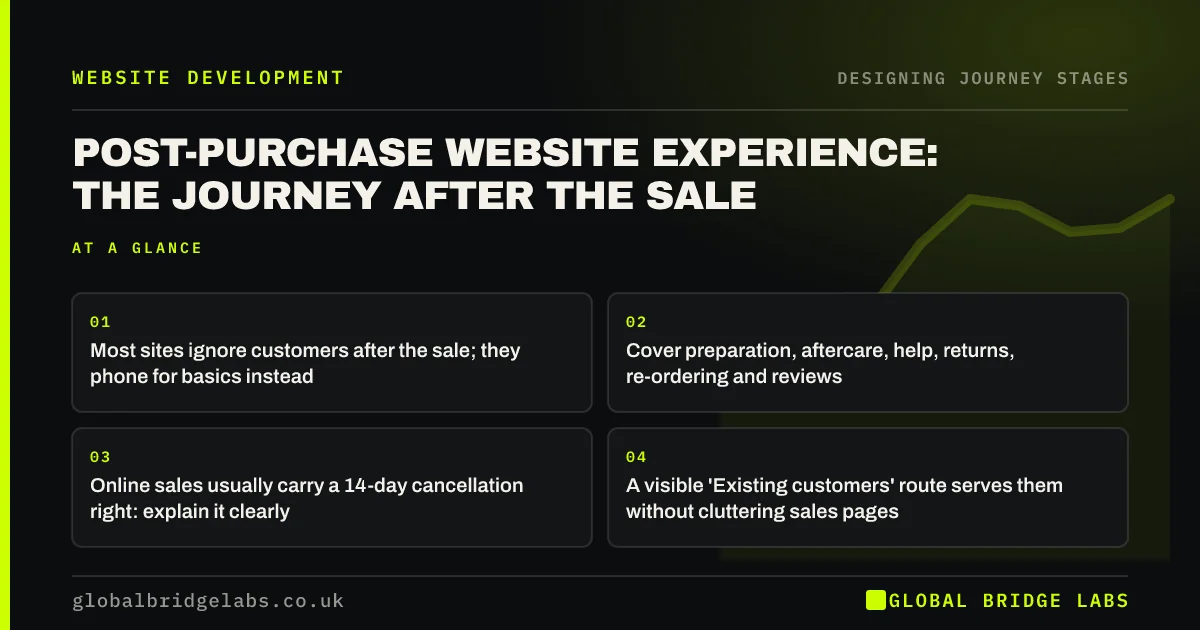
- Most sites ignore customers after the sale; they phone for basics instead.
- Cover preparation, aftercare, help, returns, re-ordering and reviews.
- Online sales usually carry a 14-day cancellation right: explain it clearly.
- A visible 'Existing customers' route serves them without cluttering sales pages.
Want to know what your customers need after they buy? Message us on WhatsApp.
Chat on WhatsApp →What is the post-purchase customer journey?
The post-purchase customer journey is everything that happens after a buyer commits: confirmation, preparation, delivery or the service itself, aftercare, support, invoices, returns, re-ordering and referral. It is the return stage of the journey. It shapes whether the customer buys again, what they say in reviews and who they recommend you to.
What do customers need from your website after buying?
After buying, customers need practical information they can find without calling: what to expect and when, how to prepare, how to look after what they bought, how to get help, how to return or cancel, how to pay, and how to buy again. Each is a reason to phone if the website does not answer it.
- Preparation: what to do before the visit, delivery or appointment.
- Aftercare: care guides, warranties, maintenance schedules.
- Help: FAQs, troubleshooting and how to reach support.
- Returns and cancellations: rules and steps, in plain English.
- Payments: invoices, payment options and terms.
- Repeat: re-order, rebook or upgrade.
What are the legal basics after an online sale?
For online and distance sales to consumers, the Consumer Contracts Regulations generally give a 14-day cancellation period, with exceptions such as personalised goods, and require clear pre-contract information. Your post-purchase pages should explain cancellation, returns and refunds simply and match your terms. Services have their own rules about work started within the cancellation period.
How do you design for existing customers without cluttering the site?
Give existing customers their own route: an 'Existing customers' or 'Help' link in the header or footer that leads to a hub with preparation, aftercare, help, returns and re-ordering. Link to the relevant pages from confirmation emails and invoices. Sales pages stay focused on new buyers, and customers find what they need in one place.
How does post-purchase design lead to more sales?
Post-purchase design leads to more sales through repeat business, referrals and reviews. A customer who can rebook in two taps is more likely to rebook. One who had a smooth experience is more likely to recommend you and leave a review, which helps the next buyer at the compare stage. The journey becomes a loop rather than a line.
- Referral journeys: designing for visitors sent by a friend
- Returning visitors: the buyers your website ignores
Want a simple re-order or rebook route added to your site? Message us on WhatsApp.
Chat on WhatsApp →When should post-purchase content stay off the website?
Keep content off the public site when it is specific to one customer, confidential or security sensitive, such as account details, contract terms or site access arrangements. Use a client portal, email or a password-protected page for those. Public pages should cover what applies to every customer.
What does this look like in practice?
A pattern we see in service businesses: the phone is busy with existing customers asking when the engineer arrives, how to prepare, or how to book the annual service. None of it is on the website. Staff time goes on answers, and new enquiries wait.
A small help hub, linked from confirmation emails, with preparation guides and a rebook form takes much of that load off the phone. Across our client work, owners have got 31 hours a week back once routine work is handled outside their own inbox, and a help hub is often the first step. Global Bridge Labs (GBL) designs the return stage alongside the sales pages.
Post-purchase checklist
- List the questions customers ask after buying.
- Create preparation and aftercare pages.
- Explain cancellation, returns and refunds simply.
- Add an 'Existing customers' or 'Help' route.
- Link help pages from confirmation emails and invoices.
- Add a simple re-order, rebook and review route.
Next step
Your existing customers are your most valuable visitors. We will map what they need after buying and show how the website can serve it.
Message us on WhatsApp to design your post-purchase journey, or book a 30-minute consultation.
Chat on WhatsApp →Sources and further reading
Frequently asked questions
What is post-purchase experience on a website?
Everything the website offers customers after they buy: confirmation, preparation and aftercare guides, help and FAQs, returns and cancellation information, payment details, and ways to re-order, rebook or leave a review. It reduces support calls and encourages repeat business.
Should my website have a section for existing customers?
Yes, for most businesses with repeat or ongoing customers. A simple 'Existing customers' or 'Help' link leading to preparation, aftercare, help, returns and re-ordering keeps sales pages focused and saves staff time answering the same questions.
What is the cancellation period for online purchases in the UK?
Under the Consumer Contracts Regulations, consumers generally have 14 days to cancel most distance and online purchases, with exceptions such as personalised or perishable goods and special rules for services started early. Explain your rules clearly and make sure they match your terms.
Written by

Global Bridge Labs (GBL) is a UK–Sri Lanka partner for social media, websites and BPO. Everything here comes from client delivery, not theory.