On this page
- 01Key takeaways
- 02What is a customer journey, in one sentence?
- 03What does a customer journey look like for a small business?
- 04What are touchpoints in a customer journey?
- 05Is a customer journey the same as a sales funnel?
- 06Why does the customer journey matter for your website?
- 07When is the customer journey idea over-used?
- 08What does this look like in practice?
- 09Customer journey basics checklist
- 10Next step
- 11Sources and further reading
- 12Frequently asked questions
Key takeaways
A customer journey is the full sequence of steps a person takes to get something done with a business, from noticing a need to buying and beyond. It crosses channels, such as search, social media, phone calls and your website, and it unfolds over minutes for some purchases and months for others. Your website is one part of the journey, not the whole of it.
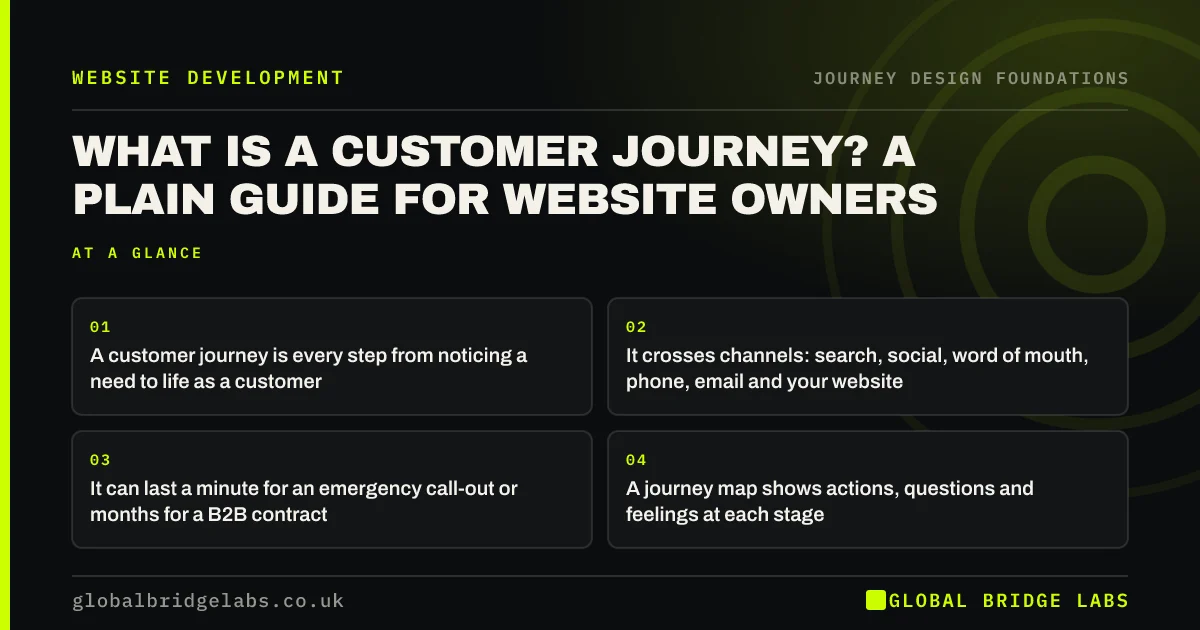
- A customer journey is every step from noticing a need to life as a customer.
- It crosses channels: search, social, word of mouth, phone, email and your website.
- It can last a minute for an emergency call-out or months for a B2B contract.
- A journey map shows actions, questions and feelings at each stage.
Want to see your own customer journey on one page? Message us on WhatsApp.
Chat on WhatsApp →What is a customer journey, in one sentence?
A customer journey is the sequence of steps, across every channel and over time, that a person goes through to reach a goal with a business, such as fixing a problem, buying a product or choosing a supplier. It includes what they do, what they ask and how they feel at each step, not only the moments they spend on your website.
Nielsen Norman Group describes a journey map as a visualisation of the process a person goes through to accomplish a goal. The journey is the real thing; the map is your picture of it, and the picture is only as good as the research behind it.
What does a customer journey look like for a small business?
For a small business, a customer journey usually runs: a need appears, the buyer searches or asks someone, they land on a page, they look for proof and price, they compare two or three options, they get in touch, and they decide. After the sale they need help, they may re-order, and they may recommend you. Each step is a chance to keep or lose them.
Take a homeowner with a broken boiler in January. They search 'boiler repair near me' on a phone, tap the second result, check the reviews, look for a call-out price, and ring the first firm that answers. The whole journey takes ten minutes and the website's job is to make the phone ring. A firm choosing an accountant behaves differently: weeks of reading, a referral, two calls and a proposal.
What are touchpoints in a customer journey?
Touchpoints are the individual moments when a buyer meets your business: a search result, a Google review, a social post, a page on your site, a phone call, a quote email or an invoice. The customer journey is the route through those touchpoints. A journey breaks when two touchpoints disagree, such as a price on the website that differs from the quote.
- Before contact: search results, reviews, social posts, referrals, adverts.
- On the website: landing page, service pages, proof, pricing, forms.
- During the sale: phone calls, emails, quotes, site visits, proposals.
- After the sale: confirmations, invoices, support, follow-up, review requests.
Is a customer journey the same as a sales funnel?
No. A sales funnel describes your process: how many prospects move from one stage of your pipeline to the next. A customer journey describes the buyer's experience: what they do, ask and feel along the way, including steps you never see. The funnel is useful for counting. The journey is useful for designing pages that answer the right question at the right time.
Why does the customer journey matter for your website?
The customer journey matters for your website because visitors arrive with a question that belongs to a specific stage, and a page that answers a different question loses them. Someone comparing suppliers needs proof and price guidance; someone who has never heard of you needs to know what you do. Knowing the journey tells you which page needs which answer.
It also explains why visits do not always turn into enquiries straight away. Many buyers research on one visit and enquire on another, sometimes on a different device. A site that serves only the final step misses the earlier visits that made the enquiry possible.
When is the customer journey idea over-used?
The idea is over-used when it becomes a diagram exercise rather than a design tool. Some businesses spend weeks on maps covering every possible persona and channel, then change nothing on the website. Others copy a generic five-stage model without checking it against their own customers. A useful journey is specific, based on real conversations, and short enough to act on.
What does this look like in practice?
A pattern we see with trades businesses: the owner describes the journey as 'they Google us and ring'. Asking five recent customers shows a longer route. Most saw the van or a neighbour's job first, checked reviews, looked for photos of similar work, and then rang. The website had no project photos and buried the reviews.
Adding a short gallery of local jobs and reviews near the phone number serves the step buyers were already taking. Across our client work we have seen a 2.4x enquiry rate from conversion changes of this kind. Global Bridge Labs (GBL) starts by asking customers, not by assuming.
Customer journey basics checklist
- Write down, in one line, what your customers are trying to get done.
- List every touchpoint before, during and after the sale.
- Ask three recent customers how they found and chose you.
- Note where your website appears in their story.
- Find one step where buyers ask the same question repeatedly.
- Make sure the website answers it.
Next step
Knowing the definition is the easy part. Seeing your own customers' journey, and where the website helps or gets in the way, is where the value is. We can sketch it with you in a short call.
Message us on WhatsApp to map your customer journey, or book a 30-minute consultation.
Chat on WhatsApp →Sources and further reading
- Journey mapping 101 · Nielsen Norman Group
- User journeys vs. user flows · Nielsen Norman Group
- Path exploration · Google Analytics Help
Frequently asked questions
What is a customer journey in simple terms?
A customer journey is every step someone takes to get something done with a business, from first noticing a need to buying and using the product or service. It includes what they do, what they want to know and how they feel, across channels such as search, social media, phone and your website.
What is an example of a customer journey?
A homeowner's boiler breaks, they search 'boiler repair near me' on a phone, read reviews on two firms, look for a call-out price, ring the firm that answers first, get a visit the same day and later leave a review. That is a full customer journey in about ten minutes plus aftercare.
What is the difference between a customer journey and a journey map?
The customer journey is what actually happens to your buyers. A journey map is a picture of it, usually a table or diagram showing stages, actions, questions, feelings and problems. The map is only as accurate as the research behind it, which is why interviews with real customers matter.
Why is the customer journey important for small businesses?
Small businesses usually have limited traffic and limited sales time, so losing buyers at avoidable steps is costly. Knowing the journey shows which questions each page must answer, where buyers stall and which fixes are worth doing first, without spending money on a redesign that misses the real problem.
Written by

Global Bridge Labs (GBL) is a UK–Sri Lanka partner for social media, websites and BPO. Everything here comes from client delivery, not theory.