On this page
- 01Key takeaways
- 02What is the awareness stage of the customer journey?
- 03What content do awareness stage visitors need?
- 04How do you move awareness visitors to the next stage?
- 05How do you measure awareness stage pages?
- 06Does awareness content help in AI search?
- 07When should a small business skip awareness content?
- 08What does this look like in practice?
- 09Awareness stage checklist
- 10Next step
- 11Sources and further reading
- 12Frequently asked questions
Key takeaways
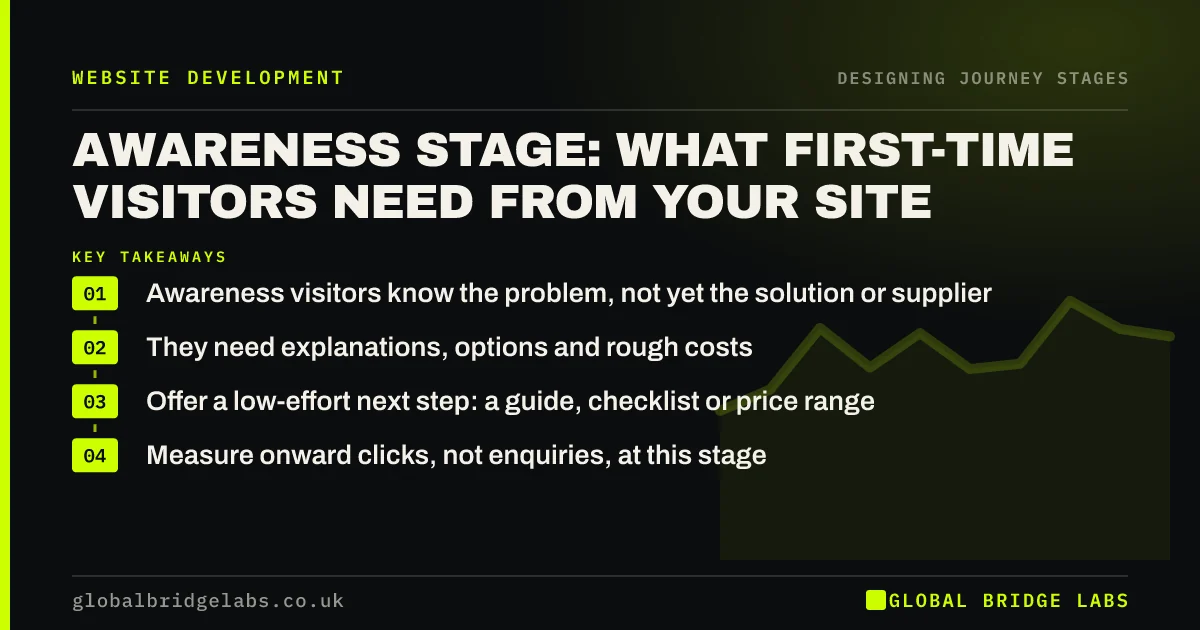
Awareness stage visitors have a problem but have not decided what to do about it or who to ask. They need plain explanations, options and rough costs, not a hard sell. Give them helpful guides that answer their question fully, show that you solve the problem, and offer a low-effort next step such as a price guide or checklist. Most will not enquire on this visit.
- Awareness visitors know the problem, not yet the solution or supplier.
- They need explanations, options and rough costs.
- Offer a low-effort next step: a guide, checklist or price range.
- Measure onward clicks, not enquiries, at this stage.
Want to know whether your guides move readers on? Message us on WhatsApp.
Chat on WhatsApp →What is the awareness stage of the customer journey?
The awareness stage is the start of the customer journey, when a buyer realises they have a problem or need and starts looking for information. They search for symptoms and questions, such as 'why is my boiler losing pressure' or 'do I need to register for VAT', rather than for a supplier. They are learning, not choosing.
What content do awareness stage visitors need?
Awareness stage visitors need content that explains their problem in plain English, sets out the options including doing nothing, gives rough costs and timescales, and tells them when to get help. Clear, complete answers build trust that pays off later, when the same buyer returns to choose a supplier.
- Guides that answer a specific question fully.
- Explanations of options, including do-it-yourself where safe.
- Rough cost and time ranges.
- Signs that the problem needs a professional.
- A short note on how you help, with a link.
How do you move awareness visitors to the next stage?
Move awareness visitors on by offering a next step that matches their readiness. A reader learning about damp is not ready to book; they may be ready for a price guide, a checklist of signs, or a page explaining what a survey involves. Link clearly from the guide to the relevant service, but keep the hard sell for later pages.
- Link to the matching service page in the body, not only the footer.
- Offer a price guide or checklist as a soft next step.
- Show a review or accreditation near the service link.
- Make it easy to return: a clear brand and simple navigation.
How do you measure awareness stage pages?
Measure awareness pages by engagement and onward movement, not by enquiries. Useful measures are engaged sessions, clicks to service pages, price guide views or downloads, and returning visits. An article with few direct enquiries but strong onward clicks is doing its job. One with high traffic and no onward clicks needs a better route.
Does awareness content help in AI search?
Yes. Awareness questions are exactly what people now ask AI tools, and those tools draw on pages with clear, complete, well-structured answers. Google's guidance on AI features says the same practices that help pages in search apply. A guide that answers a question in its first paragraph and backs it with specifics is more likely to be cited.
When should a small business skip awareness content?
Skip awareness content when your buyers do not research, such as emergency call-outs where they search for a supplier immediately, or when you lack time to write it well. Thin awareness articles add little. Focus first on service pages and the compare stage, then add guides for the questions you are asked most.
What does this look like in practice?
A pattern we see with service firms that blog: articles are written for search volume, get readers, and end with 'Contact us today'. Readers who are only starting to research ignore it. Nothing in between connects learning to choosing.
Adding a section that explains when to call a professional, with a link to the relevant service and a price guide, gives readers a step they will take. Across our client work we have seen a 2.4x enquiry rate from conversion changes of this kind. Global Bridge Labs (GBL) plans the route out of every guide.
Awareness stage checklist
- List the questions buyers ask before they look for a supplier.
- Answer each fully in a guide, in plain English.
- Include options, rough costs and when to get help.
- Link to the matching service in the body.
- Offer a soft next step: price guide or checklist.
- Measure onward clicks and returning visits.
Next step
If your guides attract readers but not buyers, the gap is usually the route out. We will review your top articles and show what each needs.
Message us on WhatsApp for a review of your awareness content, or book a 30-minute consultation.
Chat on WhatsApp →Sources and further reading
- Creating helpful, reliable, people-first content · Google Search Central
- AI features and your website · Google Search Central
- Engagement rate and bounce rate · Google Analytics Help
Frequently asked questions
What is awareness stage content?
Content for people who have a problem or need but have not yet decided how to solve it or who to ask. It explains the problem, sets out options and rough costs, and tells readers when to get professional help, with a soft route to your relevant service.
Should awareness stage pages have a call to action?
Yes, but a light one that fits the reader's readiness, such as a price guide, checklist or link to the service page. A hard 'book now' rarely suits someone still learning. Measure these pages by onward clicks and returning visits rather than direct enquiries.
How much awareness content does a small business need?
Start with guides answering the five to ten questions buyers ask most before looking for a supplier. Write each one well rather than many thinly. Add more once service pages and the compare stage are strong.
Written by

Global Bridge Labs (GBL) is a UK–Sri Lanka partner for social media, websites and BPO. Everything here comes from client delivery, not theory.