On this page
- 01Short answer
- 02What is price transparency on a website?
- 03Why do businesses hide prices, and what does it cost?
- 04How do you show prices for bespoke work?
- 05What are the UK legal rules on showing prices?
- 06How do published prices help in search and AI answers?
- 07When is it right not to publish prices?
- 08What does this look like in practice?
- 09Pricing checklist
- 10Next step
- 11Sources and further reading
- 12Frequently asked questions
Short answer
Yes, most UK businesses should show prices on their website, even when every job is different. Publish fixed prices where you can, ranges or from prices where you cannot, and the factors that drive cost in every case. Price guidance filters out poor-fit enquiries and keeps price-conscious buyers from leaving to find a competitor who answers.
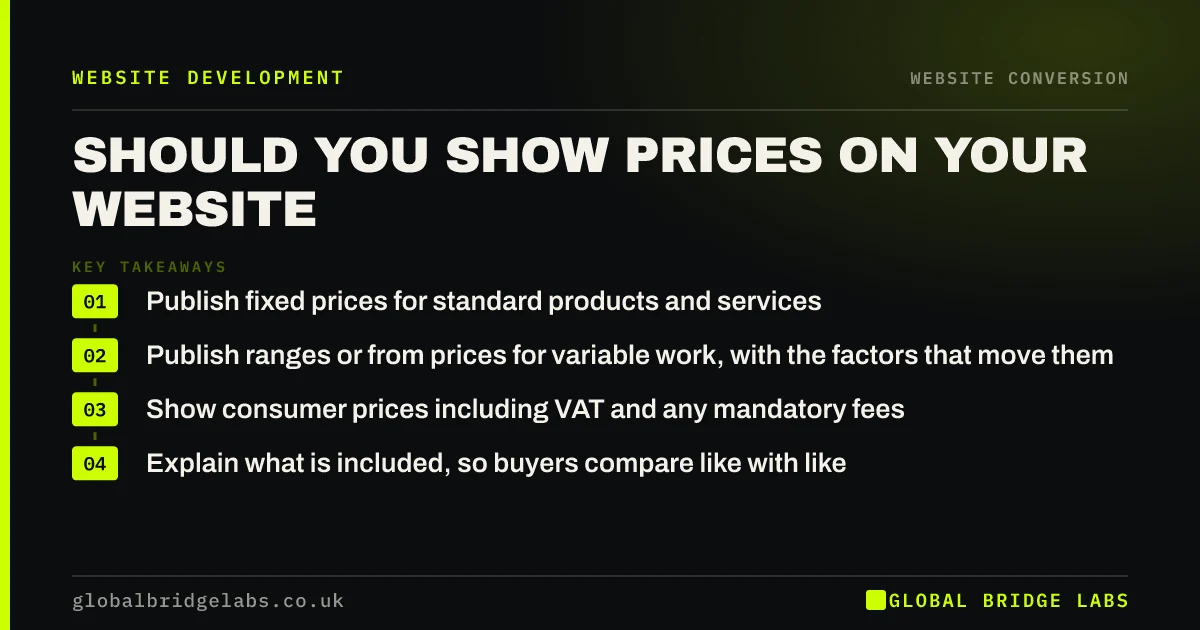
- Publish fixed prices for standard products and services.
- Publish ranges or from prices for variable work, with the factors that move them.
- Show consumer prices including VAT and any mandatory fees.
- Explain what is included, so buyers compare like with like.
Not sure how to present pricing for bespoke work? Message us on WhatsApp and we will suggest a format.
Chat on WhatsApp →What is price transparency on a website?
Price transparency on a website means giving visitors enough information about cost to judge whether a product or service is within their budget before they contact the business, whether through fixed prices, ranges, starting prices or a clear explanation of what drives the price.
It does not mean publishing a full rate card for complex work. It means not leaving the buyer to guess.
Why do businesses hide prices, and what does it cost?
Businesses hide prices because they fear competitors will undercut them, because every job is different, or because they want the chance to sell value on a call. Those are understandable reasons, but hiding prices has a cost.
Price is one of the first questions buyers ask. When a site will not answer it, many visitors assume the business is expensive and leave. Those who do enquire may be a poor fit, which wastes time on both sides.
- Price-sensitive visitors leave without enquiring.
- Poor-fit enquiries take up quoting time.
- Competitors who publish ranges look more open and trustworthy.
- AI assistants and search results cannot quote your pricing, so they quote someone else's.
How do you show prices for bespoke work?
Use one of four formats, depending on how variable the work is.
- From prices: Boiler installations from £2,400 including VAT.
- Ranges: Most loft conversions in Leeds cost £45,000 to £65,000.
- Packages: Small, medium and large options with what each includes.
- Cost factors: the four things that move the price, with a typical example.
What are the UK legal rules on showing prices?
Prices shown to consumers should be the total price, including VAT and any mandatory charges. Under the Digital Markets, Competition and Consumers Act 2024, drip pricing, where unavoidable fees are revealed only later in the buying process, is treated as an unfair commercial practice. The CMA can now fine businesses directly for breaches.
For contracts made online with consumers, the Consumer Contracts Regulations also require clear pre-contract information, including the total price and any delivery charges. Business-to-business prices can be shown excluding VAT, but say so clearly.
Want your pricing section checked for clarity and compliance? Message us on WhatsApp.
Chat on WhatsApp →How do published prices help in search and AI answers?
Buyers increasingly ask Google, ChatGPT and Perplexity questions such as how much does a loft conversion cost in Leeds. Those answers are assembled from pages that state prices clearly. If your site publishes a typical range with the factors behind it, it can be the page that gets cited. If it says contact us for a quote, it cannot.
Price content also ranks in its own right. A short section or page answering how much a service costs in your area targets one of the highest-intent searches there is, because people searching for prices are usually close to buying.
When is it right not to publish prices?
Keeping prices off the site can be right when work is genuinely unique and large, such as commercial construction tenders, or when prices change daily with materials. Even then, publish what drives cost and a typical example, so buyers can self-qualify.
The trade-off is volume against fit. Without price guidance you may get more enquiries, but a larger share will not proceed. With it, you get fewer, better ones. Most small businesses benefit more from the second.
What does this look like in practice?
A pattern in home improvement and professional services: a site that says every project is unique, contact us for a quote, and an inbox where a large share of quote requests have budgets far below the minimum viable job.
Adding typical price ranges and a short explanation of what moves them tends to reduce the number of unaffordable requests, while giving buyers who can afford the work more confidence to proceed. Quoting time goes down because conversations start with realistic expectations.
Pricing checklist
Check every service and product page.
- Publish a fixed price, range or from price.
- List the factors that change the price.
- Include VAT and mandatory fees for consumers.
- State what is included and excluded.
- Give one typical worked example.
- Date prices and review them at least annually.
Next step
If you want to show pricing without boxing yourself in, we will work out the right format for your services with you in 30 minutes.
Message us on WhatsApp to plan your pricing section, or book a 30-minute consultation.
Chat on WhatsApp →Sources and further reading
- Unfair commercial practices guidance (CMA207) · Competition and Markets Authority
- Consumer Contracts (Information, Cancellation and Additional Charges) Regulations 2013 · legislation.gov.uk
- Online and distance selling for businesses · GOV.UK
Frequently asked questions
Should I put my prices on my website?
In most cases yes, as fixed prices, ranges or from prices, together with the factors that affect cost. Price guidance helps buyers decide whether to enquire, reduces poor-fit requests and builds trust. Only very large, unique or rapidly changing work justifies leaving prices off completely.
How do I show prices when every job is different?
Publish a from price or a typical range, explain the three or four factors that move the price, and give one worked example of a typical job. Buyers understand that bespoke work varies. What they want is enough information to know whether it is within their budget.
Do website prices have to include VAT?
Prices shown to consumers should include VAT and any mandatory fees, so the headline price is what they actually pay. Business-to-business prices can be shown excluding VAT, provided that is clearly stated. Hiding unavoidable fees until later can breach UK consumer protection law.
Will competitors use my published prices against me?
They may look, but most competitors can already get your prices by asking for a quote. The risk is usually smaller than the cost of losing buyers who leave because they cannot find any price. Explaining what is included helps you compete on value rather than headline price.
Written by

Global Bridge Labs (GBL) is a UK–Sri Lanka partner for social media, websites and BPO. Everything here comes from client delivery, not theory.