On this page
- 01Key takeaways
- 02What is a non-linear customer journey?
- 03How do non-linear journeys show up on your website?
- 04How do you design for buyers who loop back?
- 05What about buyers who switch devices?
- 06How do you measure a non-linear journey?
- 07When can you treat the journey as linear?
- 08What does this look like in practice?
- 09Non-linear journey checklist
- 10Next step
- 11Sources and further reading
- 12Frequently asked questions
Key takeaways
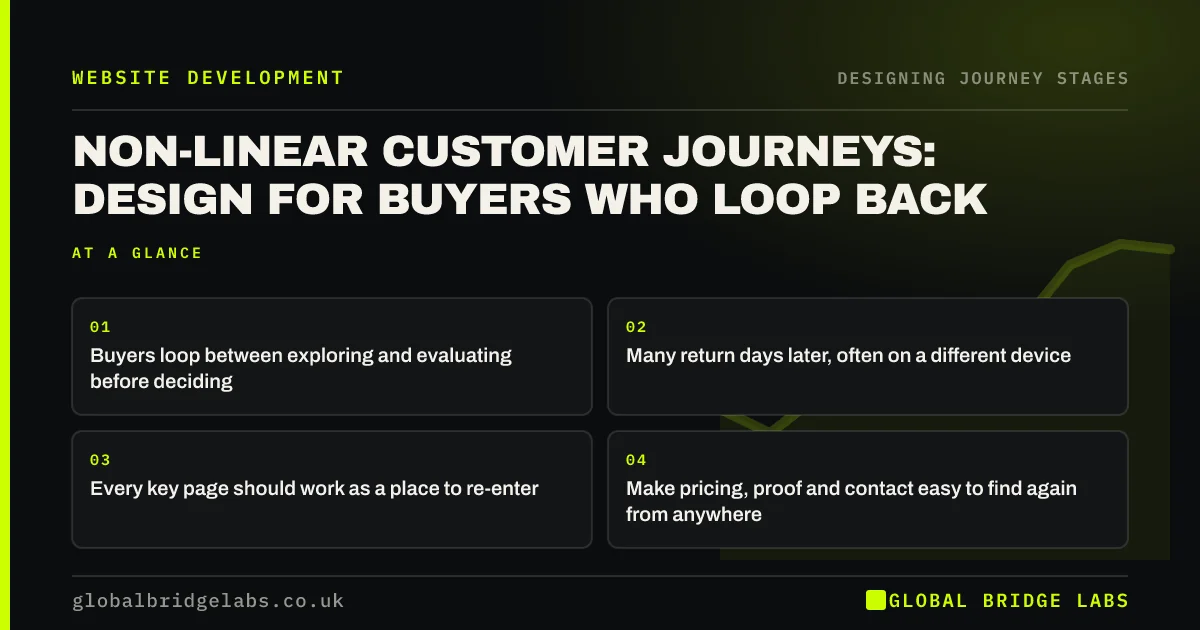
Real customer journeys are rarely straight lines. Buyers research, compare, leave, return on another device, check reviews and come back to your pricing a week later. Google's research called this the messy middle. Design for it by making every page a sensible place to re-enter, keeping key answers easy to find again, and giving buyers ways to save or share what they found.
- Buyers loop between exploring and evaluating before deciding.
- Many return days later, often on a different device.
- Every key page should work as a place to re-enter.
- Make pricing, proof and contact easy to find again from anywhere.
Want to see how your buyers loop through your site? Ask us on WhatsApp.
Chat on WhatsApp →What is a non-linear customer journey?
A non-linear customer journey is one where buyers move back and forth between stages rather than progressing neatly from awareness to purchase. They research, compare, return to research when something new comes up, pause, and re-enter through a different channel. Google's 2020 research, Decoding Decisions, described buyers looping between exploration and evaluation in what it called the messy middle.
How do non-linear journeys show up on your website?
Non-linear journeys show up as returning visitors, repeat visits to pricing and case study pages, sessions that start on inner pages from branded search, and enquiries that arrive after several visits. GA4 path explorations often show visitors bouncing between a service page, pricing and reviews before leaving, then returning later.
How do you design for buyers who loop back?
Design for looping buyers by making the answers they come back for easy to reach from anywhere. Keep pricing, proof, process and contact in consistent places, linked from every service page. Use clear page titles so they can find the page again in search or their browser history. Let them save or share: a quote summary by email, a printable page or a WhatsApp share.
- Consistent navigation to pricing, proof and contact.
- Clear page titles and headings that are easy to search for again.
- Ways to save or share: email a summary, share by WhatsApp.
- Content that does not depend on having read a previous page.
- Phone and contact visible on every key page.
What about buyers who switch devices?
Many buyers research on a phone and enquire on a laptop, or the reverse. Keep the content the same across devices, so a page found on a phone can be found again on a desktop. Avoid content hidden on mobile. Let buyers send themselves a link or summary. Analytics usually cannot link the two visits unless the buyer signs in, so expect some enquiries to look like they came from nowhere.
How do you measure a non-linear journey?
Measure it with measures that allow for loops. In GA4, look at returning users, days to conversion where available, and the pages viewed before key events over several sessions. Ask buyers how many times they visited and what they compared. Avoid judging pages on single-session conversion rates alone, because a page that brings buyers back may never be the last one before the form.
- Time to enquiry: how long buyers take to get in touch
- Customer journey analytics for small businesses
Want your reports set up to show multi-visit journeys? Message us on WhatsApp.
Chat on WhatsApp →When can you treat the journey as linear?
You can treat it as linear for short, urgent journeys, such as emergency call-outs, where buyers go from search to call in one session. You can also treat specific tasks, like a checkout or booking flow, as linear, because they are. The non-linear view matters most for considered purchases.
What does this look like in practice?
A pattern we see in path reports for considered purchases: buyers move from a service page to case studies, back to the service page, to pricing, and out. A week later they return through branded search, go straight to pricing, then to the contact page. Without pricing linked from the service page, the first loop would have been harder and some would not have returned.
Making those answers reachable from every service page supports the loop rather than fighting it. Across our client work we have seen a 2.4x enquiry rate from conversion changes of this kind. Global Bridge Labs (GBL) designs for the second visit as well as the first.
Non-linear journey checklist
- Check returning users and multi-visit paths in GA4.
- Link pricing, proof and contact from every service page.
- Use clear, searchable page titles.
- Add a way to save or share key pages.
- Keep content the same on mobile and desktop.
- Judge pages over several sessions, not one.
Next step
If your buyers take several visits to decide, your site needs to support the loop. We will map how they move through it and where returning is harder than it should be.
Message us on WhatsApp to map your non-linear customer journey, or book a 30-minute consultation.
Chat on WhatsApp →Sources and further reading
- Path exploration · Google Analytics Help
- User journeys vs. user flows · Nielsen Norman Group
- Mobile-first indexing best practices · Google Search Central
Frequently asked questions
Is the customer journey linear?
Usually not. Buyers loop between researching and comparing, pause, switch devices and return through different channels before deciding. Google's research called this the messy middle. Short urgent purchases and specific tasks such as checkouts are the main exceptions.
What is the messy middle?
The messy middle is Google's 2020 description of the space between a buyer's trigger and their purchase, where they loop between exploring options and evaluating them. Websites help by making key answers easy to find again and by supporting buyers who return several times.
How do I design a website for a non-linear journey?
Make every key page a sensible place to re-enter, keep pricing, proof and contact linked from service pages, use clear searchable titles, let buyers save or share pages, keep content consistent across devices and judge pages over several sessions rather than one.
Written by

Global Bridge Labs (GBL) is a UK–Sri Lanka partner for social media, websites and BPO. Everything here comes from client delivery, not theory.