On this page
- 01Key takeaways
- 02What is the consideration stage?
- 03What do buyers need to compare suppliers?
- 04Where should compare-stage content go?
- 05Should you compare yourself with competitors?
- 06How do you know the compare stage is weak?
- 07When should you hold back compare-stage detail?
- 08What does this look like in practice?
- 09Consideration stage checklist
- 10Next step
- 11Sources and further reading
- 12Frequently asked questions
Key takeaways
Consideration stage buyers know what they need and are choosing who to buy from. They want price guidance, proof from similar customers, a clear process, timescales and a reason to pick you. If your site does not answer these, buyers leave to find a competitor that does. For many small businesses this is the weakest stage and the one most worth fixing.
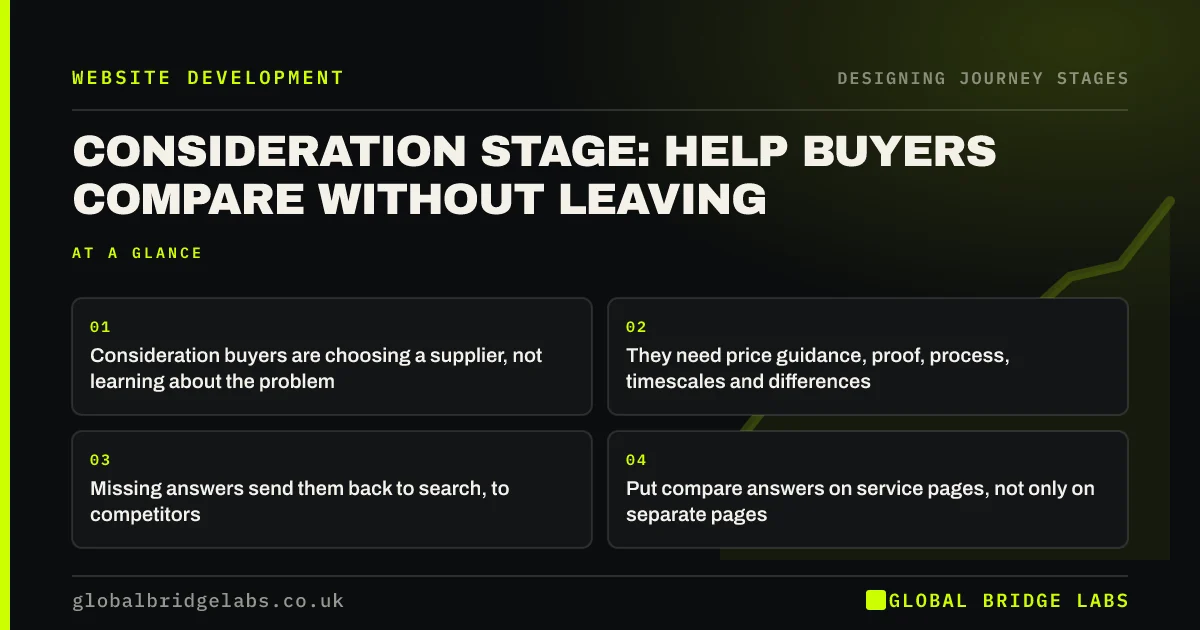
- Consideration buyers are choosing a supplier, not learning about the problem.
- They need price guidance, proof, process, timescales and differences.
- Missing answers send them back to search, to competitors.
- Put compare answers on service pages, not only on separate pages.
Want your service pages checked for the compare stage? Message us on WhatsApp.
Chat on WhatsApp →What is the consideration stage?
The consideration stage is the part of the customer journey where buyers have decided to solve their problem and are comparing options and suppliers. They visit several sites, read reviews, check prices and look for evidence that a business has helped someone like them. The question changes from 'what should I do?' to 'who should I trust to do it?'.
What do buyers need to compare suppliers?
Buyers comparing suppliers need five things: a sense of price, proof from similar customers, a clear process, realistic timescales, and a reason to choose you over the alternatives. Each missing answer is a reason to look elsewhere. Price is usually the biggest gap on small business sites.
- Price guidance: ranges, 'from' prices or typical project costs.
- Proof: reviews, case studies and photos from similar buyers.
- Process: the steps from enquiry to completion.
- Timescales: how soon you can start and how long it takes.
- Difference: what you do that others do not, specifically.
Where should compare-stage content go?
Compare-stage content should sit on the service pages buyers already visit, close to the decision. Price guidance, a short process, two relevant case studies and key reviews belong on each main service page. Separate pricing, comparison and case study pages are useful for depth, but buyers should not have to find them to make a choice.
Should you compare yourself with competitors?
You should help buyers compare, carefully. Naming competitors can work in some markets, but it is risky for small businesses and must be accurate. A safer approach is to compare options rather than firms: in-house versus outsourced, repair versus replace, standard versus premium. It shows you understand the choice and positions your offer honestly.
How do you know the compare stage is weak?
The compare stage is weak when visitors spend time on service pages and then leave without enquiring, when buyers phone mainly to ask prices and timescales, and when sales calls start with questions the site could answer. In GA4, check service pages with long engagement and low onward clicks; in recordings, watch for scrolling up and down looking for something.
- Session recordings: watch real journeys without guesswork
- Answer buyer objections on your website before they ask
Want to know if buyers leave your service pages to check competitors? Send us the URL on WhatsApp.
Chat on WhatsApp →When should you hold back compare-stage detail?
Hold back detail when it would mislead, for example exact prices for work that depends on a survey. In that case, give honest ranges, explain what changes the price and what a survey costs. Regulated sectors may also have rules on how prices and claims are shown; check them before publishing comparisons.
What does this look like in practice?
A pattern we see with considered purchases: service pages describe the work well but give no prices, examples or timescales. Buyers request quotes from four firms, and the business spends hours quoting jobs it never wins, while buyers who wanted a rough idea first leave silently.
Adding typical cost ranges, three local examples and a timeline usually brings fewer, better quote requests. Across our client work we have seen a 2.4x enquiry rate from conversion changes of this kind. Global Bridge Labs (GBL) treats the compare stage as the first place to look.
Consideration stage checklist
- Add price guidance to every main service page.
- Show two pieces of proof from similar buyers.
- Add a four- to six-step process.
- State realistic start and completion times.
- Say specifically what makes you different.
- Link to deeper pricing and comparison pages.
Next step
The compare stage is where many enquiries are quietly lost. We will check your main service pages against the five things buyers compare and show what is missing.
Message us on WhatsApp for a compare-stage review, or book a 30-minute consultation.
Chat on WhatsApp →Sources and further reading
- How long do users stay on web pages? · Nielsen Norman Group
- Unfair commercial practices guidance (CMA207) · Competition and Markets Authority
- Writing to GOV.UK standards: writing guidelines · GOV.UK
Frequently asked questions
What is consideration stage content?
Content for buyers who know what they need and are choosing a supplier. It includes price guidance, proof from similar customers, a clear process, timescales and a specific reason to choose you. It works best on service pages, with deeper pricing and comparison pages behind it.
How do I stop buyers leaving my site to compare competitors?
Answer the questions they would otherwise ask competitors: rough price, proof, process, timescales and difference. Put those answers on the service pages buyers already visit. Buyers still compare, but they do it with your answers in mind, and fewer leave to find basics elsewhere.
Should I put prices on my website?
For most small businesses, some price guidance helps the compare stage, even as ranges or 'from' prices with an explanation of what changes the cost. Exact prices are not always possible. Our separate guide on showing prices covers the trade-offs in detail.
Written by

Global Bridge Labs (GBL) is a UK–Sri Lanka partner for social media, websites and BPO. Everything here comes from client delivery, not theory.