On this page
- 01Key takeaways
- 02What is the decision stage?
- 03What makes buyers hesitate at the last step?
- 04What should a decision stage page include?
- 05Why does 'what happens next' matter so much?
- 06Which contact options should you offer?
- 07When does pushing for the decision backfire?
- 08What does this look like in practice?
- 09Decision stage checklist
- 10Next step
- 11Sources and further reading
- 12Frequently asked questions
Key takeaways
Decision stage buyers have all but chosen you and are deciding whether to act now. What stops them is uncertainty about what happens next, doubts about risk, effort in the form, or a missing practical detail. Remove those last reasons to wait: say what happens after they get in touch, show guarantees and terms, keep the form short and offer the contact method they prefer.
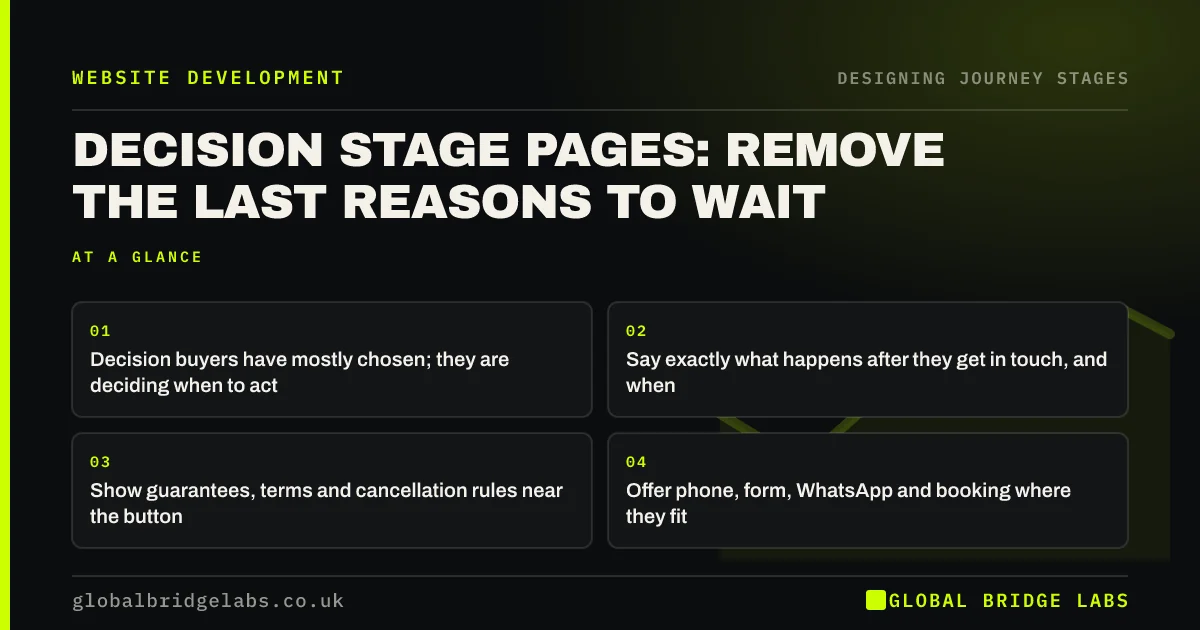
- Decision buyers have mostly chosen; they are deciding when to act.
- Say exactly what happens after they get in touch, and when.
- Show guarantees, terms and cancellation rules near the button.
- Offer phone, form, WhatsApp and booking where they fit.
Want your decision pages checked for reasons to wait? Message us on WhatsApp.
Chat on WhatsApp →What is the decision stage?
The decision stage is the point in the customer journey where a buyer has narrowed their options, often to you, and is deciding whether and when to commit. The questions shift from 'are they right for me?' to 'what happens if I go ahead?' and 'what if it goes wrong?'. The website's job is to make acting now feel safe and easy.
What makes buyers hesitate at the last step?
Buyers hesitate at the last step for four main reasons: they do not know what happens next, they fear committing to something they cannot undo, the form or booking asks too much, or a practical detail is missing, such as availability or payment terms. Each is fixable on the page.
- Uncertainty: 'Will they call me? When? Will I be pressured?'.
- Risk: 'What if I am not happy? Can I cancel?'.
- Effort: long forms, compulsory fields, account creation.
- Missing detail: availability, payment terms, what to prepare.
What should a decision stage page include?
A decision stage page, usually the service page's final section, the contact page or the booking page, should include a clear next step, a 'what happens next' sequence with timings, any guarantee or cancellation terms, the contact options buyers prefer and a short, relevant piece of proof near the button.
- One primary action, clearly labelled with the outcome.
- A 'what happens next' list: reply time, call, visit, quote.
- Guarantees, cancellation and payment terms in plain English.
- Phone, form, WhatsApp and booking options where they fit.
- A short review from a similar buyer near the button.
Why does 'what happens next' matter so much?
'What happens next' matters because the unknown is a common reason to delay. A buyer who reads 'We will call within two working hours to arrange a free survey, usually within three days, and you will receive a fixed quote within 48 hours of the visit' can picture the process. One who sees only 'Submit' is left to imagine it, and many decide to wait.
Which contact options should you offer?
Offer the contact options your buyers use, which usually means more than one. Urgent buyers want a phone number; busy professionals want a form or booking link; many UK buyers like WhatsApp for quick questions. Show the options together, with hours and expected response time, so buyers choose the one that suits their moment.
Unsure which contact options your buyers want? Ask us on WhatsApp.
Chat on WhatsApp →When does pushing for the decision backfire?
Pushing backfires when it relies on pressure: fake countdown timers, false scarcity or pre-ticked options. These can breach UK consumer protection law, which prohibits misleading practices, and they damage trust with buyers who notice. Make acting easy and safe; do not make waiting feel dangerous when it is not.
What does this look like in practice?
A pattern we see on contact pages: a long form, no phone number and no word on what happens next. Recordings show visitors scrolling to the form, pausing, and leaving. Buyers who had all but chosen the firm decide to 'think about it'.
Cutting the form to four fields, adding the phone number and a three-step 'what happens next' block removes the reasons to wait. Across our client work we have seen a 2.4x enquiry rate from conversion changes of this kind. Global Bridge Labs (GBL) writes the 'what happens next' block before the form.
Decision stage checklist
- One clear primary action per page.
- A 'what happens next' sequence with timings.
- Guarantees and terms near the button.
- Phone, form, WhatsApp or booking as buyers prefer.
- Short form: ask only what you need to reply.
- No pressure tactics or misleading urgency.
Next step
Buyers who reach your contact page have done most of the work. We will find the last reasons they wait and show how to remove them.
Message us on WhatsApp for a decision-stage review, or book a 30-minute consultation.
Chat on WhatsApp →Sources and further reading
- Unfair commercial practices guidance (CMA207) · Competition and Markets Authority
- Consumer Contracts (Information, Cancellation and Additional Charges) Regulations 2013 · legislation.gov.uk
- Structuring forms · GOV.UK Service Manual
Frequently asked questions
What is decision stage content?
Content for buyers who have mostly chosen you and are deciding whether to act now. It explains what happens after they get in touch, sets out guarantees and terms, offers the contact methods they prefer and keeps forms short, so committing feels safe and easy.
Why do visitors reach the contact page and not enquire?
Usually because of uncertainty about what happens next, worry about commitment, too much effort in the form, or a missing practical detail. Adding a 'what happens next' sequence, clear terms, a shorter form and alternative contact options addresses most of these.
Are countdown timers a good idea on a website?
Only when the deadline is real. Fake urgency and false scarcity can breach UK consumer protection law on misleading practices and damage trust. Make acting easy and safe instead of making waiting seem risky when it is not.
Written by

Global Bridge Labs (GBL) is a UK–Sri Lanka partner for social media, websites and BPO. Everything here comes from client delivery, not theory.