On this page
- 01Key takeaways
- 02What is the GBL Journey Fit Scorecard?
- 03How do you score each stage?
- 04What does each total score mean?
- 05What evidence should you use when scoring?
- 06When is the scorecard the wrong tool?
- 07What does this look like in practice?
- 08Scorecard checklist
- 09Next step
- 10Sources and further reading
- 11Frequently asked questions
Key takeaways
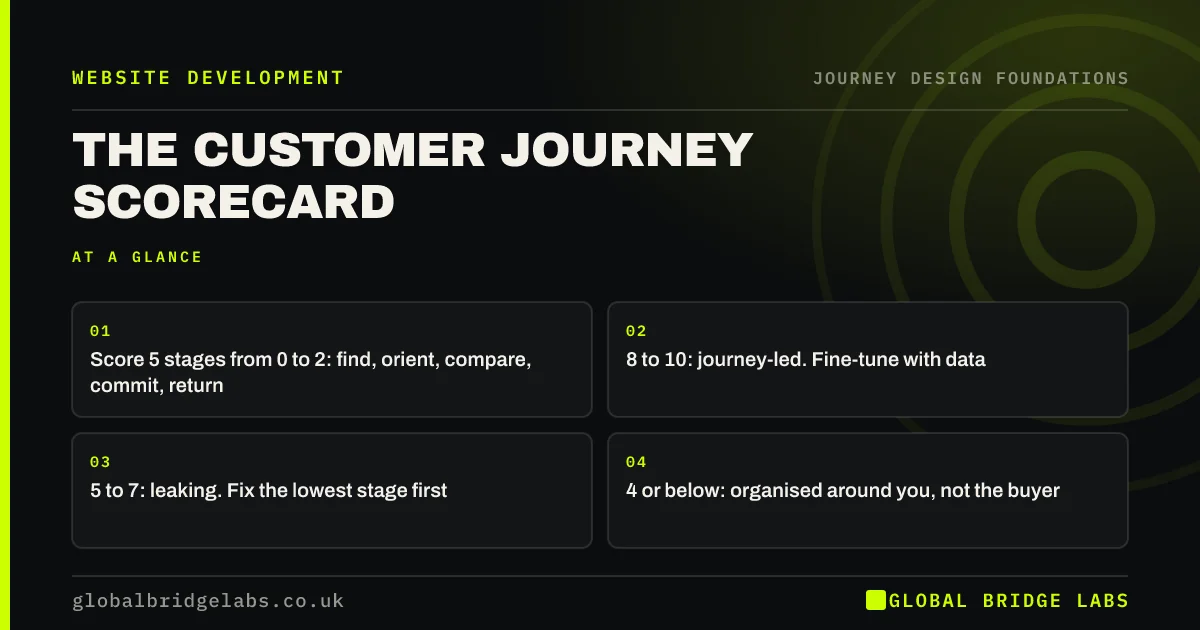
The GBL Journey Fit Scorecard rates your website on five customer journey stages: find, orient, compare, commit and return. Score each from 0 to 2 for a total out of 10. A score of 8 to 10 means the site is journey-led; 5 to 7 means it serves buyers in places but leaks; 4 or below means it is organised around the business, not the buyer.
- Score 5 stages from 0 to 2: find, orient, compare, commit, return.
- 8 to 10: journey-led. Fine-tune with data.
- 5 to 7: leaking. Fix the lowest stage first.
- 4 or below: organised around you, not the buyer. Re-map before redesigning.
Want us to score your site with you? Message us on WhatsApp.
Chat on WhatsApp →What is the GBL Journey Fit Scorecard?
The GBL Journey Fit Scorecard is a one-hour review that Global Bridge Labs (GBL) uses to rate how well a website serves its customer journey. It scores five stages, find, orient, compare, commit and return, from 0 (missing) to 2 (strong), giving a mark out of 10. It is designed for owners and managers, not specialists, and needs only a phone, GA4 and your inbox.
How do you score each stage?
Score each stage by checking three or four specific things on your own site, on a phone, as a buyer would. Give 0 if the stage is missing, 1 if it is present but patchy, and 2 if it is consistently strong across your main pages. Be strict: a strong homepage does not earn a 2 if service pages fail.
- Find (0 to 2): a page for each main service and area; Google Business Profile complete; landing pages match search terms.
- Orient (0 to 2): top ten landing pages say what, who for, where and next step in two phone screens.
- Compare (0 to 2): price guidance, proof from similar buyers, process and timescales on each main service.
- Commit (0 to 2): one clear next step per page, short form, tappable phone, what happens next.
- Return (0 to 2): useful confirmation page, prompt first reply, aftercare, re-order and review routes.
What does each total score mean?
A total of 8 to 10 means the site is journey-led: buyers can enter anywhere and find their way, and further gains come from testing and data. A total of 5 to 7 means the site serves buyers in places but leaks at one or two stages; fix the lowest stage first. A total of 4 or below means the site is organised around the business, so map the journey before changing pages.
These cut-offs are GBL's working rules, not an industry standard. They are designed to point to the next action, not to grade the site for its own sake.
What evidence should you use when scoring?
Use three kinds of evidence: what you see on a phone, what GA4 shows, and what customers ask. In GA4, check the landing pages report and a path exploration from your top entry pages. In your inbox, count the questions the website should have answered. Ten minutes of each is enough for a first score.
- Phone: open each top landing page cold, as a buyer from search.
- GA4: landing pages, path exploration, form start and submit events.
- Inbox: the five most repeated questions in the last month.
- Team: ask whoever answers the phone what buyers misunderstand.
When is the scorecard the wrong tool?
The scorecard is the wrong tool for diagnosing technical problems such as speed, broken forms or tracking errors; those need their own checks. It also gives a rough answer for very large sites, where stages differ by product line. Score one product line or buyer type at a time in that case. And a high score does not replace sales follow-up: a journey-led site still loses buyers whose enquiries go unanswered.
What does this look like in practice?
A common first score for a small business site is find 2, orient 1, compare 0, commit 2, return 0: a total of 5. The site ranks, the form works, but service pages give no price guidance or proof, and the confirmation page says only 'Thanks'.
That pattern points to two jobs worth more than a redesign: a compare layer on the main service pages, and a confirmation page that says who will call and when. Across our client work we have seen a 2.4x enquiry rate from conversion changes of this kind. Global Bridge Labs (GBL) re-scores after each change.
Scorecard checklist
- Book one hour and use a phone, not a desktop.
- Pick your top ten landing pages from GA4.
- Score find, orient, compare, commit and return from 0 to 2.
- Write one sentence of evidence for each score.
- Total out of 10 and note the lowest stage.
- Fix the lowest stage, then re-score in a month.
Next step
Scoring your own site is useful; scoring it with someone who has not seen it before is more honest. We will run the scorecard with you and agree the first fix.
Message us on WhatsApp to run the Journey Fit Scorecard on your site, or book a 30-minute consultation.
Chat on WhatsApp →Sources and further reading
- Journey mapping 101 · Nielsen Norman Group
- Path exploration · Google Analytics Help
- How long do users stay on web pages? · Nielsen Norman Group
Frequently asked questions
How do I audit my website's customer journey?
Score five stages, find, orient, compare, commit and return, from 0 to 2 using your phone, GA4 and your inbox. Check landing pages as a buyer would, look at the paths visitors take and count questions the site should have answered. Fix the lowest-scoring stage first.
What is a good customer journey score?
On the GBL Journey Fit Scorecard, 8 to 10 out of 10 means the site is journey-led, 5 to 7 means it leaks at one or two stages, and 4 or below means it is organised around the business rather than buyers. These are working cut-offs designed to point to the next action.
How often should I score my website?
Score it before any redesign, after each significant change, and at least once a quarter. A quarterly score takes about an hour and catches drift, such as new pages without next steps or service pages that lost their price guidance.
Written by

Global Bridge Labs (GBL) is a UK–Sri Lanka partner for social media, websites and BPO. Everything here comes from client delivery, not theory.