On this page
- 01Key takeaways
- 02Who should attend a customer journey workshop?
- 03What should you bring?
- 04What is a good half-day agenda?
- 05How do you keep the workshop on evidence?
- 06What should come out of the workshop?
- 07When is a workshop the wrong format?
- 08What does this look like in practice?
- 09Workshop checklist
- 10Next step
- 11Sources and further reading
- 12Frequently asked questions
Key takeaways
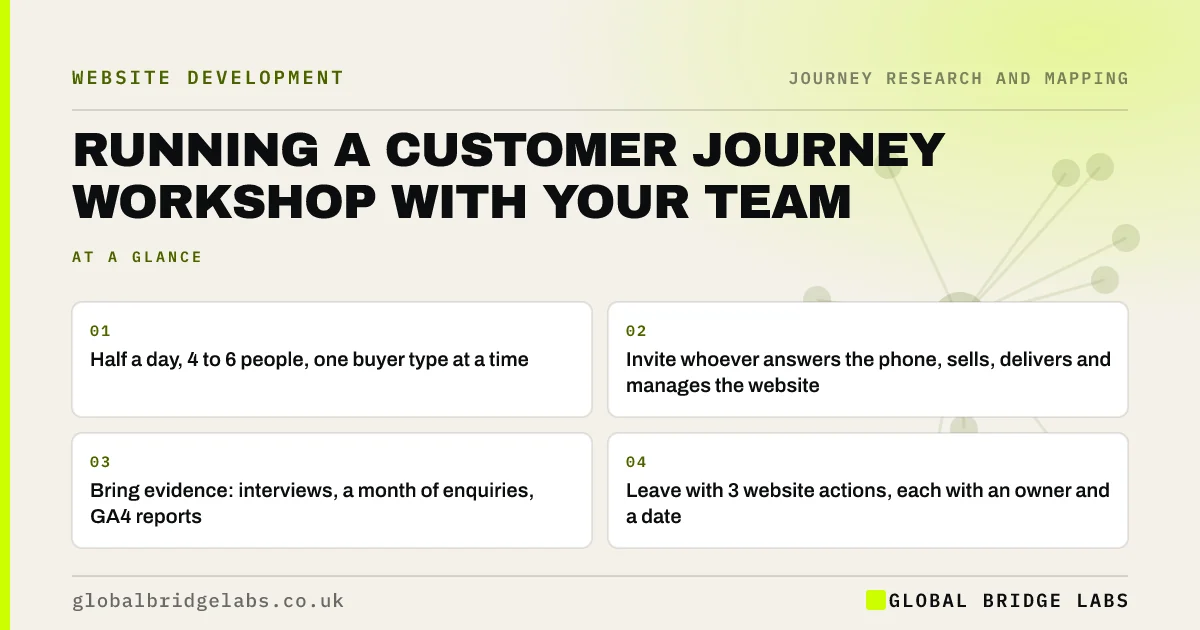
A customer journey workshop brings the people who talk to customers into one room to build a journey map from evidence. For a small business, half a day with four to six people is enough. Bring interview notes, enquiries and GA4 reports, map one buyer type at a time, and leave with three website actions, each with an owner and a date.
- Half a day, 4 to 6 people, one buyer type at a time.
- Invite whoever answers the phone, sells, delivers and manages the website.
- Bring evidence: interviews, a month of enquiries, GA4 reports.
- Leave with 3 website actions, each with an owner and a date.
Want someone to run your journey workshop? Message us on WhatsApp.
Chat on WhatsApp →Who should attend a customer journey workshop?
Invite the people who see different parts of the journey: whoever answers the phone and inbox, whoever quotes and sells, whoever delivers the work, whoever manages the website and marketing, and the owner. Four to six people is ideal. Front-line staff often know more about buyers' questions than managers do.
What should you bring?
Bring evidence, not opinions. That means notes from five customer interviews per buyer type, a month of enquiries and call notes, the top questions from your tally, and GA4 reports on landing pages, exit pages and enquiry sources. Print or display them so the group can point at real examples.
- Customer interview notes with exact quotes.
- A month of enquiries, emails and WhatsApp threads.
- The question tally by journey stage.
- GA4 landing pages, exit pages and a path exploration.
- A blank journey map template on a wall or screen.
What is a good half-day agenda?
A good half-day agenda moves from evidence to map to actions, and protects the last hour for decisions. Workshops that run out of time before the actions are the most common failure.
- 15 minutes: purpose, buyer type and the evidence on the wall.
- 45 minutes: stages and actions, filled from the evidence.
- 45 minutes: questions and feelings, using interview quotes.
- 30 minutes: mark breaks and where the website could help.
- 15 minutes: break.
- 30 minutes: rank breaks by buyers affected and cost.
- 30 minutes: agree 3 actions with owners and dates.
How do you keep the workshop on evidence?
Keep the workshop on evidence by asking 'how do we know?' for every claim and marking guesses as guesses. The facilitator's job is to stop the loudest opinion winning. Quotes from customers settle most arguments; where there is no evidence, the action is to find some, not to decide by vote.
What should come out of the workshop?
The workshop should produce a one-page journey map for the buyer type and a short list of actions. Website actions might be adding price guidance to a service page, shortening a form or rewriting the confirmation page. Operational actions might be a same-day reply rule. Each action needs an owner and a date, or it will not happen.
Have workshop actions that need turning into website changes? Send them to us on WhatsApp.
Chat on WhatsApp →When is a workshop the wrong format?
A workshop is the wrong format when there is no evidence to work from, when the team is one or two people, or when a senior voice will override what customers said. In those cases, do the interviews first, or have one person draft the map from evidence and the team review it.
What does this look like in practice?
A pattern we see in journey workshops: the person who answers the phone says, almost in passing, that half the calls start with 'I could not find on your website whether...'. That one remark, backed by the call tally, often becomes the top website action of the day.
Including front-line staff is what surfaces it. Across our client work we have seen a 2.4x enquiry rate from conversion changes of this kind. Global Bridge Labs (GBL) facilitates workshops so the actions come from evidence rather than rank.
Workshop checklist
- Invite 4 to 6 people, including front-line staff.
- Gather interviews, enquiries and GA4 reports beforehand.
- Map one buyer type per half day.
- Ask 'how do we know?' for every claim.
- Protect the last hour for actions.
- Leave with 3 actions, each with an owner and a date.
Next step
An outside facilitator keeps a journey workshop on evidence and on time. We can run yours and turn the actions into a website plan.
Message us on WhatsApp to book a customer journey workshop, or book a 30-minute consultation.
Chat on WhatsApp →Sources and further reading
- Journey mapping 101 · Nielsen Norman Group
- User research · GOV.UK Service Manual
- Path exploration · Google Analytics Help
Frequently asked questions
How long should a customer journey workshop be?
For a small business, half a day per buyer type is enough if the research is done beforehand. Longer workshops tend to drift into opinion. Protect the final hour for ranking problems and agreeing actions with owners and dates.
Who should be in a customer journey mapping workshop?
The people who see different parts of the journey: whoever answers the phone and inbox, whoever sells and quotes, whoever delivers, whoever manages the website, and the owner. Four to six people is ideal. Front-line staff are often the most valuable voices.
What is the output of a journey mapping workshop?
A one-page journey map for the buyer type and a short list of actions, typically three, each with an owner and a date. Actions split into website changes, such as new answers or shorter forms, and operational changes, such as faster replies.
Written by

Global Bridge Labs (GBL) is a UK–Sri Lanka partner for social media, websites and BPO. Everything here comes from client delivery, not theory.