On this page
- 01Key takeaways
- 02What are customer touchpoints?
- 03What are examples of touchpoints for a small business?
- 04Where does the website fit among the touchpoints?
- 05How do you map your touchpoints?
- 06Which touchpoints matter most?
- 07When is touchpoint mapping overkill?
- 08What does this look like in practice?
- 09Touchpoint checklist
- 10Next step
- 11Sources and further reading
- 12Frequently asked questions
Key takeaways
Customer touchpoints are the individual moments when a buyer meets your business, from a search result or review to a quote email or invoice. Your website is several touchpoints, not one. List every touchpoint before, during and after the sale, check that each one says the same thing, and make sure the website hands buyers cleanly to the next touchpoint.
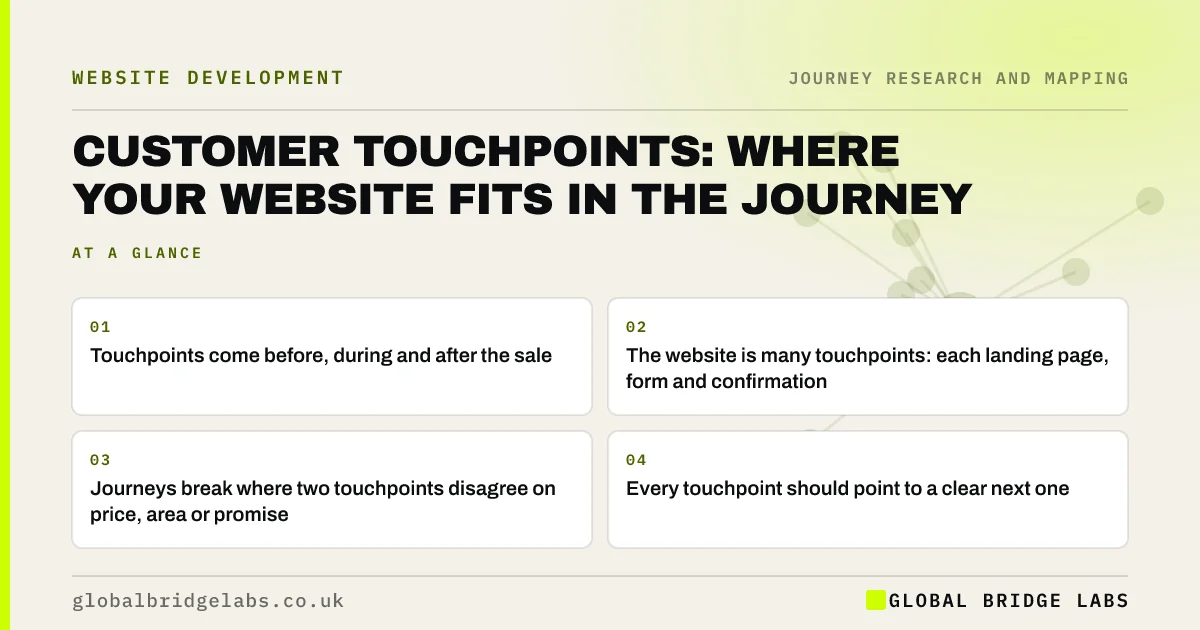
- Touchpoints come before, during and after the sale.
- The website is many touchpoints: each landing page, form and confirmation.
- Journeys break where two touchpoints disagree on price, area or promise.
- Every touchpoint should point to a clear next one.
Want your touchpoints listed and checked for gaps? Message us on WhatsApp.
Chat on WhatsApp →What are customer touchpoints?
Customer touchpoints are any point of contact between a buyer and your business, whether you control it or not. They include search results, reviews, social posts, adverts, your website pages, phone calls, emails, quotes, visits, invoices and follow-ups. The customer journey is the route a buyer takes through them.
What are examples of touchpoints for a small business?
For a typical UK small business, touchpoints fall into three groups. Before contact, buyers see your search listing, Google Business Profile, reviews, social posts, vans or signs, and referrals. During the sale, they meet your website, forms, phone, quotes and proposals. After the sale, they receive confirmations, invoices, aftercare, review requests and offers.
- Before: search result, Google Business Profile, reviews, social posts, referral, signage.
- Website: landing pages, service pages, pricing, proof, forms, chat.
- During: phone call, email reply, quote, site visit, proposal.
- After: confirmation, invoice, support, review request, re-order reminder.
Where does the website fit among the touchpoints?
The website sits in the middle of most journeys. Buyers usually reach it from an earlier touchpoint, such as a search, a review or a recommendation, and leave it for a later one, such as a phone call or a form reply. Its job is to confirm what the earlier touchpoint promised and set up the next one clearly. A page that contradicts a review or advert breaks trust.
How do you map your touchpoints?
Map touchpoints by listing every way a buyer meets you, in journey order, and noting for each what it says, who owns it and where it points next. Then look for contradictions, such as a price on an advert that differs from the website, and dead ends, such as a social profile with no link to the relevant page.
- List touchpoints in journey order, by buyer type.
- Note what each promises: price, area, response time, guarantees.
- Note who owns it: you, a staff member, an agency, a platform.
- Note where it points next.
- Flag contradictions and dead ends.
Which touchpoints matter most?
The touchpoints that matter most are the ones where buyers make a decision or wait. For most small businesses those are the first page they land on, the moment they compare prices or proof, and the first reply after they enquire. Improve those before polishing touchpoints buyers barely notice.
When is touchpoint mapping overkill?
Touchpoint mapping is overkill if it turns into an exhaustive inventory with no decisions attached. A sole trader with a website, a phone and a Google profile can list touchpoints in ten minutes. Keep the list to what buyers really use, and spend the time on the contradictions and gaps.
What does this look like in practice?
A pattern we see in touchpoint reviews: the Google Business Profile says 'open 24 hours', the website says 'Monday to Friday, 8 to 6', and the voicemail says nothing. Buyers who call on Saturday hear no answer and move on, and the website gets blamed for low enquiries.
Aligning hours, areas and response promises across touchpoints costs nothing and removes a quiet source of lost buyers. Across our client work we have seen a 2.4x enquiry rate from conversion changes of this kind. Global Bridge Labs (GBL) checks every touchpoint that sends buyers to the site.
Touchpoint checklist
- List every touchpoint before, during and after the sale.
- Check hours, areas and prices match everywhere.
- Check each touchpoint links to the right next step.
- Check the website confirms what adverts and reviews promise.
- Check the first reply after an enquiry.
- Fix contradictions before adding new touchpoints.
Next step
Contradictions between touchpoints are easy to miss from the inside. We will walk the journey as a buyer and list every mismatch we find.
Message us on WhatsApp for a touchpoint check, or book a 30-minute consultation.
Chat on WhatsApp →Sources and further reading
- Journey mapping 101 · Nielsen Norman Group
- Service blueprints: definition · Nielsen Norman Group
- Google Business Profile Help · Google
Frequently asked questions
What are examples of customer touchpoints?
Search results, Google Business Profile, online reviews, social posts, adverts, signage, referrals, website pages, forms, phone calls, email replies, quotes, site visits, invoices, aftercare messages and review requests. Any moment a buyer meets your business is a touchpoint.
Is a website a touchpoint?
Yes, and it is really several touchpoints: each landing page, service page, form and confirmation page is a separate moment of contact. Buyers usually arrive from an earlier touchpoint and leave for a later one, so the website must confirm what came before and set up what comes next.
What is the difference between a touchpoint and a channel?
A channel is a route, such as search, social media, email or phone. A touchpoint is a specific moment on a channel, such as a particular search result, a post, a quote email or a call. One channel can hold many touchpoints.
Written by

Global Bridge Labs (GBL) is a UK–Sri Lanka partner for social media, websites and BPO. Everything here comes from client delivery, not theory.