On this page
- 01Key takeaways
- 02What should a customer journey map template contain?
- 03Which stages should the columns use?
- 04What goes in each row?
- 05What does a filled-in template look like?
- 06How do you turn the template into a website brief?
- 07When does a template get in the way?
- 08What does this look like in practice?
- 09Template checklist
- 10Next step
- 11Sources and further reading
- 12Frequently asked questions
Key takeaways
A customer journey map template for website planning is a one-page table: stages across the top, and rows for actions, questions, feelings, touchpoints, breaks and website opportunities. Fill one per main buyer type, using evidence from interviews, emails and analytics. The last row, website opportunities, is the one that turns the map into a brief.
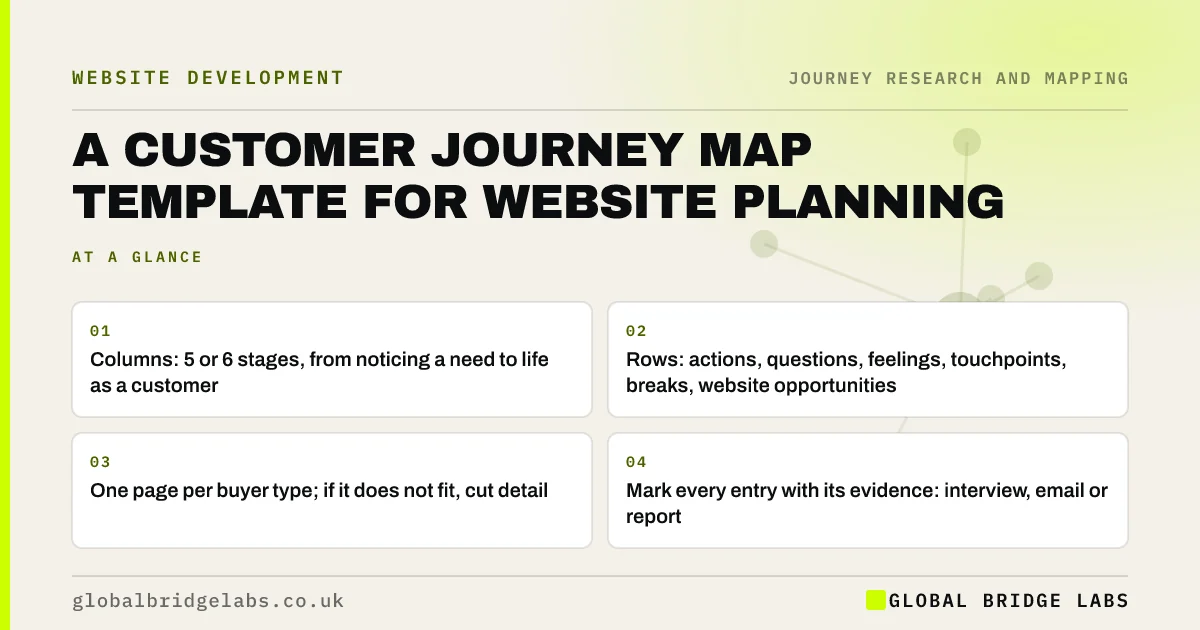
- Columns: 5 or 6 stages, from noticing a need to life as a customer.
- Rows: actions, questions, feelings, touchpoints, breaks, website opportunities.
- One page per buyer type; if it does not fit, cut detail.
- Mark every entry with its evidence: interview, email or report.
Want the template sent to you? Ask for the journey map template on WhatsApp.
Chat on WhatsApp →What should a customer journey map template contain?
A customer journey map template should contain a header naming the buyer type and their goal, stage columns, and six rows: what the buyer does, what they ask, how they feel, which touchpoints they use, where the journey breaks, and what the website could do about it. Nielsen Norman Group's core components, actor, scenario, phases, actions, mindsets, emotions and opportunities, map directly onto this layout.
Which stages should the columns use?
Use stages that match your buyers' real steps, in their language. A practical default is: need appears, search and find, check and orient, compare, enquire or buy, first contact, delivery, after the sale. Merge or split them to fit. An emergency call-out may compress to three columns; a B2B contract may need eight.
What goes in each row?
Each row answers one question about the stage. Keep entries short, in the buyer's words where you can quote them, and evidence-based. If a cell is a guess, mark it as one and test it later.
- Actions: what the buyer physically does, such as 'searches on phone', 'asks a neighbour'.
- Questions: what they need to know, such as 'do they cover my area?', 'roughly how much?'.
- Feelings: their mood, such as 'anxious', 'impatient', 'unsure who to trust'.
- Touchpoints: where they meet you, such as Google result, review, service page, phone.
- Breaks: where they stall or leave, with the evidence.
- Website opportunities: the page, answer or route that would fix the break.
What does a filled-in template look like?
Here is an illustrative row set for a homeowner choosing a kitchen fitter at the compare stage. Actions: looks at three firms' websites over a week, mostly on a phone. Questions: what does a kitchen like mine cost, how long will I be without a kitchen, have they done one near me? Feelings: excited but wary of being overcharged. Touchpoints: service page, gallery, reviews. Breaks: no price guidance, so they request three quotes and choose on price. Website opportunity: a price guide by kitchen size, a timeline and local project photos.
How do you turn the template into a website brief?
Copy every entry in the website opportunities row into a list, group them by page, and rank them by how many buyers the break affects. That list is the content and structure section of your website brief. Entries that are not website changes, such as faster quotes, go on a separate operational list with an owner.
Want your filled-in template turned into a page-by-page plan? Send it to us on WhatsApp.
Chat on WhatsApp →When does a template get in the way?
A template gets in the way when filling every cell becomes the goal. Empty cells are fine if a stage has nothing notable. It also gets in the way when it is filled from opinion in a meeting rather than from evidence. Use it to organise research, not to replace it.
What does this look like in practice?
A pattern we see when teams first use the template: the feelings row is left blank because it feels soft. Yet that row often explains the breaks. Buyers who feel anxious want reassurance and a human; buyers who feel impatient want a price and a button. The same page cannot serve both without knowing which mood dominates.
Filling that row from interview quotes changes the tone and order of the page. Across our client work we have seen a 2.4x enquiry rate from conversion changes of this kind. Global Bridge Labs (GBL) fills the feelings row from customers' own words.
Template checklist
- Name the buyer type and their goal in the header.
- Choose 5 or 6 stages in the buyer's words.
- Fill actions, questions, feelings, touchpoints, breaks, opportunities.
- Mark each entry's evidence source.
- Rank breaks by buyers affected.
- Move website opportunities into the brief.
Next step
A blank template is easy to find; a filled one built on evidence is what changes a website. We can send the template and review your first draft with you.
Message us on WhatsApp for the journey map template and a review of your draft, or book a 30-minute consultation.
Chat on WhatsApp →Sources and further reading
- Journey mapping 101 · Nielsen Norman Group
- User journeys vs. user flows · Nielsen Norman Group
- User research · GOV.UK Service Manual
Frequently asked questions
What should be included in a customer journey map?
The buyer type and goal, five or six stages, and for each stage: actions, questions, feelings, touchpoints, breaks and opportunities. For website planning, the opportunities row should name specific pages, answers or routes that would remove each break.
Is there a simple customer journey map template?
Yes: a one-page table with stages as columns and six rows for actions, questions, feelings, touchpoints, breaks and website opportunities. A spreadsheet or a sheet of A3 paper works as well as specialist software for a small business.
How many customer journey maps do I need?
One per main buyer type, which for most small businesses means two to four. Buyers with different goals or very different journeys, such as emergency and planned work, need separate maps. Minor variations can be notes on an existing map.
Written by

Global Bridge Labs (GBL) is a UK–Sri Lanka partner for social media, websites and BPO. Everything here comes from client delivery, not theory.