On this page
- 01Key takeaways
- 02Why do customer journey maps fail?
- 03Mistake 1: mapping opinions instead of evidence
- 04Mistake 2: one map for every customer
- 05Mistake 3: stopping at the website
- 06Mistake 4: too much detail
- 07Mistake 5: no actions, owners or dates
- 08Mistake 6: mapping once and never again
- 09What does this look like in practice?
- 10Mapping mistakes checklist
- 11Next step
- 12Sources and further reading
- 13Frequently asked questions
Key takeaways
Most customer journey maps fail for the same few reasons: they are built from opinions instead of evidence, they try to cover everyone, they stop at the website's edge, and they never turn into changes. Avoid them by interviewing customers first, mapping two to four buyer types, including the steps after the enquiry, and ending every map with three actions that have owners and dates.
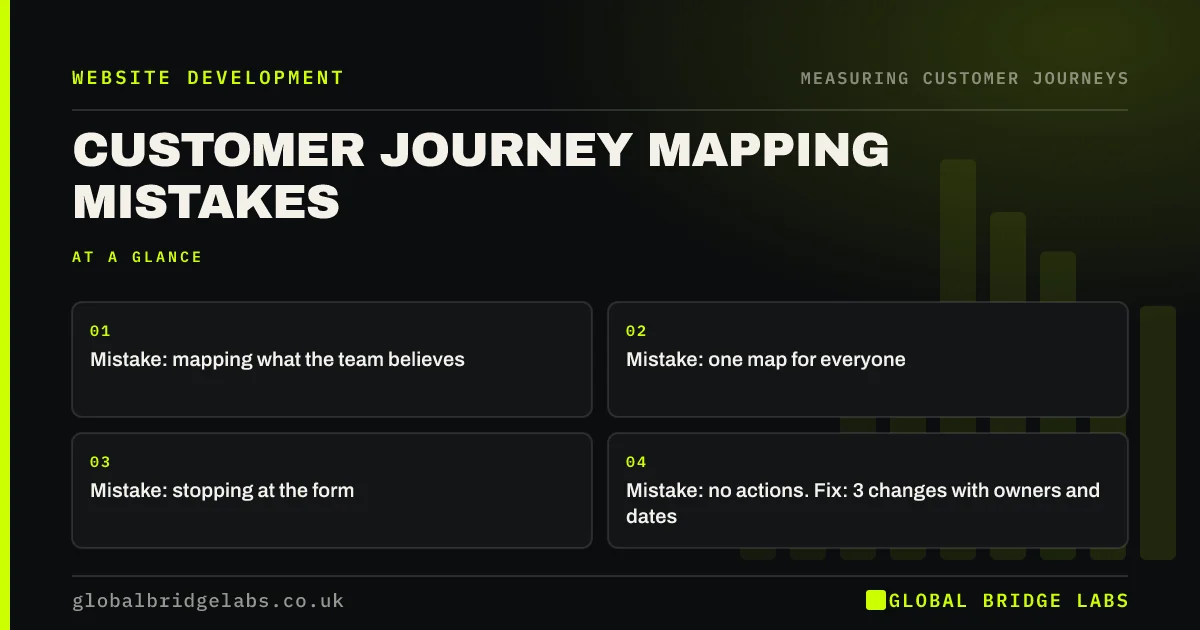
- Mistake: mapping what the team believes. Fix: interview 5 customers per type.
- Mistake: one map for everyone. Fix: 2 to 4 maps by buyer type.
- Mistake: stopping at the form. Fix: map reply, quote and aftercare too.
- Mistake: no actions. Fix: 3 changes with owners and dates.
Have a journey map that never changed anything? Send it to us on WhatsApp.
Chat on WhatsApp →Why do customer journey maps fail?
Customer journey maps fail when they become documents rather than tools. A map built in a meeting reflects the team's beliefs, a map covering everyone is too general to act on, and a map with no actions changes nothing. The fixes are simple: evidence, focus and a clear list of changes.
Mistake 1: mapping opinions instead of evidence
The most common mistake is building the map from what the team thinks customers do. Teams know their business well but see it from the inside. Base every step on evidence: interview five recent customers per buyer type, read a month of enquiries and check analytics. Mark guesses as guesses and test them.
Mistake 2: one map for every customer
A single map for all customers blends different journeys into one that matches nobody. An emergency call-out and a planned installation, or a sole trader and a limited company, ask different questions at different speeds. Map two to four buyer types separately; fewer than that usually blurs, more usually goes unused.
Mistake 3: stopping at the website
Many maps end at the form submission. Yet the steps after it, the reply, call, quote and first appointment, decide many sales. A map that stops at the form misses the most common break in small business journeys: slow or vague follow-up. Map through to the first job and aftercare.
Mistake 4: too much detail
Maps with dozens of columns and every possible channel look thorough and are hard to use. If a map does not fit on one page per buyer type, cut detail until it does. The point is to see the biggest breaks clearly, not to document everything.
Mistake 5: no actions, owners or dates
A map with no actions is a cost with no return. End every mapping session with three changes, each with an owner and a date: for example, add price guidance to the busiest service page, shorten the form to four fields, and introduce a same-day reply rule. Then check the effect in your metrics.
Want help turning your map into three changes? Message us on WhatsApp.
Chat on WhatsApp →Mistake 6: mapping once and never again
Journeys change: new services, new competitors, new channels such as AI search. A map made three years ago may describe buyers who no longer exist. Review the map every six to twelve months, or whenever the business changes, using fresh interviews and data.
What does this look like in practice?
A pattern we see in inherited journey maps: a large poster with five stages, six personas and no evidence sources, made in a workshop and never referred to again. The website has not changed since.
Rebuilding it from five interviews per buyer type, keeping two maps, and ending with three actions gives the team something to do on Monday. Across our client work we have seen a 2.4x enquiry rate from conversion changes of this kind. Global Bridge Labs (GBL) judges a map by the changes it causes.
Mapping mistakes checklist
- Base every step on interviews, emails or analytics.
- Map 2 to 4 buyer types separately.
- Include steps after the enquiry.
- Keep each map to one page.
- End with 3 actions, owners and dates.
- Review every 6 to 12 months.
Next step
If your journey map has not changed your website, it probably fell into one of these traps. We will review it and turn it into actions.
Message us on WhatsApp for a journey map review, or book a 30-minute consultation.
Chat on WhatsApp →Sources and further reading
- Journey mapping 101 · Nielsen Norman Group
- Personas make users memorable for product team members · Nielsen Norman Group
- User research · GOV.UK Service Manual
Frequently asked questions
What are common mistakes in customer journey mapping?
Building the map from opinions rather than evidence, using one map for all customers, stopping at the website form, adding too much detail, ending without actions, owners and dates, and never updating it. Each has a simple fix.
Why do customer journey maps not get used?
Usually because they are too general, too detailed or have no actions attached. A useful map covers one buyer type, fits on a page, is based on evidence and ends with three specific changes that someone owns and has a date for.
How often should a customer journey map be updated?
Every six to twelve months, or whenever the business changes significantly, such as new services, new markets or new channels. Use fresh interviews and data rather than editing the old map from memory.
Written by

Global Bridge Labs (GBL) is a UK–Sri Lanka partner for social media, websites and BPO. Everything here comes from client delivery, not theory.