On this page
- 01Key takeaways
- 02Why do businesses outsource in a downturn?
- 03Which work should you outsource in a downturn?
- 04What terms matter most in a downturn?
- 05Should you replace staff with outsourcing in a downturn?
- 06How does outsourcing protect service in a downturn?
- 07When should you not outsource in a downturn?
- 08How do you plan outsourcing for the recovery?
- 09How do you scale an outsourced team down safely?
- 10What does this look like in practice?
- 11Downturn checklist
- 12Next step
- 13Sources and further reading
- 14Frequently asked questions
Key takeaways
Outsourcing in a recession or downturn makes sense when you need to keep customer service and admin running without committing to new fixed salaries. Flexible, short-term arrangements let capacity follow demand. Avoid long minimum terms, keep core knowledge in-house, and do not cut the channels that bring in revenue.
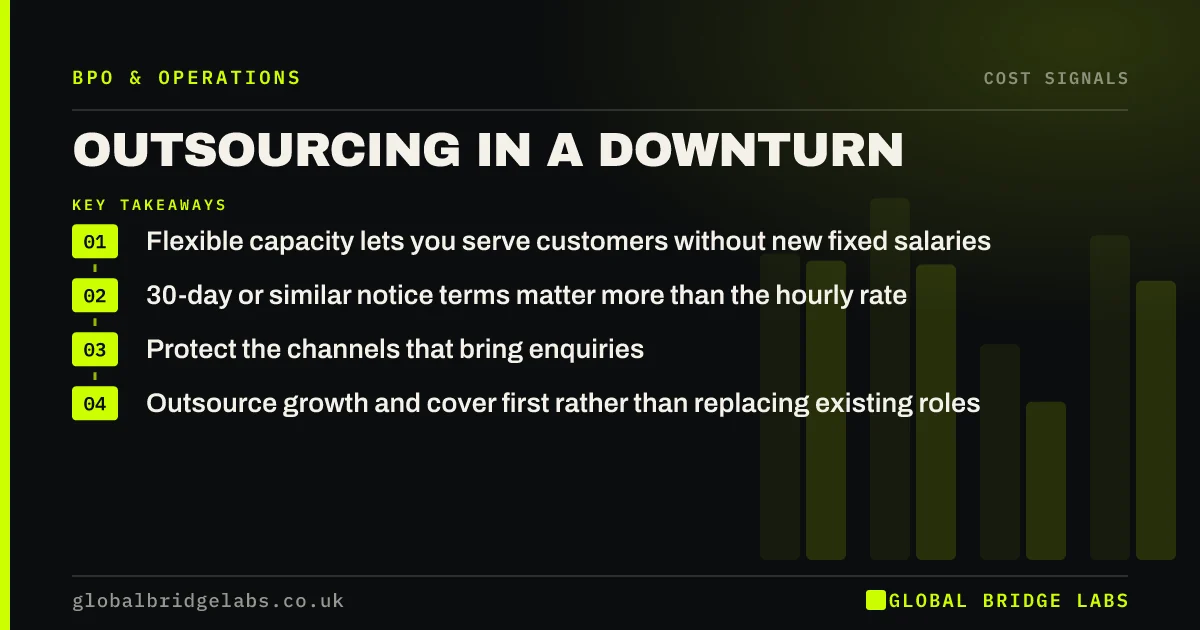
- Flexible capacity lets you serve customers without new fixed salaries.
- 30-day or similar notice terms matter more than the hourly rate.
- Protect the channels that bring enquiries in.
- Outsource growth and cover first rather than replacing existing roles.
Planning for a slower market? Message us on WhatsApp and we will talk through options.
Chat on WhatsApp →Why do businesses outsource in a downturn?
Because a downturn makes fixed costs dangerous and demand hard to predict. Hiring locks in salary for months or years; not hiring risks slow service just when customers are more price-sensitive and more likely to switch. Outsourcing on flexible terms sits between the two: capacity when needed, reduced when not.
Which work should you outsource in a downturn?
Outsource work that protects revenue and cash: enquiry handling, customer service, invoicing and credit control. These keep sales and cash flowing when every customer matters. Leave strategic work, pricing and key relationships in-house.
- Enquiry handling, so no lead goes unanswered.
- Customer service, to protect retention.
- Invoicing and credit control, to protect cash.
- Cover for gaps left by hiring freezes.
What terms matter most in a downturn?
Flexibility matters more than rate. Look for short notice periods, monthly billing, the ability to reduce hours at short notice and no large setup fees. A low rate with a 12-month minimum is a fixed cost in disguise, and exactly what a downturn punishes.
Want your contract terms checked for flexibility? Send them to us on WhatsApp.
Chat on WhatsApp →Should you replace staff with outsourcing in a downturn?
Be careful. Redundancy has legal steps and costs, including statutory redundancy pay for employees with two years' service, and consultation duties. If the work moves to a provider, TUPE may apply. Many SMEs instead use outsourcing to cover leavers who are not replaced, or to handle volume above what the core team covers.
How does outsourcing protect service in a downturn?
Customers become more cautious and more likely to compare, so slow replies cost more. Covering enquiries and service with a flexible team keeps response times steady while the core team focuses on retention and sales. The Institute of Customer Service's UK Customer Satisfaction Index was 78.3 out of 100 in July 2026, and prompt resolution is what separates high scorers.
When should you not outsource in a downturn?
Do not outsource when volume has already fallen enough for the existing team to cope comfortably, or when the provider requires a long commitment. Do not outsource in a panic without documentation or data protection paperwork either. In a sharp drop, the right move may be to pause and use spare in-house capacity to document processes for later.
How do you plan outsourcing for the recovery?
Use the downturn to prepare. Document processes while the team has time, measure baselines and agree scaling terms with a provider. When demand returns, you can add capacity in weeks rather than months, and avoid the rush to hire that follows most recoveries.
How do you scale an outsourced team down safely?
Agree the rules before you need them. The contract should say how much notice is needed to reduce hours, what the minimum block is, and which work is prioritised when hours are reduced. When you scale down, keep the most revenue-critical work covered, such as new enquiries, and reduce lower-priority tasks first.
- Notice period for reducing hours, ideally 30 days or less.
- A minimum monthly block sized to your quietest month.
- A priority list for what stays covered.
- The same team retained, so knowledge is not lost.
What does this look like in practice?
A pattern we see in UK home improvement businesses during slow markets: a hiring freeze leaves the office short when an administrator leaves. A part-time outsourced seat for enquiries and invoicing covers the gap on monthly terms, and scales up when the spring upturn arrives without a new recruitment round.
Downturn checklist
Use this to plan capacity in a slow market.
- Protect enquiry handling and customer service.
- Prioritise invoicing and credit control for cash.
- Choose flexible terms over the lowest rate.
- Cover leavers and peaks before replacing roles.
- Check TUPE and redundancy rules before changing jobs.
- Document processes now for the recovery.
Next step
Tell us how demand has changed and where you are short. We will suggest a flexible option that protects revenue without adding fixed cost.
Message us on WhatsApp about your situation, or book a 30-minute consultation.
Chat on WhatsApp →Sources and further reading
- Redundancy: your rights · GOV.UK
- Business transfers, takeovers and TUPE · GOV.UK
- UK Customer Satisfaction Index · Institute of Customer Service
Frequently asked questions
Is outsourcing a good idea in a recession?
It can be, when it replaces hiring or overtime with flexible capacity on short notice terms and protects revenue-critical work such as enquiries, customer service and credit control. Long minimum terms and outsourcing in a panic without documentation are the common mistakes.
What should small businesses cut in a downturn?
Costs that do not protect revenue or cash: unused software, premises, low-return marketing and fixed capacity for work that swings. Avoid cutting enquiry handling and customer service, because customers compare more in a downturn and slow replies lose sales.
Can I outsource instead of making redundancies?
Possibly, but check the law first. If an employee's work moves to a provider, TUPE may apply. Redundancy also has consultation duties and statutory pay for employees with two years' service. Many businesses use outsourcing to cover leavers rather than replace existing staff.
Written by

Global Bridge Labs (GBL) is a UK–Sri Lanka partner for social media, websites and BPO. Everything here comes from client delivery, not theory.