On this page
- 01Key takeaways
- 02What is checkout abandonment?
- 03Why do shoppers abandon checkout?
- 04Which fixes recover the most sales?
- 05What about abandoned basket emails?
- 06When is abandonment not a problem?
- 07What does this look like in practice?
- 08Checkout abandonment checklist
- 09Next step
- 10Sources and further reading
- 11Frequently asked questions
Key takeaways
Checkout abandonment is when shoppers start checking out and leave before paying. Baymard Institute puts the documented average online cart abandonment rate at about 70%. Some of that is browsing, but a large share is caused by fixable problems: surprise costs, forced accounts, long forms, slow delivery and doubts about payment security.
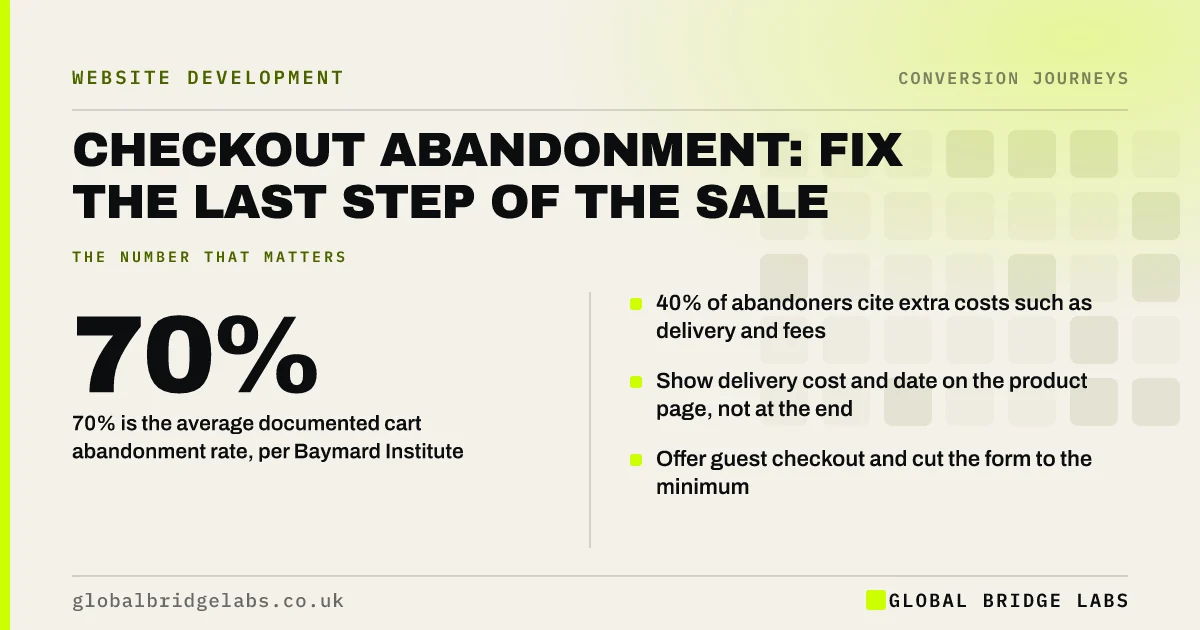
- 70% is the average documented cart abandonment rate, per Baymard Institute.
- 40% of abandoners cite extra costs such as delivery and fees.
- Show delivery cost and date on the product page, not at the end.
- Offer guest checkout and cut the form to the minimum.
Want your checkout tested for leaks? Message us on WhatsApp.
Chat on WhatsApp →What is checkout abandonment?
Checkout abandonment is when a shopper adds items to the basket or begins checkout but leaves without completing the purchase. It is measured as the share of started checkouts, or baskets, that do not become orders. For small e-commerce sites it is often the single most valuable place to improve conversion, because these shoppers have already chosen a product.
Why do shoppers abandon checkout?
Baymard Institute's research on reasons for abandonment, among shoppers who were ready to buy, puts extra costs first by a wide margin.
- Extra costs too high (delivery, tax, fees): about 40%.
- Delivery was too slow: about 20%.
- Did not trust the site with card details: about 19%.
- Checkout was too long or complicated: nearly 1 in 5.
- Had to create an account.
Which fixes recover the most sales?
Fix surprises and effort first. These changes are usually configuration rather than development on platforms such as Shopify and WooCommerce.
- Show delivery costs and dates on product pages and in the basket.
- Offer guest checkout as the default.
- Cut form fields: Baymard found an ideal checkout needs about 12 form elements.
- Offer familiar payment options, such as card, Apple Pay, Google Pay and PayPal.
- Show security and returns information near the payment step.
- Keep the basket saved if the shopper leaves.
Want a checkout fix list for your shop? Ask us on WhatsApp.
Chat on WhatsApp →What about abandoned basket emails?
Abandoned basket emails can recover some sales, but only if you have a lawful basis to send them. Under UK rules, sending marketing emails to individuals generally needs consent or the soft opt-in for existing customers. Check the ICO's guidance on PECR before setting them up, and fix the checkout itself first, because an email cannot remove a surprise cost.
When is abandonment not a problem?
Some abandonment is normal browsing: people use baskets to save items, compare prices or check delivery costs. A 70% average includes all of that. Focus on abandonment at the payment and delivery steps, where shoppers have shown clear intent, and on changes over time rather than the absolute number.
What does this look like in practice?
A UK independent coffee roaster revealed delivery costs only at the final step and required an account. We added a delivery cost line on product pages, a free delivery threshold in the basket, and guest checkout. Completed orders rose in the following month, and the share of shoppers reaching payment and leaving fell.
Checkout abandonment checklist
- Show delivery cost and date before checkout.
- Make guest checkout the default.
- Remove every unnecessary form field.
- Offer familiar payment methods.
- Show security and returns information near payment.
- Track each checkout step to find the biggest drop.
- Check PECR rules before sending basket reminder emails.
Next step
Shoppers who reach checkout have already chosen you. Losing them to a surprise cost or a forced account is the most expensive leak in e-commerce. We can help you find and fix it.
Message us on WhatsApp for a checkout review, or book a 30-minute consultation.
Chat on WhatsApp →Sources and further reading
- Cart abandonment rate statistics · Baymard Institute
- E-commerce checkout usability: research and benchmark · Baymard Institute
- Electronic and telephone marketing under PECR · Information Commissioner's Office
- Google Merchant Center Help · Google
Frequently asked questions
What is a normal cart abandonment rate?
Baymard Institute puts the documented average at about 70%. That includes shoppers who were only browsing or comparing, so focus on abandonment at the delivery and payment steps and on your own trend over time. Rising abandonment is the warning sign.
Why do customers abandon their basket?
The top reason, cited by about 40% of shoppers in Baymard's research, is extra costs such as delivery and fees. Slow delivery, doubts about payment security, long or complicated checkouts and forced account creation follow. Showing costs early fixes the biggest one.
How do I reduce checkout abandonment?
Show delivery costs and dates early, offer guest checkout, cut form fields, offer familiar payment methods, show security and returns information near payment, and track each checkout step so you can fix the biggest drop first. Most are settings, not development.
Can I send abandoned basket emails in the UK?
Only with a lawful basis. For individuals, electronic marketing generally needs consent, or the soft opt-in for existing customers buying similar products. Check the ICO's PECR guidance before setting up automated reminders. Fix the checkout itself first, because an email cannot remove a surprise delivery cost or a forced account.
Written by

Global Bridge Labs (GBL) is a UK–Sri Lanka partner for social media, websites and BPO. Everything here comes from client delivery, not theory.