On this page
- 01Key takeaways
- 02What is visitor intent?
- 03Why does intent mismatch lose buyers?
- 04Which page and next step suit each intent?
- 05How do you map traffic to intent?
- 06When is one page right for several intents?
- 07What does this look like in practice?
- 08Intent mapping checklist
- 09Next step
- 10Sources and further reading
- 11Frequently asked questions
Key takeaways
Visitor intent is the reason someone arrives on a page: to learn, to compare, or to buy. A page converts when it matches that reason and offers the next step that fits it. Many good websites lose buyers by sending every visitor, whatever their intent, to the same page with the same 'contact us' button.
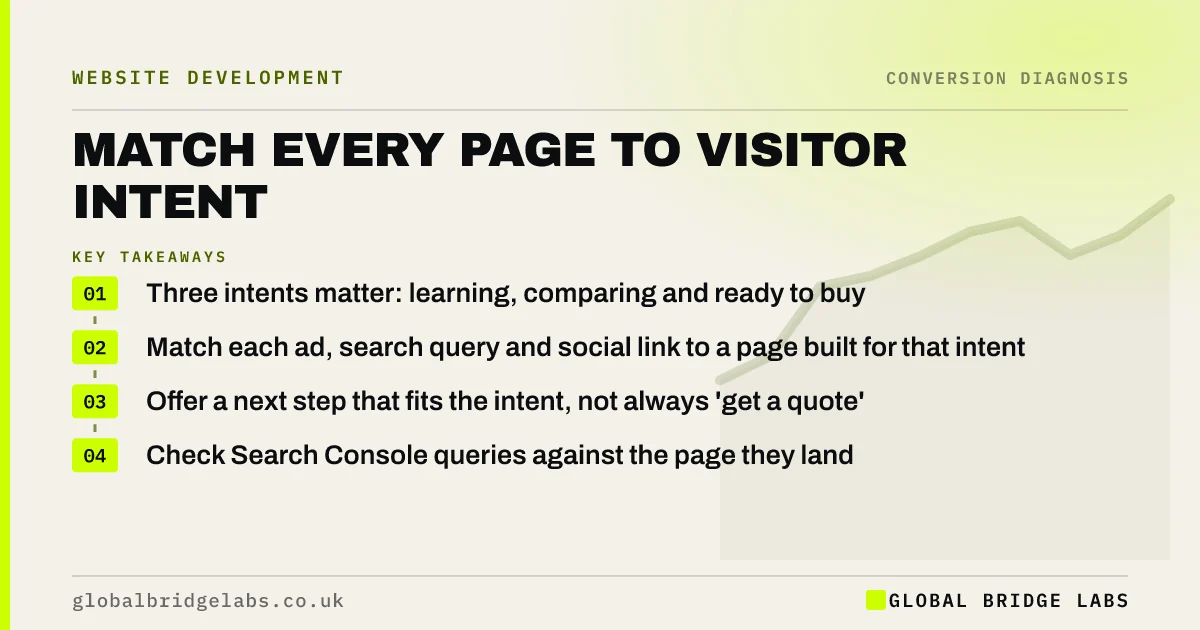
- Three intents matter: learning, comparing and ready to buy.
- Match each ad, search query and social link to a page built for that intent.
- Offer a next step that fits the intent, not always 'get a quote'.
- Check Search Console queries against the page they land on.
Want your top traffic sources mapped to the right pages? Message us on WhatsApp.
Chat on WhatsApp →What is visitor intent?
Visitor intent is the goal a visitor has when they arrive on a page, usually signalled by the search they typed, the ad they clicked or the post they followed. For small businesses, three intents cover most visits: learning about a problem, comparing options or providers, and being ready to buy or book.
Why does intent mismatch lose buyers?
A mismatch forces the visitor to do work. Someone searching 'emergency boiler repair Leeds' who lands on a homepage about the company's history has to hunt for the answer, and most will not. Someone reading about 'how much does a loft conversion cost' who is pushed straight to a quote form is not ready and leaves.
Google's own guidance on helpful content stresses satisfying the searcher's purpose. The same principle decides conversion.
Which page and next step suit each intent?
Each intent needs a different page and a different next step. The mapping below works for most UK service businesses.
- Learning ('how much does X cost', 'do I need X'): a guide page; next step is a checklist, calculator or related service page.
- Comparing ('X vs Y', 'best X near me', 'reviews'): a comparison, proof or pricing page; next step is a consultation or quote.
- Ready to buy ('X near me', 'book X', brand searches): a service or booking page; next step is call, book or quote now.
How do you map traffic to intent?
Export your top queries from Google Search Console and your top landing pages from GA4. Label each query as learning, comparing or ready to buy, then check whether the page it lands on matches. Do the same for each ad group and each social post link. Mismatches are your fix list.
- Queries with 'cost', 'how', 'what': usually learning.
- Queries with 'vs', 'best', 'reviews', 'compare': usually comparing.
- Queries with 'near me', a town name, 'book', 'emergency': usually ready.
Send us your top 20 search queries on WhatsApp and we will label them for you.
Chat on WhatsApp →When is one page right for several intents?
A well-built service page can serve comparing and ready-to-buy visitors together, as long as it gives a fast action at the top for the ready buyer and depth below for the comparer. Learning intent usually needs its own page. Stretching a service page to answer every beginner question makes it worse for the buyer.
What does this look like in practice?
A UK solar installer sent all Google Ads traffic, from 'solar panel cost' to 'solar installer near me', to one page with a quote form. The cost searchers rarely enquired. We split the traffic: cost searches went to a pricing guide with a savings calculator, and local searches went to a service page with a short survey form. Both pages outperformed the single page they replaced.
Intent mapping checklist
- Export top queries and landing pages for the last three months.
- Label each query as learning, comparing or ready to buy.
- Check the landing page matches the intent.
- Give each intent a fitting next step.
- Point each ad group and social link to the matching page.
- Re-check the mapping every quarter.
Next step
Matching pages to intent is one of the cheapest conversion fixes because it often means re-pointing traffic rather than rebuilding pages. We can map yours with you in a single session.
Message us on WhatsApp for an intent map of your traffic, or book a 30-minute consultation.
Chat on WhatsApp →Sources and further reading
- Creating helpful, reliable, people-first content · Google Search Central
- Google Search Console · Google
- URL builders: collect campaign data with custom URLs · Google Analytics Help
Frequently asked questions
What is search intent on a website?
Search intent is the goal behind a search: to learn, to compare, to buy or to find a specific site. Pages rank and convert best when they satisfy that goal directly and offer a next step that fits the visitor's stage.
Why is my landing page not converting ad traffic?
Often because the page does not match what the ad promised or what the searcher wanted. Send each ad group to a page that answers its exact query, repeats the ad's offer in the headline and offers a next step suited to the intent.
Should blog posts have a quote form?
Usually not as the main action. Blog readers tend to be learning, so a checklist, calculator or link to the relevant service page works better. Keep a quiet link to contact for the few who are ready. Measure blog posts by the visits they send on to service pages.
How do I find the intent of my website visitors?
Look at the search queries in Google Search Console, the ads and posts that sent them, and the pages they land on. Words like 'how' and 'cost' suggest learning, 'vs' and 'best' suggest comparing, and 'near me' or 'book' suggest readiness.
Written by

Global Bridge Labs (GBL) is a UK–Sri Lanka partner for social media, websites and BPO. Everything here comes from client delivery, not theory.