On this page
- 01Key takeaways
- 02Why put speed in the contract?
- 03Which targets should you specify?
- 04How should the test conditions be written?
- 05What is fair to hold a supplier to?
- 06What should happen if the site fails?
- 07What does this look like in practice?
- 08Speed contract checklist
- 09Next step
- 10Sources and further reading
- 11Frequently asked questions
Key takeaways
If speed is not written into a website contract, it is not part of what you are buying. 'The site will be fast' cannot be tested, and a target score can be met on one page on one day. Useful speed requirements name the pages, the device, the measures and the pass marks, say how and when they will be checked, and state what happens if the site fails.
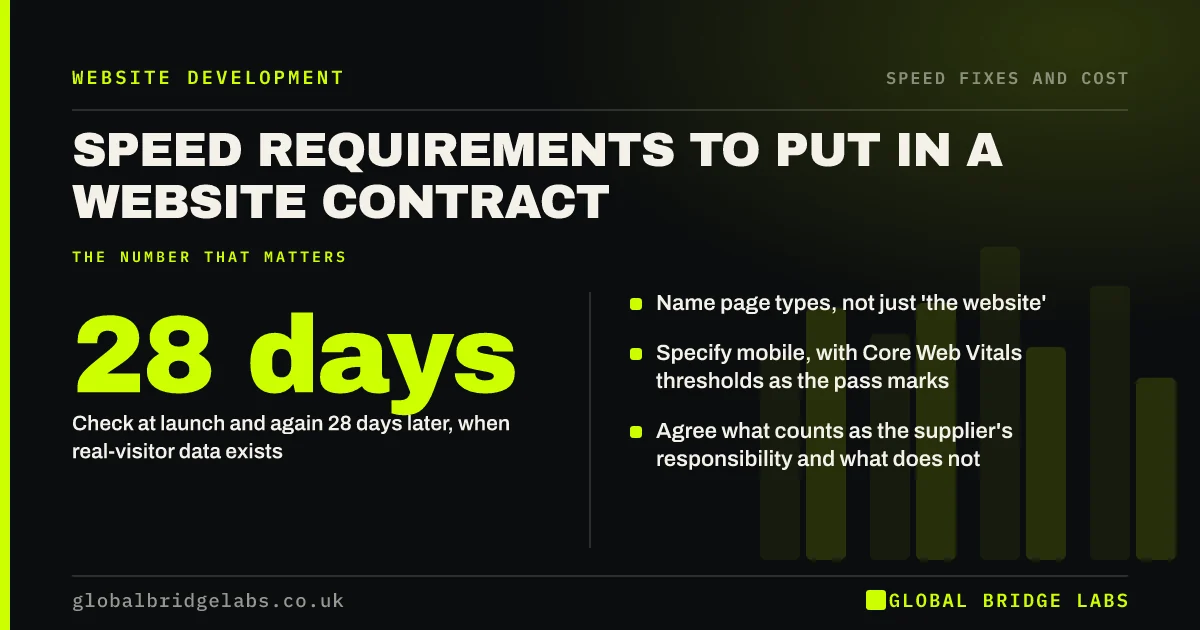
- Name page types, not just 'the website'.
- Specify mobile, with Core Web Vitals thresholds as the pass marks.
- Check at launch and again 28 days later, when real-visitor data exists.
- Agree what counts as the supplier's responsibility and what does not.
About to sign a web design contract? Send us the speed clause on WhatsApp for a second look.
Chat on WhatsApp →Why put speed in the contract?
Because design is approved on a large screen and speed is discovered later, on a phone, after the invoice is paid. Without a written requirement, a slow site is a disappointment, not a defect, and fixing it is extra work at extra cost.
A clear requirement also helps the supplier. It gives them grounds to refuse the video header or the sixth tracking tag that would break it.
Which targets should you specify?
Specify outcomes a third party could verify, using Google's published thresholds so nobody has to argue about the numbers.
- Largest Contentful Paint: 2.5 seconds or less on mobile.
- Interaction to Next Paint: 200 milliseconds or less.
- Cumulative Layout Shift: below 0.1.
- Server response: time to first byte within about 0.8 seconds.
- Forms: visible confirmation within one second of submission.
- Optional: first-load weight limit for key templates.
How should the test conditions be written?
State the conditions precisely, because the same page gives different results under different tests.
- 1. Pages: list each template, such as home, service, product, article, contact.
- 2. Device: mobile setting, with desktop as a secondary check.
- 3. Tool: name it, for example PageSpeed Insights.
- 4. Method: the median of three or five runs for lab results.
- 5. Timing: at launch for lab results, and after 28 days for field data.
- 6. Content: tested with real images and copy, not placeholders.
- Why do website speed tests give different results?
- Lab data vs field data: which speed numbers to believe
Want a speed clause drafted in plain English for your brief? Ask us on WhatsApp.
Chat on WhatsApp →What is fair to hold a supplier to?
Hold a supplier to what they control: the theme or code, the templates, image handling, caching and the hosting they recommend. It is not fair to hold them to things you add or insist on.
- Supplier: templates, scripts they add, image sizing, caching, fonts.
- You: tracking tags, chat tools and widgets you request.
- You: images uploaded after launch at the wrong size.
- Shared: third-party tools both sides agreed to, recorded with their cost in speed.
- Either: hosting, depending on who chose it.
What should happen if the site fails?
Say in advance. A reasonable clause gives the supplier a period to fix failures at their own cost where the cause is within their scope, and links final payment or sign-off to passing. It should also cover the months after launch: a short warranty during which speed regressions caused by the build are corrected.
Avoid demanding the impossible. A requirement for a lab score of 100, or for targets that ignore tools you have insisted on, invites either refusal or gaming.
What does this look like in practice?
A pattern we see in disputes after launch: the brief said the site should be 'fast and modern'. The new site is slower than the old one on mobile. The supplier points to a desktop score. The client has nothing in writing to say that is not the test.
A single paragraph naming the templates, the mobile setting and the three thresholds would have settled it before work began. Global Bridge Labs (GBL) writes speed acceptance criteria into its own proposals for that reason.
Speed contract checklist
- List the page templates covered.
- State mobile thresholds for LCP, INP and CLS.
- Name the tool, method and number of runs.
- Set checks at launch and at 28 days.
- Record who is responsible for which scripts.
- Link sign-off to passing, with a fix period.
Next step
A paragraph in the contract is cheaper than an argument after launch. If you are briefing a new site, we can help you write requirements a supplier can price and you can test.
Message us on WhatsApp for help with speed requirements in your brief, or book a 30-minute consultation.
Chat on WhatsApp →Sources and further reading
- Understanding Core Web Vitals and Google search results · Google Search Central
- About PageSpeed Insights · Google for Developers
- Performance budgets 101 · web.dev (Google)
- Time to First Byte (TTFB) · web.dev (Google)
Frequently asked questions
What website speed requirements should be in a contract?
Name the page templates, specify mobile, and set pass marks using Core Web Vitals: Largest Contentful Paint within 2.5 seconds, Interaction to Next Paint within 200 milliseconds and Cumulative Layout Shift below 0.1. State the tool, the method and when the checks happen.
Should I ask for a specific PageSpeed score in a contract?
It is better to ask for Core Web Vitals thresholds on mobile. A single lab score varies between runs and can be met on one page without improving real experience. If you include a score, specify the page types, the mobile setting and a median of several runs.
Who is responsible if a new website is slow?
The supplier, for what they built and chose: templates, code, image handling and caching. You are responsible for tools you asked to be added and content uploaded afterwards. Agree this in writing, along with who chose the hosting.
When should website speed be tested for sign-off?
Twice. At launch, using lab tests on the named templates with real content. Then 28 days later, when real-visitor field data is available. Link final acceptance to both, with a period for the supplier to fix failures in scope.
Written by

Global Bridge Labs (GBL) is a UK–Sri Lanka partner for social media, websites and BPO. Everything here comes from client delivery, not theory.