On this page
- 01Key takeaways
- 02What does productivity mean for an outsourced team?
- 03How do you compare productivity fairly?
- 04How does productivity change the cost?
- 05Why are early productivity numbers misleading?
- 06What lowers outsourced productivity?
- 07Should you pay per task to protect productivity?
- 08Which productivity measures suit which work?
- 09What does this look like in practice?
- 10Productivity checklist
- 11Next step
- 12Sources and further reading
- 13Frequently asked questions
Key takeaways
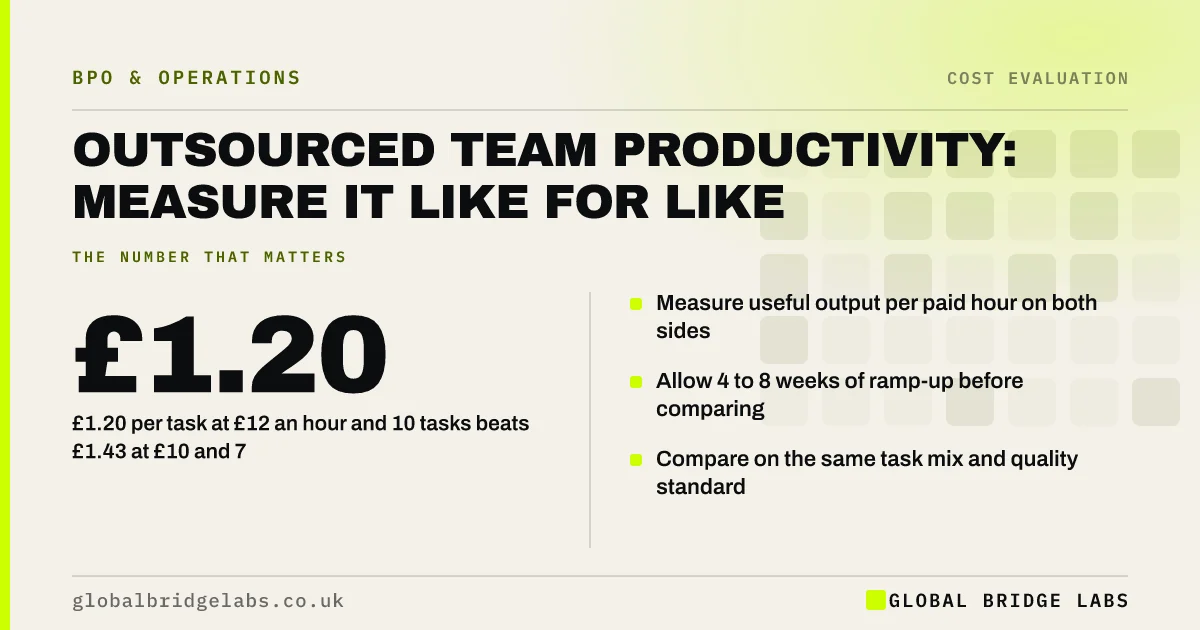
Outsourced team productivity vs in-house should be measured as useful output per paid hour, on the same tasks and definitions. Productivity changes the real cost: a team at £12 per hour doing 10 tasks costs £1.20 per task, while one at £10 doing 7 costs £1.43. Allow for ramp-up before comparing.
- Measure useful output per paid hour on both sides.
- £1.20 per task at £12 an hour and 10 tasks beats £1.43 at £10 and 7.
- Allow 4 to 8 weeks of ramp-up before comparing.
- Compare on the same task mix and quality standard.
Want productivity measures set up for your team? Message us on WhatsApp.
Chat on WhatsApp →What does productivity mean for an outsourced team?
Productivity is useful output per paid hour: tasks completed to standard, tickets resolved or records processed. For an outsourced team, it is measured against the hours you pay for. It matters because the hourly rate alone says nothing about how much work you get for it.
How do you compare productivity fairly?
Compare the same tasks, with the same definition of done and the same quality standard. Exclude tasks that only one side handles. Measure over several weeks, not days, and compare a settled outsourced team with the in-house team, not a first-week team with a five-year veteran.
- Same task types and mix.
- Same definition of a completed task.
- Same quality standard and checks.
- Several weeks of data on both sides.
How does productivity change the cost?
Divide the hourly cost by tasks per hour. A provider at £12 an hour completing 10 tasks costs £1.20 per task; one at £10 completing 7 costs £1.43. In-house, a £30,000 employee at £28.30 per productive hour completing 10 tasks costs £2.83 per task. Productivity can matter more than rate.
Want cost per task compared across options? Send us your task data on WhatsApp.
Chat on WhatsApp →Why are early productivity numbers misleading?
Every new team, in-house or outsourced, is slower while it learns systems, products and exceptions. Productivity typically climbs over the first four to eight weeks for documented work. Agree a ramp-up curve in advance so early numbers are judged against it, not against a settled team.
What lowers outsourced productivity?
Slow system access, missing documentation, questions waiting a day for answers, and work that arrives in bursts with no queue. Most of these sit on the client side. Fast access, a written process and a daily question slot usually lift productivity more than anything the provider does.
Should you pay per task to protect productivity?
Per-task pricing moves productivity risk to the provider, which suits stable, well-defined work such as data entry or invoice processing. For varied work such as customer support, hourly pricing with productivity targets is usually fairer. Pick the model that matches how predictable the work is.
Which productivity measures suit which work?
Pick one main output measure per type of work, and keep it the same in-house and outsourced. A clear measure turns debates about whether a team is working hard into a simple comparison.
- Customer support: contacts resolved per hour.
- Data entry: records completed to standard per hour.
- Accounts payable: invoices processed per hour.
- Booking: appointments booked per hour of cover.
What does this look like in practice?
A pattern we see in UK professional services firms: the managed team's output looks low in week two, because each case waits for a partner's answer. Moving to a daily question slot and a decision guide doubles the team's throughput within a month, at the same hourly rate.
Productivity checklist
Use these steps.
- Define a completed task for each task type.
- Measure in-house output per paid hour first.
- Agree a ramp-up curve with the provider.
- Remove access and question delays.
- Compare cost per task each month.
Next step
Send us the tasks you want to measure. We will set up like-for-like productivity measures in a 30-minute call.
Message us on WhatsApp for a productivity comparison, or book a 30-minute consultation.
Chat on WhatsApp →Sources and further reading
- The Sourcing and Consultancy Playbooks · Cabinet Office
- Rates and thresholds for employers 2026 to 2027 · HM Revenue & Customs
Frequently asked questions
How do you measure outsourced team productivity?
Measure useful output per paid hour, such as tasks completed to standard, tickets resolved or records processed, using the same definitions and quality standard as your in-house team. Measure over several weeks rather than days, so normal variation does not distort the picture.
Are offshore teams less productive?
Not inherently. Productivity depends on documentation, system access, training and how quickly questions are answered. Many causes of low output sit with the client, such as slow access or delayed answers, and fixing them often lifts output more than any change on the provider's side.
How long does an outsourced team take to reach full productivity?
Typically four to eight weeks for documented, routine work, and longer for complex processes with many exceptions. Agree a ramp-up curve in advance, so early numbers are judged against it rather than against a settled in-house team with years of experience.
Should productivity targets be in the contract?
For stable, well-defined work, yes, or use per-task pricing so productivity risk sits with the provider. For varied work such as customer support, agree targets as part of the monthly scorecard rather than rigid contract terms, and review them as the work changes.
Written by

Global Bridge Labs (GBL) is a UK–Sri Lanka partner for social media, websites and BPO. Everything here comes from client delivery, not theory.