On this page
- 01Key takeaways
- 02What is ethical outsourcing?
- 03What does UK law require?
- 04What should you check about pay and conditions?
- 05Why are very low prices a warning sign?
- 06Is offshoring UK jobs unethical?
- 07How do you balance ethics with cost?
- 08What about data ethics?
- 09What does this look like in practice?
- 10Checklist: outsource ethically
- 11Next step
- 12Sources and further reading
- 13Frequently asked questions
Key takeaways
Ethical outsourcing means the people doing your outsourced work are paid fairly, work in decent conditions and are treated with respect, and that you can show it. It is also practical: well-treated teams stay longer and do better work. Check pay, hours, conditions and transparency before signing, not after.
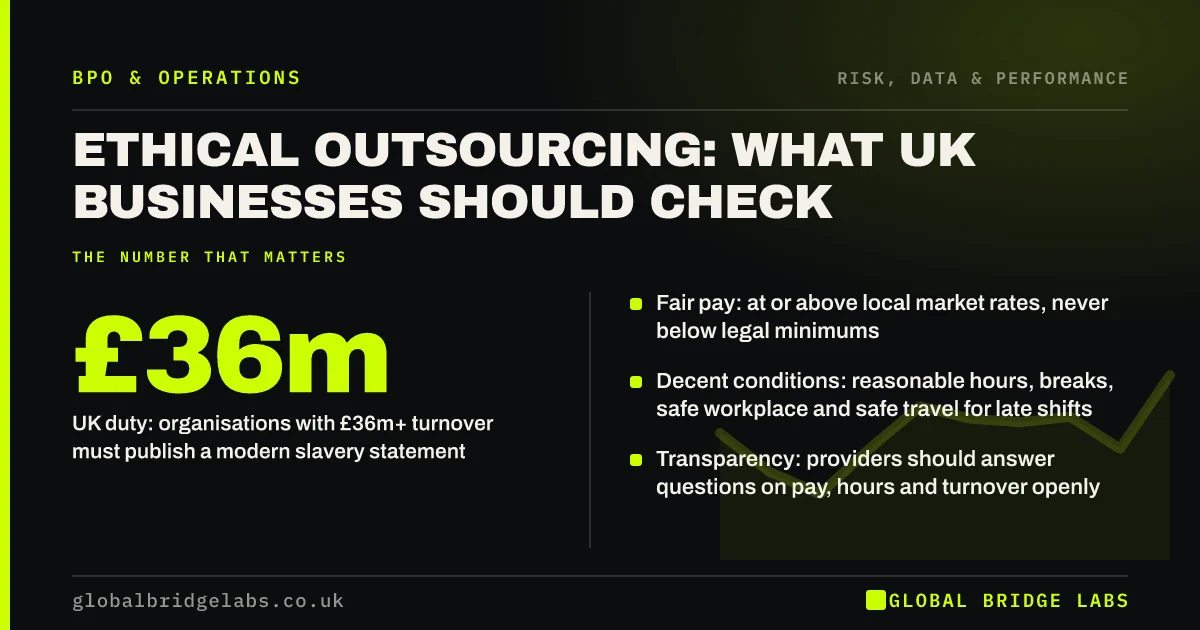
- Fair pay: at or above local market rates, never below legal minimums.
- Decent conditions: reasonable hours, breaks, safe workplace and safe travel for late shifts.
- UK duty: organisations with £36m+ turnover must publish a modern slavery statement.
- Transparency: providers should answer questions on pay, hours and turnover openly.
- Extremely low prices are the clearest warning sign.
Want to know how we treat and pay our team? Message us on WhatsApp and ask. We will answer directly.
Chat on WhatsApp →What is ethical outsourcing?
Ethical outsourcing is contracting business process outsourcing (BPO) or other services in a way that respects the rights and wellbeing of the workers involved, complies with the law in every country concerned, and is transparent to clients and their customers.
It matters for three reasons: it is the right thing to do, it protects your reputation, and it produces better service, because stable, respected teams outperform exploited ones.
What does UK law require?
Section 54 of the Modern Slavery Act 2015 requires commercial organisations carrying on business in the UK with a turnover of £36 million or more to publish an annual statement on the steps they take to prevent slavery and human trafficking in their business and supply chains. Home Office guidance explains what the statement should cover.
Most SMEs fall below that threshold, but larger customers may ask you about your supply chain, including outsourcing providers, as part of their own due diligence.
What should you check about pay and conditions?
Ask directly. Ethical providers are happy to answer.
- How does pay compare with the local market and legal minimums?
- Are overtime and late-shift allowances paid?
- What are standard hours, breaks and leave entitlements?
- Is transport provided or supported for late or night shifts?
- Are staff directly employed, with written contracts and statutory benefits?
- What training and career progression is available?
Why are very low prices a warning sign?
People are the largest cost in outsourcing. A price well below the market has to come from somewhere: lower pay, unpaid hours, less supervision or poorer conditions. As indicative market ranges, managed offshore BPO costs around £9–£18 per hour. A quote far below that range should prompt questions about how staff are paid and treated.
Is offshoring UK jobs unethical?
It is a fair question. Outsourcing can reduce roles in the UK, and employers should handle any change affecting staff lawfully and considerately, including TUPE and consultation duties where they apply. It also creates skilled, well-paid jobs in the delivery country, and many SMEs outsource work that was falling on the owner rather than replacing staff.
The ethical test is how it is done: honestly with your own team, fairly for the people doing the work, and transparently with customers.
How do you balance ethics with cost?
Compare providers on total value rather than lowest rate. A fairly paid, well-supervised team usually costs a little more per hour and delivers lower turnover, better quality and fewer hidden costs. Across our client work, back-office cost per task has fallen by 42% with fairly run managed teams; savings do not require exploitation.
Want a costed plan from a provider that will answer every question about its team? Tell us your requirements on WhatsApp and we will discuss them.
Chat on WhatsApp →What about data ethics?
Ethical outsourcing also means treating your customers' data with care: working inside your systems, limiting access, and complying with UK GDPR, including the transfer rules for offshore teams. Customers trust you with their information; that trust extends to anyone you let see it.
What does this look like in practice?
Global Bridge Labs (GBL) runs its own delivery hub in Colombo rather than subcontracting to unknown third parties, so we can answer directly for how our team is recruited, trained, paid and supported. UK clients are welcome to ask, and to meet the people who will work on their account.
Checklist: outsource ethically
Check these with every provider.
- Ask how pay compares with the local market.
- Confirm hours, breaks, leave and late-shift support.
- Confirm staff are directly employed with written contracts.
- Ask whether work is subcontracted to third parties.
- Ask for turnover figures and wellbeing support.
- Question any price far below the market range.
- Handle any impact on your own staff lawfully and openly.
Next step
Ask us anything about how our team works. We will answer directly, and you can meet the team lead before you decide. 30 minutes, no pitch.
Message us on WhatsApp with your questions, or book a 30-minute consultation.
Chat on WhatsApp →Sources and further reading
- Slavery and human trafficking in supply chains: guidance for businesses · Home Office
- Business transfers, takeovers and TUPE · GOV.UK
- International transfers of personal data · Information Commissioner's Office
Frequently asked questions
Is outsourcing ethical?
Outsourcing can be ethical when workers are paid fairly, work in decent conditions and are directly employed with proper contracts, when data is protected, and when any impact on UK staff is handled lawfully and openly. It becomes unethical when low prices depend on exploiting workers.
Who needs a modern slavery statement in the UK?
Under section 54 of the Modern Slavery Act 2015, commercial organisations carrying on business in the UK with an annual turnover of £36 million or more must publish a slavery and human trafficking statement each year. Smaller businesses are not required to, but may be asked by larger customers.
How do I know my outsourcing provider treats staff fairly?
Ask directly about pay relative to the local market, hours, breaks, leave, late-shift support, contracts, turnover and whether work is subcontracted. Ethical providers answer openly and let you meet the team. Vague answers and very low prices are warning signs.
Does outsourcing take jobs from the UK?
It can affect UK roles, and employers must follow employment law, including TUPE where it applies. Many SMEs, however, outsource work that was falling on the owner or piling up unassigned, and use the time freed to grow, which can create UK roles elsewhere in the business.
Written by

Global Bridge Labs (GBL) is a UK–Sri Lanka partner for social media, websites and BPO. Everything here comes from client delivery, not theory.