On this page
- 01Key takeaways
- 02What does bookkeeping cover?
- 03What does an in-house bookkeeper cost?
- 04What does outsourced bookkeeping cost?
- 05Why is the saving smaller for bookkeeping?
- 06When does outsourcing bookkeeping still win?
- 07When should bookkeeping stay in-house?
- 08What controls do you need?
- 09What does a good bookkeeping handover include?
- 10What does this look like in practice?
- 11Bookkeeping checklist
- 12Next step
- 13Sources and further reading
- 14Frequently asked questions
Key takeaways
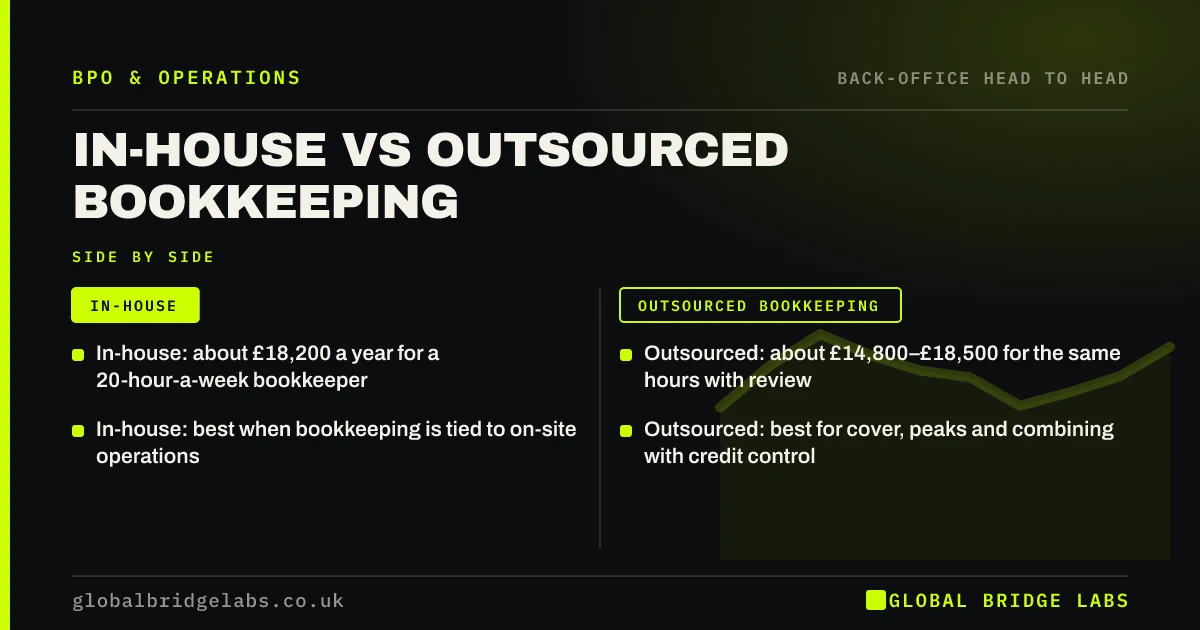
In-house vs outsourced bookkeeping is closer on cost than most functions. A part-time bookkeeper for 20 hours a week costs about £18,200 a year with overheads. Outsourcing the same hours costs about £14,800–£18,500 including your review time. Outsourcing wins on cover, month-end peaks and key-person risk more than on rate.
- In-house: about £18,200 a year for a 20-hour-a-week bookkeeper.
- Outsourced: about £14,800–£18,500 for the same hours with review.
- In-house: best when bookkeeping is tied to on-site operations.
- Outsourced: best for cover, peaks and combining with credit control.
Want your bookkeeping costed both ways? Message us on WhatsApp.
Chat on WhatsApp →What does bookkeeping cover?
Bookkeeping is the day-to-day recording of financial transactions: sales and purchase invoices, bank reconciliations, expense claims and supplier payments. It feeds the accountant, who prepares statutory accounts and tax returns. Outsourcing bookkeeping is different from changing accountant; the two often work together.
What does an in-house bookkeeper cost?
A bookkeeper working 20 hours a week at a full-time equivalent of £28,000 earns about £14,900. With employer National Insurance and pension, employment costs are about £16,700, or about £18 per worked hour over roughly 928 hours. Add a software seat and equipment, about £1,500, for a total near £18,200.
Check salaries for your area; ONS earnings data by occupation is a useful reference.
What does outsourced bookkeeping cost?
Skilled offshore back-office work sits at the upper end of the indicative £9–£18 range, around £14–£18 per hour. The same 928 hours cost about £13,000–£16,700 a year. Add an hour a week of your own review, about £1,840 a year, for a total of about £14,800–£18,500.
Want the outsourced option priced for your transaction volumes? Send them to us on WhatsApp.
Chat on WhatsApp →Why is the saving smaller for bookkeeping?
Because a part-time bookkeeper is often fully used and paid near the outsourced rate per hour, and the work needs skill. Small employers can also claim the Employment Allowance, which reduces the employer National Insurance bill. The cost case for outsourcing rests on the things the in-house figure does not show.
When does outsourcing bookkeeping still win?
When the bookkeeper is the only person who knows the finances, when month-end or year-end creates backlogs, when holidays leave invoices unprocessed, or when bookkeeping can be combined with credit control and supplier admin in one managed service. Removing key-person risk is often worth more than the rate difference.
When should bookkeeping stay in-house?
When it is tangled with on-site operations such as cash handling, stock counts or paper-based approvals, or when your bookkeeper also does other valuable work in the business. A hybrid, with routine entry outsourced and approvals in-house, often suits.
What controls do you need?
Keep payment approval in-house, give the outsourced team read or draft access rather than the ability to release payments, and require two-person checks on any change to supplier bank details. These controls protect against error and fraud whoever does the bookkeeping.
What does a good bookkeeping handover include?
A good handover lets the outsourced team work without asking the same questions every month. Prepare it before the start date and keep it updated.
- Chart of accounts and coding rules with examples.
- Bank feeds and supplier list, with approval limits.
- Month-end checklist and deadlines.
- Who approves what, and how to reach them.
What does this look like in practice?
A pattern we see in UK trades firms: the owner's partner keeps the books in evenings, and invoices go out late. Moving invoicing, reconciliations and chasing to a managed team gets invoices out on time and shortens the wait for payment, while the accountant still prepares the year-end accounts.
Bookkeeping checklist
Use these steps to compare.
- Count monthly transactions and hours spent.
- Cost the in-house role with overheads.
- Price outsourced hours at a skilled rate.
- Add your review time.
- Weigh cover, peaks and key-person risk.
- Keep payment approvals in-house either way.
Next step
Tell us your monthly transactions and who does the books today. We will compare in-house and outsourced bookkeeping honestly in a 30-minute call.
Message us on WhatsApp for a bookkeeping comparison, or book a 30-minute consultation.
Chat on WhatsApp →Sources and further reading
- Rates and thresholds for employers 2026 to 2027 · HM Revenue & Customs
- Workplace pensions: what you, your employer and the government pay · GOV.UK
- Employment Allowance · GOV.UK
- Earnings and hours worked, occupation by four-digit SOC: ASHE Table 14 · Office for National Statistics
Frequently asked questions
Is outsourced bookkeeping cheaper than a bookkeeper?
Sometimes only slightly. A 20-hour-a-week bookkeeper costs about £18,200 a year with overheads, and outsourcing the same hours costs about £14,800–£18,500 including your review time. The stronger case for outsourcing is cover, month-end capacity and removing key-person risk. Compare both with full costs included.
Is outsourcing bookkeeping the same as using an accountant?
No. Bookkeeping records day-to-day transactions such as invoices, bills and bank reconciliations; an accountant prepares statutory accounts and tax returns from those records. You can outsource bookkeeping and keep the same accountant, and the two often work well together. Agree deadlines between them.
How do I keep control of payments if I outsource bookkeeping?
Keep payment release and approval in-house, give the provider draft or read access to banking rather than the ability to pay, and require two-person checks on any change to supplier bank details. These controls protect against error and fraud whoever does the bookkeeping.
What bookkeeping volume suits outsourcing?
Outsourcing usually suits businesses with enough transactions to need several hours a week, or where month-end creates a backlog. Very small volumes that the owner handles in an hour a month rarely justify it, unless the owner's time is better spent on sales or delivery.
Written by

Global Bridge Labs (GBL) is a UK–Sri Lanka partner for social media, websites and BPO. Everything here comes from client delivery, not theory.