On this page
- 01Key takeaways
- 02Why does an unpredictable workload strain a small team?
- 03How do you measure how much your workload swings?
- 04What is the base-and-flex staffing model?
- 05Are predictable and unpredictable peaks different?
- 06What does flexible capacity cost?
- 07When is flexible outsourcing the wrong fit?
- 08How do you forecast a workload you cannot predict?
- 09What does this look like in practice?
- 10Variable workload checklist
- 11Next step
- 12Sources and further reading
- 13Frequently asked questions
Key takeaways
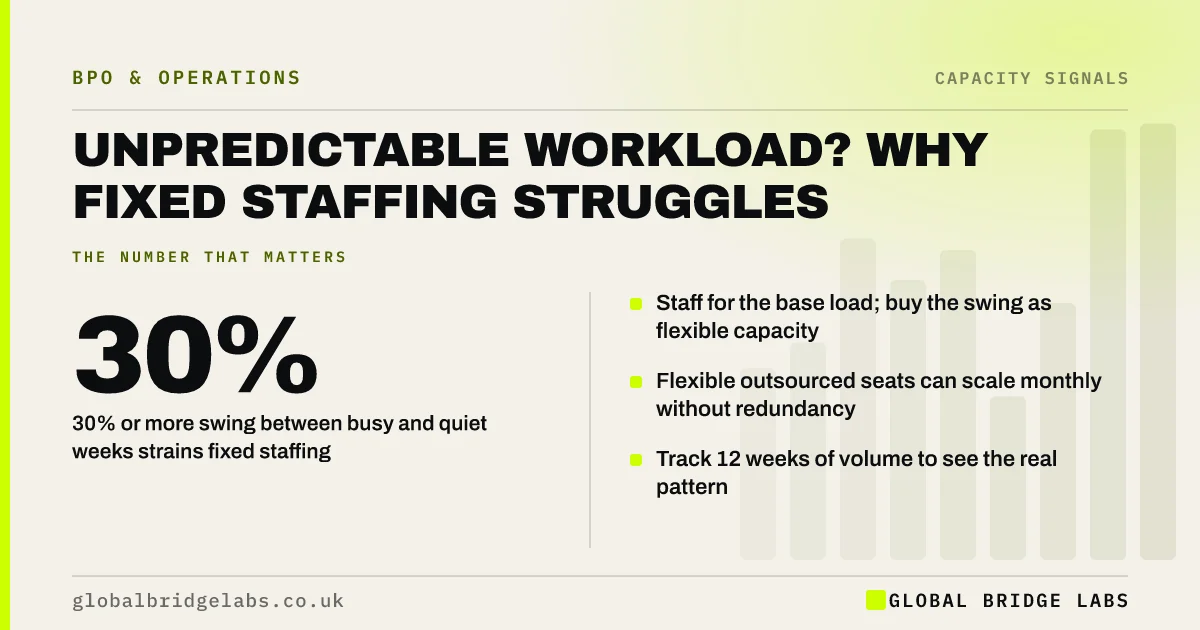
An unpredictable workload in a small business means fixed staff are either idle or overloaded. If volume swings by more than 30% between busy and quiet weeks, staffing for the average leaves you short at peaks, and staffing for the peak wastes money in troughs. Keep a core team for the base load and use flexible outsourced capacity for the swing.
- 30% or more swing between busy and quiet weeks strains fixed staffing.
- Staff for the base load; buy the swing as flexible capacity.
- Flexible outsourced seats can scale monthly without redundancy.
- Track 12 weeks of volume to see the real pattern.
Workload all over the place? Message us on WhatsApp with your busiest and quietest weeks.
Chat on WhatsApp →Why does an unpredictable workload strain a small team?
Because staff are a fixed cost and the work is not. A team sized for an average week is short at every peak and has spare time in every trough. Small teams feel this most, because one extra person is a large percentage change. The usual result is overtime at peaks and quiet guilt in troughs.
How do you measure how much your workload swings?
Count weekly volume for each process for at least 12 weeks, ideally a year. Find the average, the busiest and the quietest week. The swing is the difference between busiest and quietest, as a share of the average. A swing above 30% is hard to cover with fixed staff alone.
- Weekly volume for each process.
- Average, peak and trough weeks.
- Whether peaks are predictable, such as month end or season.
- How long each peak lasts.
What is the base-and-flex staffing model?
Base-and-flex staffing means employing enough people for the steady base load and buying the variable part of the work as flexible capacity. The base team keeps knowledge and relationships in-house. The flex capacity, from an outsourced team or overflow service, rises and falls with volume, so you pay for peaks only when they happen.
Want your base and flex sized from your own volumes? Ask us on WhatsApp.
Chat on WhatsApp →Are predictable and unpredictable peaks different?
Yes. Predictable peaks, such as Christmas, month end or summer, can be planned with seasonal cover booked in advance. Unpredictable swings, such as weather-driven demand or campaign spikes, need capacity that can flex at short notice. Outsourced teams can handle both, but unpredictable swings need a provider with spare trained people and short notice terms.
What does flexible capacity cost?
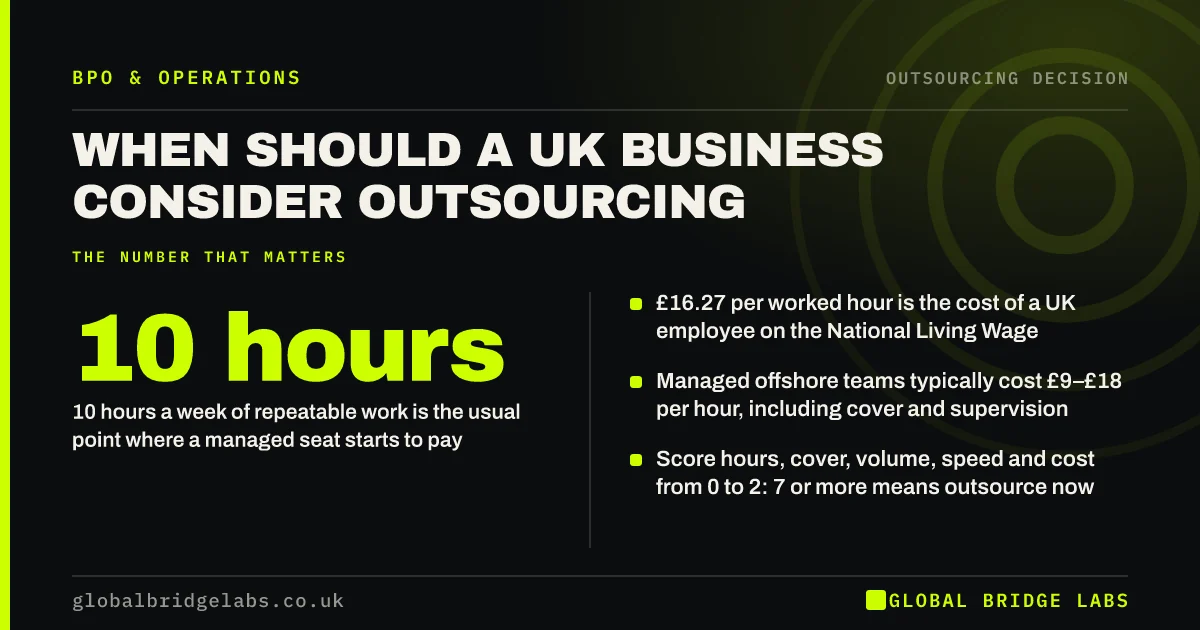
Flexible capacity usually costs a little more per hour than fixed capacity, and less overall because you stop paying for idle time. As indicative ranges, managed offshore teams cost £9–£18 per hour and onshore teams £20–£35. Check minimum monthly blocks and notice periods, because they decide how flexible the arrangement really is.
When is flexible outsourcing the wrong fit?
When the swings are in specialist work that an outside team would need months to learn, or when peaks are so short and rare that overtime covers them easily. It is also wrong if your process changes with each peak, because the flex team will relearn it every time.
How do you forecast a workload you cannot predict?
Forecast ranges, not single numbers. Even unpredictable work has patterns: weather, campaigns, invoice dates or school holidays. Look back over a year of weekly volumes, note what happened before each spike, and set a low, expected and high figure for the next quarter. Then agree with any flexible provider how quickly each level can be staffed.
- Plot a year of weekly volume by process.
- Note what came before each spike.
- Set low, expected and high figures for the next quarter.
- Agree lead times for scaling up with any provider.
What does this look like in practice?
A pattern we see in UK heating and plumbing firms: calls triple in the first cold week of autumn and halve in late spring. A core in-house team plus an outsourced call and booking seat that scales up from October keeps the diary full at the peak without paying for idle time in summer.
Variable workload checklist
Use this to plan for an unpredictable workload.
- Count weekly volume per process for at least 12 weeks.
- Calculate the swing between peak and trough.
- Separate predictable peaks from unpredictable ones.
- Size the in-house team for the base load.
- Buy the swing as flexible capacity on short notice terms.
- Review the split every quarter.
Next step
Send us your busiest and quietest weeks. We will suggest a base-and-flex split and what the flexible part would cost.
Message us on WhatsApp with your volumes, or book a 30-minute consultation.
Chat on WhatsApp →Sources and further reading
- Agency workers: your rights · GOV.UK
- Part-time workers' rights · GOV.UK
- National Minimum Wage and National Living Wage rates · GOV.UK
Frequently asked questions
How do you staff for an unpredictable workload?
Employ enough people for the steady base load and buy the variable part as flexible capacity, such as an outsourced team or overflow service on short notice terms. That keeps knowledge in-house while avoiding idle time in quiet weeks and overload in busy ones.
What is a flexible workforce for small businesses?
It is capacity that rises and falls with demand: part-time staff, agency temps, overtime or an outsourced team. For repeatable work with large swings, outsourced teams on monthly terms are often the most practical, because cover and training come included.
How much variation in workload is normal?
Most businesses see some weekly variation. Swings of more than about 30% between busy and quiet weeks are hard to cover with fixed staff alone and usually justify a flexible element. Measure 12 weeks of volume before deciding.
Written by

Global Bridge Labs (GBL) is a UK–Sri Lanka partner for social media, websites and BPO. Everything here comes from client delivery, not theory.