On this page
- 01Key takeaways
- 02What is a capacity buffer?
- 03Why not run the team at 100%?
- 04How much spare capacity is enough?
- 05What does a buffer cost?
- 06How can you hold a buffer without idle staff?
- 07When is a buffer wasteful?
- 08What does this look like in practice?
- 09Capacity buffer checklist
- 10Next step
- 11Sources and further reading
- 12Frequently asked questions
Key takeaways
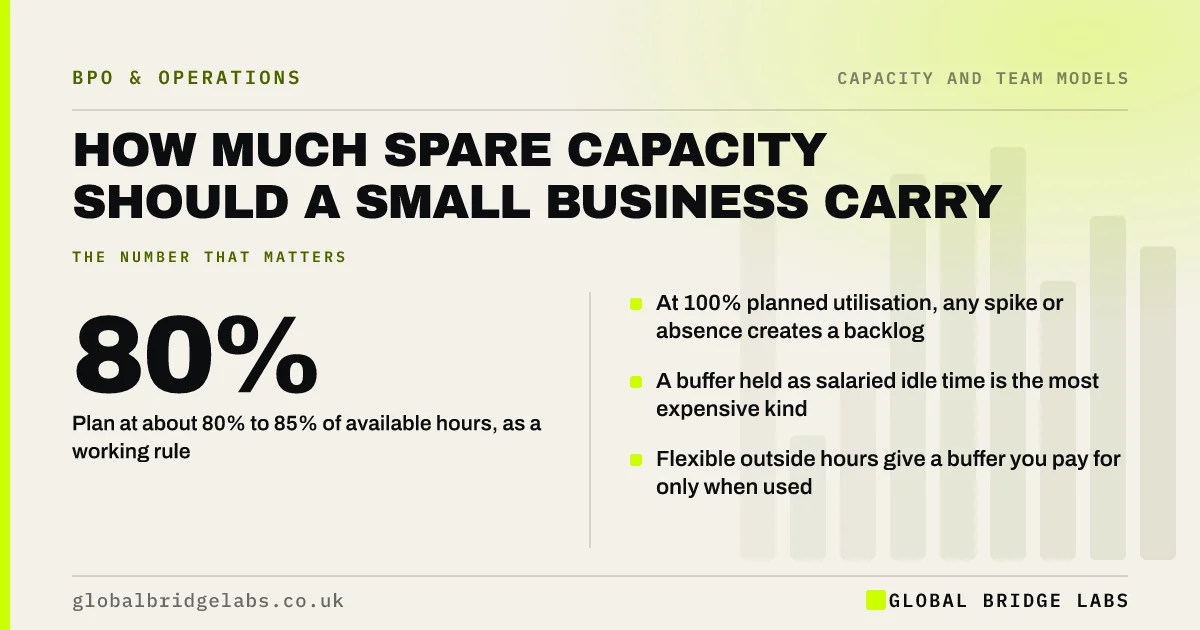
A small business should carry enough spare capacity to absorb a normal busy week and one person's absence without service slipping. As a working rule of thumb, plan routine teams at about 80% to 85% of available hours. The cheapest way to hold that buffer is as flexible outside hours, not as idle salaried time.
- Plan at about 80% to 85% of available hours, as a working rule.
- At 100% planned utilisation, any spike or absence creates a backlog.
- A buffer held as salaried idle time is the most expensive kind.
- Flexible outside hours give a buffer you pay for only when used.
Want your buffer sized against real volumes? Message us on WhatsApp with your weekly numbers.
Chat on WhatsApp →What is a capacity buffer?
A capacity buffer is the margin between the work a team is planned to do and the work it could do at full stretch. It exists to absorb variation: a busy Monday, a sick day, a complicated case. Without it, every fluctuation turns into a queue, and queues take longer to clear than they did to build.
Why not run the team at 100%?
A team planned at 100% has nowhere to put extra work, so anything unexpected waits. Work does not arrive evenly, and people are not available evenly. With 28 days of statutory holiday and an average of 4.4 sickness days per worker reported by the Office for National Statistics for 2024, each person is absent for more than six weeks a year.
The cost shows up as slow replies, overtime and errors made in a rush, which is why a fully loaded team often delivers less than a slightly under-loaded one.
How much spare capacity is enough?
For routine, customer-facing work, a buffer of 15% to 20% of available hours is a sensible starting point. Variable work needs more and steady back-office work less. Check it against your own data: if the busiest week of the last quarter was 25% above average, a 15% buffer would not have covered it.
- Steady back-office work: about 10%.
- Customer contact with daily peaks: 15% to 20%.
- Highly seasonal work: a flexible arrangement, not a fixed buffer.
What does a buffer cost?
A buffer held in salaried time costs the loaded hourly rate whether it is used or not. Five spare hours a week in a role costing £19.81 per worked hour is about £5,150 a year. The same five hours bought only in the weeks they are needed, at an indicative £9–£18 per hour offshore, might be used in half the weeks.
Want the cost of your current idle and overtime hours compared? Send us the figures on WhatsApp.
Chat on WhatsApp →How can you hold a buffer without idle staff?
Hold the buffer outside the payroll. Keep the permanent team planned at a high but sustainable level, and arrange flexible capacity that switches on above a threshold. Cross-training gives a second, internal buffer, because people can move to wherever the queue is.
- Overflow arrangement with a managed team.
- Cross-trained colleagues who can cover each other.
- Lower-priority project work that can pause in busy weeks.
When is a buffer wasteful?
A buffer is wasteful when the work is not time-sensitive. If a task can wait three days with no cost to customers or cash, let it queue and plan the team tighter. Buffers matter where delay loses sales or breaches a promise, such as enquiries, bookings, support and payment chasing.
What does this look like in practice?
A pattern we see in UK customer service teams of three or four: the rota is planned so everyone is busy all day, which looks efficient. One person takes a week off and replies slip from hours to days. An overflow line that takes the excess when the queue passes a set size keeps response times level through holidays.
Capacity buffer checklist
Use these checks to set your buffer.
- Calculate average and peak weekly hours for the process.
- Note how far the peak is above the average.
- Count planned and unplanned absence days per person.
- Decide which work loses money if it waits.
- Set planned utilisation for that work.
- Arrange where the overflow goes above that level.
Next step
Send us your weekly volumes and team hours for one process. We will show you how tight it is running and what a flexible buffer would look like.
Message us on WhatsApp for a buffer review, or book a 30-minute consultation.
Chat on WhatsApp →Sources and further reading
- Sickness absence in the UK labour market · Office for National Statistics
- Holiday entitlement · GOV.UK
- Work-related stress and how to manage it · Health and Safety Executive
Frequently asked questions
What is the ideal utilisation rate for a team?
For routine work with variable demand, planning at about 80% to 85% of available hours is a sound working rule. It leaves room for peaks, absence and difficult cases. Steady, non-urgent work can be planned tighter. Planning at 100% almost guarantees backlogs because demand and availability both vary.
Is spare capacity a waste of money?
Only when it is held in the wrong form or for the wrong work. Idle salaried hours are costly. A small buffer on time-sensitive work, or flexible outside hours used only at peaks, is cheaper than the lost sales, overtime and errors that come from having no slack at all.
How do I create slack in a small team?
Create slack by removing low-value tasks, cross-training so people can cover each other, and arranging flexible outside capacity for peaks. Then plan the permanent team slightly below full load. Slack that exists only on paper, while everyone is actually stretched, does not protect service.
What happens when a team runs at full capacity?
When a team runs at full capacity, any increase in work or any absence creates a queue. Response times lengthen, staff work overtime, errors rise and improvement work stops because nobody has time. Sustained full-capacity working is also a recognised cause of work-related stress.
Written by

Global Bridge Labs (GBL) is a UK–Sri Lanka partner for social media, websites and BPO. Everything here comes from client delivery, not theory.