On this page
- 01Short answer
- 02Why does batching work?
- 03What does a batching session look like?
- 04What do you capture in a single session?
- 05What are the three mistakes that break batching?
- 06Who should be in the room?
- 07What does this look like in practice?
- 08How do you run a batching session with a busy team?
- 09Next step
- 10Sources and further reading
- 11Frequently asked questions
Short answer
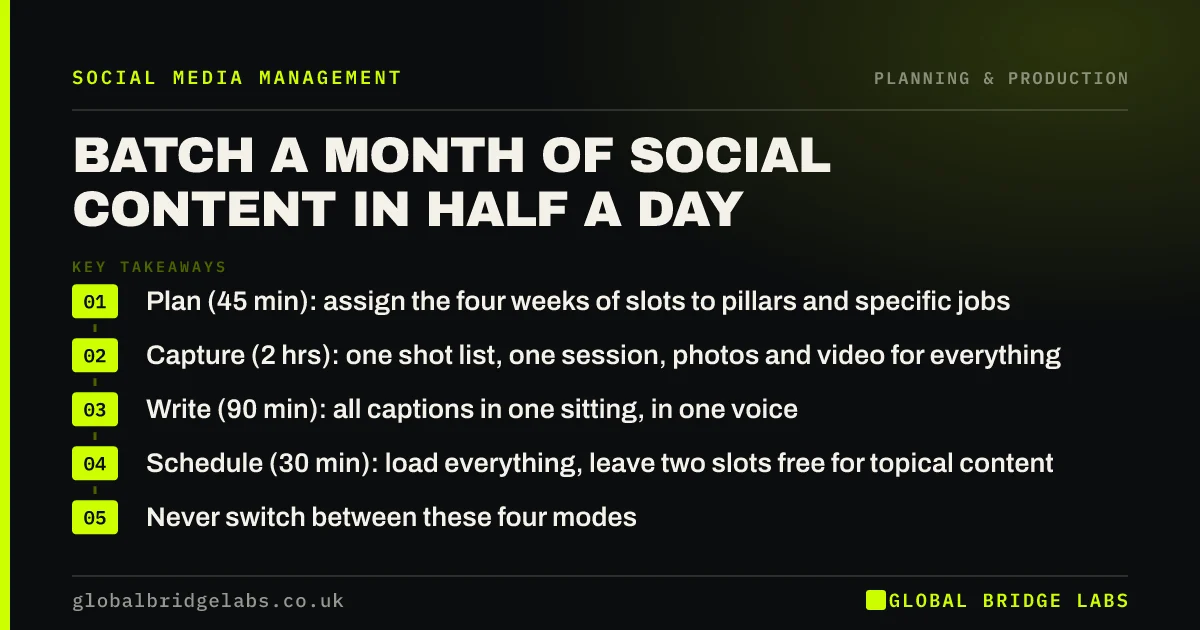
Batching means separating the four jobs inside content production and doing each one in a single block: plan, capture, write, schedule. Done properly, a half day produces four weeks of posts. Done as one continuous session of making posts, it produces exhaustion and six posts.
- Plan (45 min): assign the four weeks of slots to pillars and specific jobs.
- Capture (2 hrs): one shot list, one session, photos and video for everything.
- Write (90 min): all captions in one sitting, in one voice.
- Schedule (30 min): load everything, leave two slots free for topical content.
- Never switch between these four modes. The switching is the cost.
Want a batching session designed around your business? Message us on WhatsApp.
Chat on WhatsApp →Why does batching work?
Because content production is four different cognitive tasks, and switching between them repeatedly is where the hours disappear. Setting up a camera, deciding what to say, and writing well are not the same mode of thinking, and doing them post by post means paying the setup cost twelve times instead of once.
The practical effect for small teams is significant: the same four weeks of content typically takes a half day in batch and two to three days spread across a month.
What does a batching session look like?
Book a half day, protect it like a client appointment, and run the four blocks in order without interruption.
The planning block matters most. Walk through the next four weeks of slots and assign each to a specific, real thing: this job, that question, this new starter. If a slot cannot be assigned to something real, change the slot rather than inventing something for it.
- Before the session: collect job photos, questions from calls, and anything the team flagged.
- Plan block: four weeks of slots assigned to real subjects.
- Capture block: shoot every visual in one run, in the same conditions.
- Write block: all captions together, so voice stays consistent.
- Schedule block: load and leave two flexible slots.
What do you capture in a single session?
Work from a shot list written during the planning block, not from instinct on the day. A typical list for a UK service business: three finished-job sequences, two short talking-head answers, one team clip, and a set of detail shots that can be reused as backgrounds.
Shoot more than you need, because the marginal cost of an extra thirty seconds of footage during a session you are already running is almost nothing, and the cost of going back is a whole session.
What are the three mistakes that break batching?
First, batching without a plan, which turns the capture block into an expensive brainstorm. Second, batching too far ahead, which produces content that feels stale and dated by the time it publishes. Four weeks is the sweet spot; eight starts to show.
Third, filling every slot. Leave two open for something topical, a job that goes well, or a question that comes up. A calendar with no space for the present tense reads like a brochure.
We run batching sessions with UK clients monthly. Message us on WhatsApp if you want one run with your team.
Chat on WhatsApp →Who should be in the room?
Whoever holds the content, which in a small business is rarely the marketing person. The engineer who did the job, the chef, the consultant who had the client conversation. They need to be there for the capture block and nothing else, usually 30 minutes.
Book their time specifically and in advance. The most common failure is planning content that depends on somebody who was never asked whether they would be available.
What does this look like in practice?
A pattern in trades businesses: content produced on Friday afternoons, in whatever time is left, which means three or four posts in a good month. The change is a two-hour capture session on the first Monday of each month, with the most photogenic jobs identified the week before.
Teams that make that change usually spend less total time on content than before and publish considerably more of it. The difference is scheduling, not effort.
How do you run a batching session with a busy team?
Book people for the block they are needed in, not for the whole session. The engineer or the chef is needed for thirty minutes of the capture block and nothing else, and asking for a half day guarantees a decline.
Send the shot list the day before so nobody is thinking on the spot, and tell each person the specific thing they are being asked about. Can you talk for two minutes about why the original quote changed on the Harrogate job produces a usable clip; can you say something about your work does not.
Run the session in the same place at the same time each month. The predictability is what turns it into a routine rather than a request, which is the difference between it happening twice and it happening every month for two years.
- Book people for their block only, typically thirty minutes.
- Send the shot list a day ahead with each person's specific question.
- Same place, same time, every month.
- Ask about a named job, never for general comment.
Next step
Batching is the single highest-return process change available to a small marketing team, and it costs nothing to try once.
Message us on WhatsApp and we will design your first batching session and shot list.
Chat on WhatsApp →Sources and further reading
Frequently asked questions
How long does it take to batch a month of content?
About half a day for four weeks of posts across two channels, split into planning, capture, writing and scheduling blocks. The same content produced post by post typically consumes two to three days spread across the month, because every session repeats the setup cost.
How far ahead should I batch content?
Four weeks. Eight weeks starts to feel stale by the time later posts publish, and anything beyond that gets rewritten. Always leave two slots open in the month for topical content, or the feed reads like a brochure.
Can you batch content without a videographer?
Yes. A recent phone, natural light, a small clip-on microphone and a written shot list produce work that performs well on social. Production value matters far less than clarity of the message and consistency of publishing.
What if my business is not visual?
Then batch writing and screen recordings instead. A professional services firm can batch six short talking-head answers to real client questions in an hour, which is more useful to a buyer than any photography would be.
Written by

Global Bridge Labs (GBL) is a UK–Sri Lanka partner for social media, websites and BPO. Everything here comes from client delivery, not theory.