On this page
- 01Short answer
- 02Does the CAP Code apply to organic posts?
- 03What must be labelled as an advert?
- 04What counts as substantiating a claim?
- 05What are the rules on prices?
- 06What about competitions and giveaways?
- 07What happens if a complaint is upheld?
- 08How do you keep evidence for claims?
- 09Next step
- 10Sources and further reading
- 11Frequently asked questions
Short answer
The Advertising Standards Authority (ASA) applies the CAP Code to your social media posts, not just to paid advertising. The three rules that catch small businesses are: paid or gifted content must be obviously identifiable as advertising, every claim must be substantiated before publication, and prices must be clear about what is included.
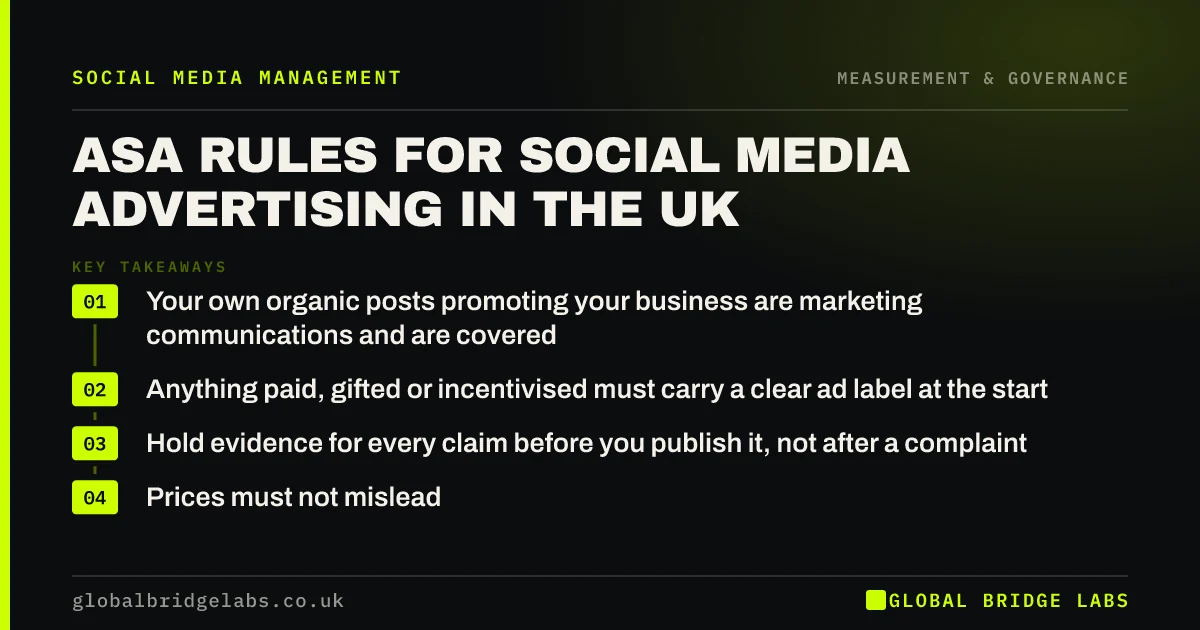
- Your own organic posts promoting your business are marketing communications and are covered.
- Anything paid, gifted or incentivised must carry a clear ad label at the start.
- Hold evidence for every claim before you publish it, not after a complaint.
- Prices must not mislead. State what is excluded, including VAT treatment.
- Testimonials must be genuine, and you must be able to produce them on request.
Want your recent posts checked against the CAP Code? Message us on WhatsApp.
Chat on WhatsApp →Does the CAP Code apply to organic posts?
Yes. The CAP Code covers advertisements and other marketing communications by or on behalf of advertisers, including content on a business's own social media channels.
This surprises many small businesses, who assume the rules attach only to paid advertising. In practice, a claim made in an ordinary Instagram caption is subject to the same substantiation requirement as one made in a paid campaign.
What must be labelled as an advert?
Any content where payment or another benefit has been given and the brand had some control over the message. That includes paid creator posts, gifted products or services, affiliate arrangements and, in many cases, content posted by employees promoting the business.
The label must be obvious before someone engages with the content, which in practice means at the start of the caption or clearly on the video, not buried among hashtags at the end. The ASA has ruled repeatedly that hidden or ambiguous labels are insufficient.
What counts as substantiating a claim?
Documentary evidence, held before publication, that supports the claim as a reasonable consumer would understand it.
That means a claim such as the fastest response times in Leeds requires evidence about competitors, not just about you. Claims about results, savings, or superiority need data. If you cannot produce the evidence on request, do not make the claim.
- Superlatives (best, fastest, cheapest) require comparative evidence.
- Performance claims require data collected in conditions matching the claim.
- Environmental claims are subject to particular scrutiny and must be specific.
- Health or wellbeing claims carry additional restrictions by sector.
- Testimonials must be genuine, recent and available on request.
We check claims and labelling as part of content review for UK clients. Message us on WhatsApp.
Chat on WhatsApp →What are the rules on prices?
Prices must be clear and must not mislead about what they include. If a headline price excludes something most customers will need, say so prominently rather than in a final line.
For consumer-facing businesses, quoted prices should include VAT. For business-to-business, excluding VAT is acceptable provided it is stated clearly. From prices must be genuinely achievable for a reasonable proportion of customers, not a theoretical minimum nobody ever pays.
What about competitions and giveaways?
Promotions are covered by a specific section of the CAP Code, and small businesses frequently miss the requirements. You need clear terms available before entry, including the closing date, how winners are selected, the prize, any restrictions, and who is administering it.
Judge fairly, award the prize promptly, and publish or make available details of the winner. Most complaints about small business giveaways concern prizes never awarded or rules changed after entry, both of which are avoidable with a paragraph of terms written beforehand.
What happens if a complaint is upheld?
The ASA will normally ask for the content to be amended or withdrawn, and rulings are published on its website with the business named. For a small business, the published ruling is usually a bigger cost than the removal.
Persistent non-compliance can lead to further steps, including working with platforms to remove content and, for paid search, having advertising restricted. The practical advice is to respond promptly and fix it, because the process is designed around compliance rather than punishment.
How do you keep evidence for claims?
Keep a simple claims file, because substantiation is required to exist before publication and is worth nothing if nobody can find it eighteen months later.
One row per claim: the claim as worded, the evidence, where the evidence is stored, the date it was obtained, and a review date. Anything based on data has a shelf life, and a claim that was accurate in 2024 is not automatically accurate now.
Review the file annually, and whenever your pricing, service or market position changes. The most common failure in small businesses is not a fabricated claim but an old one that stopped being true and nobody noticed, which is both an advertising risk and a customer trust problem.
- One row per claim: wording, evidence, location, date, review date.
- Data-based claims expire. Set a review date for each.
- Re-check the file whenever pricing or service changes.
- Remove claims you can no longer evidence rather than rewording them.
Next step
Most compliance issues in small business social media are unintentional and easy to fix: an unlabelled gifted post, a superlative nobody checked, a from price that is not achievable.
Message us on WhatsApp for a compliance review of your social media claims and labelling.
Chat on WhatsApp →Sources and further reading
Frequently asked questions
Do the ASA rules apply to my own social media posts?
Yes. The CAP Code covers marketing communications by or on behalf of advertisers, including content on your own channels. A claim in an ordinary caption requires the same substantiation as one in a paid campaign.
How should paid content be labelled?
With a clear ad label at the start of the caption or prominently on the video, so it is obvious before anyone engages. The ASA has ruled repeatedly that labels buried in hashtags at the end of a caption are insufficient.
What claims can I make about my business?
Any claim you can substantiate with documentary evidence held before publication. Superlatives such as best or fastest require comparative evidence about competitors, not only about yourself. If you cannot produce the evidence on request, do not publish the claim.
Do I need terms and conditions for a giveaway?
Yes. Promotions are covered by a specific CAP Code section requiring clear terms available before entry, including the closing date, selection method, prize, restrictions and administrator. Most complaints concern prizes never awarded or rules changed after entry.
Written by

Global Bridge Labs (GBL) is a UK–Sri Lanka partner for social media, websites and BPO. Everything here comes from client delivery, not theory.