On this page
- 01Key takeaways
- 02What counts as stock, and what counts as original?
- 03How do the two compare?
- 04Why does original content attract better customers?
- 05When is stock acceptable?
- 06What are the licence and consent rules?
- 07How do you produce original content without a big budget?
- 08What does this look like in practice?
- 09Image choice checklist
- 10Next step
- 11Sources and further reading
- 12Frequently asked questions
Key takeaways
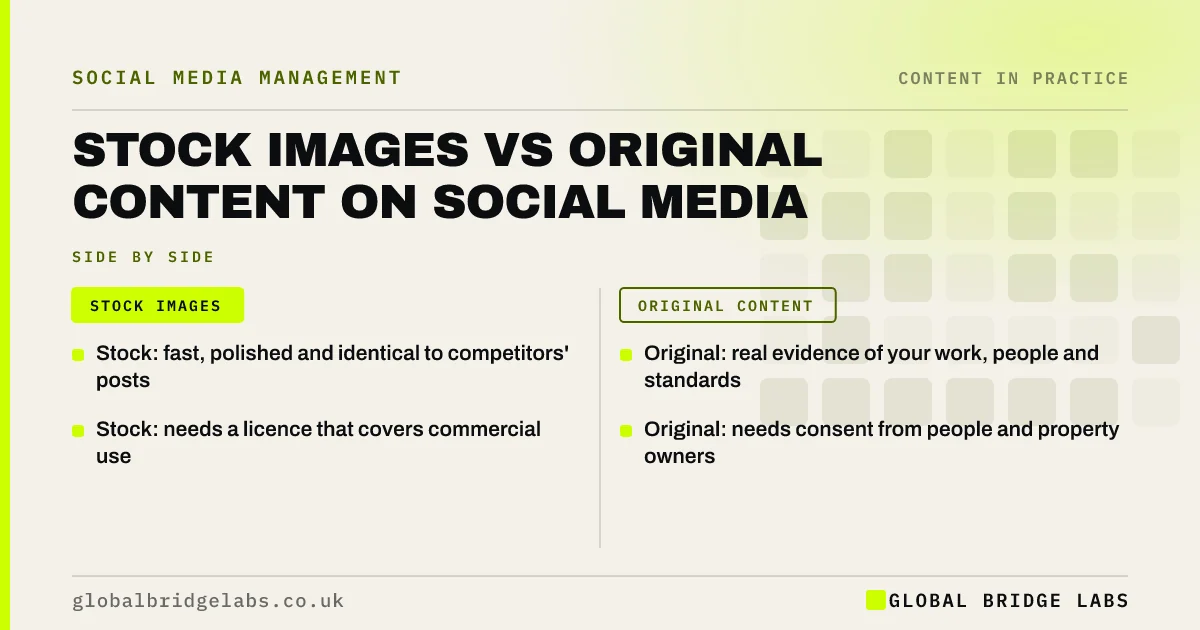
Stock images vs original content is a choice between convenience and proof. Stock images on social media are quick and look polished, but they show nothing of your work. Original photos and video, even plain ones, are evidence. For attracting the right customers, original wins in almost every case.
- Stock: fast, polished and identical to competitors' posts.
- Original: real evidence of your work, people and standards.
- Stock: needs a licence that covers commercial use.
- Original: needs consent from people and property owners.
Short of original images? Message us on WhatsApp for a simple capture routine.
Chat on WhatsApp →What counts as stock, and what counts as original?
Stock content is ready-made photography, video, illustration or templates licensed from a library, and now also generic images made by AI. Original content is anything made by or for your business that shows your own people, work, premises or products.
How do the two compare?
They compare differently on almost every point that matters to a buyer. Stock is cheaper per image and faster. Original is more persuasive and belongs to you. The comparison below assumes a small business posting three times a week.
- Trust: original shows real work; stock shows nothing of yours.
- Distinctiveness: original is unique; stock appears on other accounts.
- Speed: stock is instant; original needs a capture habit.
- Cost: stock is low per image; original costs staff time.
- Rights: stock is licensed; original is yours, with consents.
- Fit signal: original shows the scale of work; stock cannot.
Why does original content attract better customers?
Original content attracts better customers because it carries information. A photo of your team on a real site tells a buyer the size of job you take, the standard you work to and who will turn up. A stock photo of a smiling model tells them you have a subscription.
- The right-customer content scorecard for social media
- Before and after posts: proof that attracts buyers
Want to see what your own photos could do? Send us three on WhatsApp and we will discuss your requirements.
Chat on WhatsApp →When is stock acceptable?
Stock is acceptable as background for a text graphic, for abstract concepts with no visual of their own, and for occasional seasonal posts. It is not acceptable where it implies the image is your work, your premises or your customer. That would mislead.
- Backgrounds and textures behind text.
- Abstract topics such as regulations.
- Occasional seasonal greetings.
- Never as a stand-in for your own work.
What are the licence and consent rules?
Copyright in an image belongs to its creator unless it is assigned or licensed. An image found on a search engine is not free to use. Check that a stock licence covers commercial and social media use. For original content, get consent from identifiable people and from owners of private property.
How do you produce original content without a big budget?
Build a capture habit. Agree three moments on every job to photograph, keep a shared folder, and spend ten minutes a week choosing the best. A phone is enough. For flagship projects, a half-day professional shoot can supply months of material.
What does this look like in practice?
A pattern we see with UK small businesses: a tidy grid of stock images and templates that looks professional and could belong to any firm in the country. Swapping in plain phone photos of real jobs makes the feed less uniform and far more convincing.
Image choice checklist
For each image you post.
- It shows your own work, people or product where possible.
- Stock is used only as background or for abstract topics.
- Any stock licence covers commercial social use.
- People shown have agreed.
- Nothing implies stock imagery is your work.
- Originals are saved in one shared folder.
Next step
Count the stock images in your last 12 posts. Replace half of them next month with photos from real jobs.
Message us on WhatsApp for a three-photo capture routine, or book a 30-minute consultation.
Chat on WhatsApp →Sources and further reading
- How copyright protects your work · GOV.UK
- Recognising ads: brand-owned and paid social media · ASA / CAP
- What is valid consent? · Information Commissioner's Office
Frequently asked questions
Should I use stock images on social media?
Sparingly. Stock is fine as a background or for abstract topics, but it shows nothing of your work and may appear on competitors' accounts. Original photos of real jobs are more persuasive to buyers. Never use stock to stand in for your own work.
Do stock photos hurt engagement and trust?
They often reduce trust, because buyers recognise generic imagery and learn nothing from it. Real photos, even imperfect ones, act as evidence of what you do and the standard you work to. If you must use stock, keep it to backgrounds and say nothing that implies it is yours.
Can I use any image I find online?
No. Copyright belongs to the creator unless you have a licence or permission. Images from search results or other accounts are not free to use. Use your own, or licensed stock that covers commercial use. Keep a record of the licence for each image.
How do I get original content cheaply?
Take three phone photos at agreed stages of every job and store them in a shared folder. Ten minutes a week choosing the best gives a steady supply. Add a professional shoot for your best projects. Ask customers for their photos too.
Written by

Global Bridge Labs (GBL) is a UK–Sri Lanka partner for social media, websites and BPO. Everything here comes from client delivery, not theory.