On this page
- 01Short answer
- 02What are the boundaries?
- 03What can you not advertise?
- 04What content converts inside the rules?
- 05How do you handle patient content?
- 06How do you handle comments and questions?
- 07What does this look like in practice?
- 08How do you handle reviews and feedback in healthcare?
- 09Next step
- 10Sources and further reading
- 11Frequently asked questions
Short answer
Healthcare social media works within tight boundaries: no patient-identifiable content without explicit consent, no claims you cannot substantiate, and particular care with before-and-after imagery and prescription-only treatments. Within those limits, the content that converts is process, reassurance and the practitioner as a person.
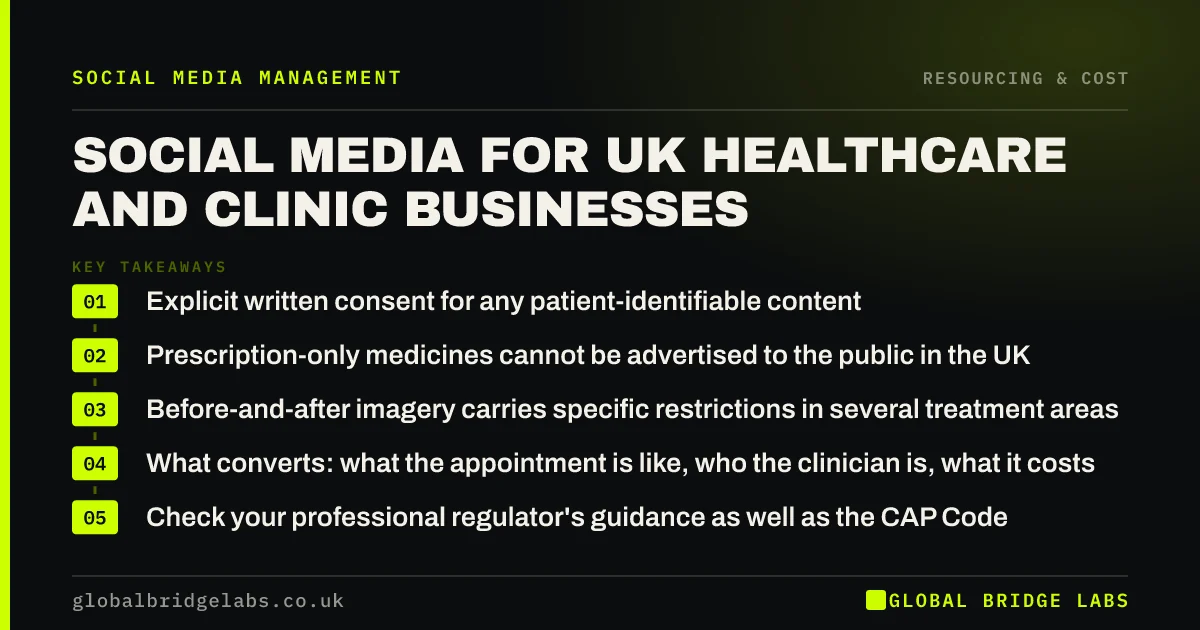
- Explicit written consent for any patient-identifiable content, with the right to withdraw.
- Prescription-only medicines cannot be advertised to the public in the UK.
- Before-and-after imagery carries specific restrictions in several treatment areas.
- What converts: what the appointment is like, who the clinician is, what it costs.
- Check your professional regulator's guidance as well as the CAP Code.
Want your clinic content reviewed against the rules? Message us on WhatsApp.
Chat on WhatsApp →What are the boundaries?
Three layers, and you must satisfy all of them: professional regulator guidance for your discipline, advertising rules under the CAP Code, and data protection law for anything involving patients.
Health data is special category personal data under UK GDPR, which means the bar for using it is higher than for ordinary marketing content. Explicit, informed, freely given and recorded consent is the practical requirement, and it must be as easy to withdraw as it was to give. This article is general guidance, not legal or regulatory advice.
What can you not advertise?
Prescription-only medicines cannot be advertised to the public in the UK. That includes naming a prescription-only treatment in promotional content, which catches out clinics offering treatments that have become widely discussed on social media.
Several treatment areas also carry restrictions on before-and-after imagery, testimonials and claims about outcomes. The ASA has taken action against clinics in these areas repeatedly. If a treatment is prescription-only, take specific advice on what you may say about it before publishing anything.
What content converts inside the rules?
Reassurance content, which is both compliant and genuinely what prospective patients want.
Most people delay healthcare appointments because of uncertainty rather than cost: what will happen, will it hurt, how long will it take, who will I see. Content that answers those questions honestly removes the barrier that is actually stopping people, and none of it requires patient involvement.
- What happens at a first appointment, step by step.
- The clinician introducing themselves and their approach.
- What the room and the equipment look like.
- Honest pricing, including what is and is not included.
- Aftercare and what to expect in the following days.
- Common misconceptions in your field, corrected carefully.
We build compliant content plans for UK clinics. Message us on WhatsApp for how it works.
Chat on WhatsApp →How do you handle patient content?
Explicit written consent, recorded, specific to the use, and withdrawable. A general consent to marketing on an intake form is unlikely to be sufficient for publishing an identifiable image on social media.
Practically: ask separately, explain exactly where the content will appear and for how long, record the consent with the date, and remove it promptly on request. If in doubt, do not publish. The reputational cost of a patient confidentiality complaint in healthcare is disproportionate to any marketing benefit.
How do you handle comments and questions?
Never give clinical advice in comments. The safe response to any individual clinical question is a version of the same reply: that it depends on individual circumstances, that it would need an assessment, and an invitation to book or call.
Write that reply once, save it, and make sure everyone answering messages uses it. The risk here is not malice but helpfulness: a well-meaning reply that reads as advice creates both clinical and regulatory exposure.
What does this look like in practice?
A pattern in clinics: very little published, because everything proposed raises a compliance question and the approval loop takes weeks.
A pre-approved library fixes it: a set of signed-off phrasings, several content formats cleared in advance, and a saved reply for clinical questions. Publishing becomes routine because the compliance work was done once rather than per post, and the content that emerges, mostly process and reassurance, tends to produce more bookings than treatment-focused content does.
How do you handle reviews and feedback in healthcare?
Very carefully, because confirming that someone is a patient is itself a disclosure. The standard reply to any review, positive or negative, should not acknowledge whether the reviewer attended your practice.
A safe construction: thank you for the feedback, we take concerns seriously and would like to look into this, please contact the practice manager on the number on our website. That responds visibly without confirming anything about an individual.
Never discuss any clinical detail in public, even to correct something you believe is inaccurate. If a review contains a factual error about treatment, the route is the platform's reporting process and a private conversation, not a public correction, and your professional regulator will almost certainly say the same.
- Do not confirm or deny that someone is a patient.
- Use one approved reply for all reviews, positive or negative.
- Never discuss clinical detail publicly, even to correct an error.
- Route factual disputes through the platform and a private conversation.
Next step
Healthcare social media is a compliance design problem first and a content problem second. Solve it once and publishing becomes straightforward.
Message us on WhatsApp for a compliant content plan and pre-approved library for your clinic.
Chat on WhatsApp →Sources and further reading
- What is valid consent? · Information Commissioner's Office
- Recognising ads: social media and influencer marketing · ASA / CAP
Frequently asked questions
Can UK clinics post patient photos on social media?
Only with explicit, informed, recorded consent specific to that use, which must be as easy to withdraw as to give. Health information is special category data under UK GDPR, so a general marketing consent on an intake form is unlikely to be sufficient.
Can I advertise treatments on social media?
Not if they are prescription-only medicines, which cannot be advertised to the public in the UK, including by name. Several treatment areas also restrict before-and-after imagery and outcome claims. Take specific advice before publishing about any prescription-only treatment.
What should a healthcare business post instead?
Reassurance content: what happens at a first appointment, who the clinician is, what the room looks like, honest pricing and aftercare. Most people delay appointments because of uncertainty rather than cost, and none of this requires patient involvement.
How should clinics answer clinical questions in comments?
With a saved reply explaining that it depends on individual circumstances and would need an assessment, plus an invitation to book. Never give clinical advice in public comments, and make sure everyone answering messages uses the same approved wording.
Written by

Global Bridge Labs (GBL) is a UK–Sri Lanka partner for social media, websites and BPO. Everything here comes from client delivery, not theory.