On this page
- 01Short answer
- 02Why is professional services social media different?
- 03What content demonstrates judgement?
- 04How do you handle compliance?
- 05How long does it take to work?
- 06What about client confidentiality?
- 07What does this look like in practice?
- 08How do you get partners to post consistently?
- 09Next step
- 10Sources and further reading
- 11Frequently asked questions
Short answer
Professional services firms win on demonstrated judgement, not on visibility. The content that converts is a specific problem, the decision you made, and what happened. Post from named individuals on LinkedIn, pre-approve language for anything regulated, and expect a long, quiet build.
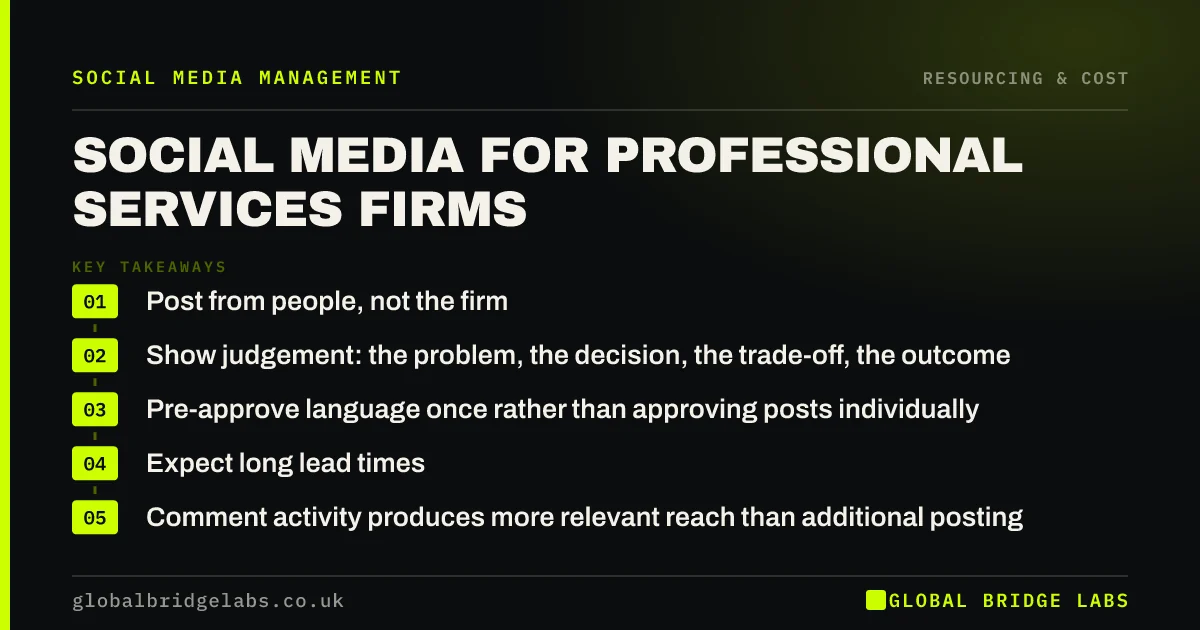
- Post from people, not the firm. Buyers hire individuals in this sector.
- Show judgement: the problem, the decision, the trade-off, the outcome.
- Pre-approve language once rather than approving posts individually.
- Expect long lead times. Buyers follow quietly for months before enquiring.
- Comment activity produces more relevant reach than additional posting.
Want a LinkedIn plan for your partners or directors? Message us on WhatsApp.
Chat on WhatsApp →Why is professional services social media different?
Because the purchase is a judgement about competence, made slowly, often by someone who will not identify themselves until they are ready to speak to you.
This has two practical consequences. The content must demonstrate thinking rather than assert expertise, because assertion is what every competitor also does. And your metrics must tolerate silence, because a buyer reading everything you post for four months generates no measurable signal until the day they enquire.
What content demonstrates judgement?
A specific situation, the options considered, the decision, the reasoning and the result. Anonymised, but concrete enough that a reader with the same problem recognises themselves.
The failure mode is generality. A post about the importance of cash flow planning tells a reader nothing about whether you are good. A post describing a client who was profitable and nearly insolvent, and the three things you changed, tells them a great deal.
- A decision you made and the trade-off you accepted.
- A common mistake in your field and what it costs.
- A regulatory or market change, with what it actually means for a specific type of business.
- A question you are asked constantly, answered properly.
- A position you hold that some of your peers would dispute.
How do you handle compliance?
Pre-approve language rather than approving individual posts. Build a library of signed-off phrasings for the things you say repeatedly, and let the team assemble content from it.
Where your sector is regulated, the boundaries generally concern giving advice without knowing circumstances, making performance claims, and handling client confidentiality. Financial promotions in particular carry specific requirements in the UK. Agree the boundaries once with whoever holds compliance responsibility, write them down, and work inside them without a per-post review.
- A social media approval workflow that does not slow you down
- ASA rules for social media advertising in the UK
We build pre-approved content libraries for regulated UK firms. Message us on WhatsApp.
Chat on WhatsApp →How long does it take to work?
Six to twelve months for meaningful inbound, and the first signals are usually qualitative: someone mentions a post in a first meeting, or a prospect arrives already understanding how you work.
Judge early progress on whether the right people engage rather than on how many. Five comments from directors at target-sized firms is a better signal than two hundred from people outside your market, and firms that abandon this channel usually do so at month four, just before it starts working.
What about client confidentiality?
Anonymise properly and get permission for anything identifiable. Changing the sector and the size is not anonymisation if the combination of details identifies the client to anyone in their market.
The safe construction is to describe the pattern rather than the case: a manufacturer of roughly this size with this problem, which we see regularly, and here is what usually causes it. That preserves the value of the insight without the risk.
What does this look like in practice?
A pattern in professional services: firm announcements published from the company page, and no inbound from social in two years.
Moving posting to two directors, three times a week each, writing about specific client situations in anonymised form and commenting daily on posts from their buyers, changes it slowly. Reach figures stay modest throughout. Several months in, prospects start arriving at first meetings having read specific posts, which changes both the conversion rate and the length of the sales conversation.
How do you get partners to post consistently?
Remove the writing, not the thinking. The obstacle is almost never willingness; it is that a busy partner will not sit down and draft a post, and asking them to produces nothing for three months.
The arrangement that works is a fortnightly twenty-minute call where someone asks them about a client situation from the last two weeks, records it, and turns it into three posts for approval. The partner contributes judgement, which is the part nobody else can supply, and contributes none of the production.
Approval should be edit or approve, not rewrite. If posts come back heavily rewritten every time, the voice guide is wrong and should be fixed once rather than corrected forever.
- Fortnightly twenty-minute interview, recorded.
- Three posts drafted from each conversation.
- Partner supplies judgement, not production.
- Approve or edit lightly. Repeated rewrites mean the voice guide needs fixing.
Next step
In professional services, social media is a credibility engine with a long fuse. It works, slowly, and it compounds in a way advertising does not.
Message us on WhatsApp for a professional services content plan for your directors.
Chat on WhatsApp →Sources and further reading
- LinkedIn Pages best practices · LinkedIn
- Recognising ads: brand-owned and paid social media · ASA / CAP
Frequently asked questions
What should a professional services firm post on social media?
Specific anonymised client situations, the decision made, the trade-off accepted and the outcome. General advice about your field tells a reader nothing about whether you are good, because every competitor publishes the same generalities.
Should partners post personally or from the firm page?
Personally. Buyers in professional services hire individuals and assess judgement, and posts from named people with job titles reach considerably further than the same content from a company page. Keep the page complete for credibility checks.
How do regulated firms handle social media compliance?
Pre-approve language rather than individual posts. Build a library of signed-off phrasings for what you say repeatedly, agree boundaries once with whoever holds compliance responsibility, and work inside them without a per-post review.
How long does social media take to work for consultants?
Six to twelve months for meaningful inbound. Early signals are qualitative: a prospect mentioning a post in a first meeting. Judge progress on whether the right people engage rather than how many, since most firms quit at month four.
Written by

Global Bridge Labs (GBL) is a UK–Sri Lanka partner for social media, websites and BPO. Everything here comes from client delivery, not theory.