On this page
- 01Short answer
- 02Why do trades businesses have an advantage?
- 03What should you film on site?
- 04Why does price transparency work so well?
- 05Which channels should a trades business use?
- 06What about permissions and safety?
- 07What does this look like in practice?
- 08How do you get the team to actually send photos?
- 09Next step
- 10Sources and further reading
- 11Frequently asked questions
Short answer
Trades businesses have the best raw material in social media and use it least. Every job is content. The three things that work are honest price breakdowns, before and after sequences, and showing what you found behind the wall. Facebook and Instagram for domestic work, LinkedIn for commercial.
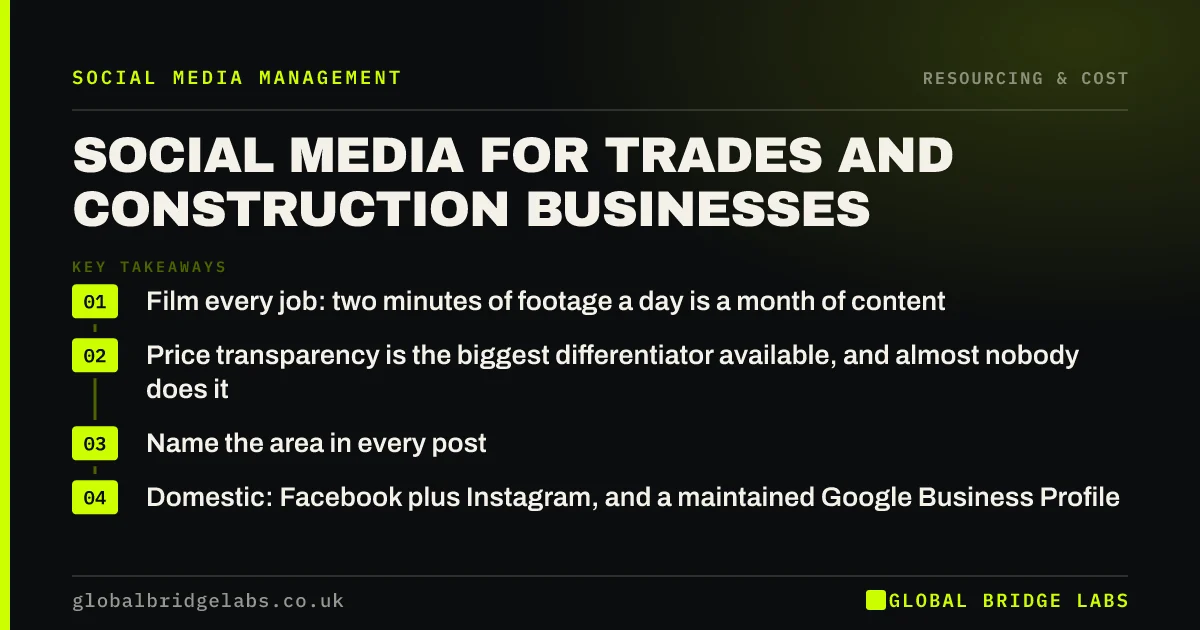
- Film every job: two minutes of footage a day is a month of content.
- Price transparency is the biggest differentiator available, and almost nobody does it.
- Name the area in every post. Reach outside your patch has no value.
- Domestic: Facebook plus Instagram, and a maintained Google Business Profile.
- Commercial: LinkedIn, aimed at facilities managers and main contractors.
Want a content plan built from your jobs? Send us a week of photos on WhatsApp.
Chat on WhatsApp →Why do trades businesses have an advantage?
Because the work is visual, the transformation is obvious, and the outcome is something people can imagine wanting. That combination is what social platforms distribute best, and most trades firms are sitting on it unused.
The constraint is never material. It is capture. A phone in a pocket on a job that already takes six hours can produce a week of content for the cost of two minutes and a habit.
What should you film on site?
A simple sequence, repeated on every job, so nobody has to think about it.
- The before, shot wide, with the problem visible.
- The thing you found that the customer did not know about.
- Twenty seconds of the work happening, close up.
- The after, from the same angle as the before.
- One sentence to camera about what made this job different.
Why does price transparency work so well?
Because almost nobody in UK trades does it, and every customer wants it. A post explaining that a bathroom refit in your area runs between £6,000 and £11,000, and what moves it within that range, is the single most reliably high-performing content format we see in this sector.
It also qualifies enquiries. Publishing ranges means the people who contact you have already accepted the order of magnitude, which shortens quoting time and raises conversion. The objection that it lets competitors see your prices matters far less than the enquiries it produces.
We will write your price transparency posts with you. Message us on WhatsApp.
Chat on WhatsApp →Which channels should a trades business use?
For domestic work: Facebook for local groups and recommendation threads, Instagram for the visual proof people check before calling, and a maintained Google Business Profile, which for most trades firms produces more enquiries per hour than either.
For commercial work: LinkedIn, posting from the owner or contracts manager about specific projects, compliance, programme management and problems solved on site. Facilities managers and main contractors are there during the working day.
What about permissions and safety?
Ask at quoting stage, not on the day. A line in the quote stating you photograph completed work for marketing unless the customer opts out removes almost all friction.
On commercial sites, check client restrictions before filming, never show security arrangements, and never film identifiable people without consent. Also check what is visible in shot: customer post, documents, vehicle registrations and children in the background are all avoidable problems.
What does this look like in practice?
A pattern that works for UK trades: a firm with eight or nine engineers moves from occasional posting across four platforms to Facebook and Instagram only, three posts a week, with the price-range format once a fortnight and every post naming the postcode area.
Enquiries become predictable rather than seasonal, and the quality changes noticeably, because people arrive already knowing the approximate cost, which cuts wasted quoting visits. Across our client work we publish an average reach lift of +184% in the first 90 days, but in this pattern the change that matters is the quality of the conversation, not the reach.
How do you get the team to actually send photos?
Make it take ten seconds and make it part of the job rather than a favour. The businesses that get consistent material are the ones where photographs are a step in the process, not a request made after the fact.
What works: a shared album everyone can add to directly from the camera roll, a line in the job sheet prompting before and after shots, and someone naming the person whose photo was used when a post performs well. What does not work: asking in a meeting, a project management tool with fields to complete, and expecting it to happen without a prompt on the job sheet.
Accept a low hit rate at first. If three of nine engineers send material consistently, that is enough for three posts a week, and the others usually follow once they see their colleagues' work published.
- Shared album, direct from the camera roll, no login.
- Photos prompted on the job sheet, not in a meeting.
- Credit the person whose photo was used.
- Three consistent contributors is enough for a full content calendar.
Next step
If you complete jobs and photograph none of them, you are throwing away the cheapest marketing asset your business produces.
Message us on WhatsApp for a trades social media plan built around your jobs and your area.
Chat on WhatsApp →Sources and further reading
- Google Business Profile Help · Google
- Lawful basis for processing personal data · Information Commissioner's Office
Frequently asked questions
What should a trades business post on social media?
Before and after sequences, what you found behind the wall, twenty seconds of work happening, and honest price ranges. Every job produces all four, so the constraint is capturing them rather than thinking of ideas.
Should tradespeople post their prices online?
Publishing ranges works extremely well in UK trades, because almost no competitor does it and every customer wants it. It also qualifies enquiries, since people who contact you have already accepted the order of magnitude, which cuts wasted quoting visits.
Which social media platform is best for builders?
For domestic work, Facebook for local groups and recommendations plus Instagram for visual proof, with a maintained Google Business Profile doing more work than either. For commercial work, LinkedIn aimed at facilities managers and main contractors.
Do I need permission to post photos of a customer's property?
Yes. Add a line to your quote stating that completed work is photographed for marketing unless the customer opts out. On commercial sites check client restrictions first, and never show security arrangements, documents or identifiable people without consent.
Written by

Global Bridge Labs (GBL) is a UK–Sri Lanka partner for social media, websites and BPO. Everything here comes from client delivery, not theory.