On this page
- 01Key takeaways
- 02Myth: 80/20 is a legal or industry standard
- 03Myth: a good monthly figure means good service
- 04Myth: faster is always better
- 05Myth: the only fix is more staff
- 06Myth: 80/20 means 20% of callers are ignored
- 07What does this look like in practice?
- 08Myth-busting checklist
- 09Next step
- 10Sources and further reading
- 11Frequently asked questions
Key takeaways
Several myths about 80/20 lead small businesses to the wrong target or the wrong fix. It is not a legal standard, a good monthly figure does not mean callers are happy, and faster is not always better. Treat service level as a planning tool, read it with other measures, and set a target that suits your callers.
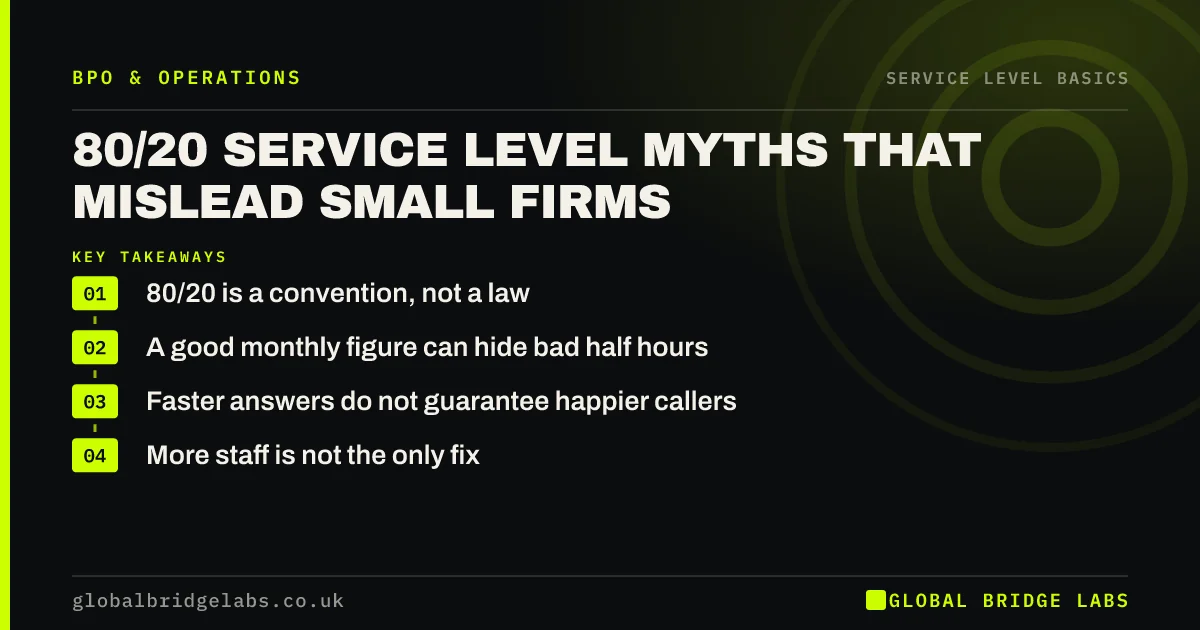
- 80/20 is a convention, not a law.
- A good monthly figure can hide bad half hours.
- Faster answers do not guarantee happier callers.
- More staff is not the only fix.
Not sure which service level advice to trust? Message us on WhatsApp.
Chat on WhatsApp →Myth: 80/20 is a legal or industry standard
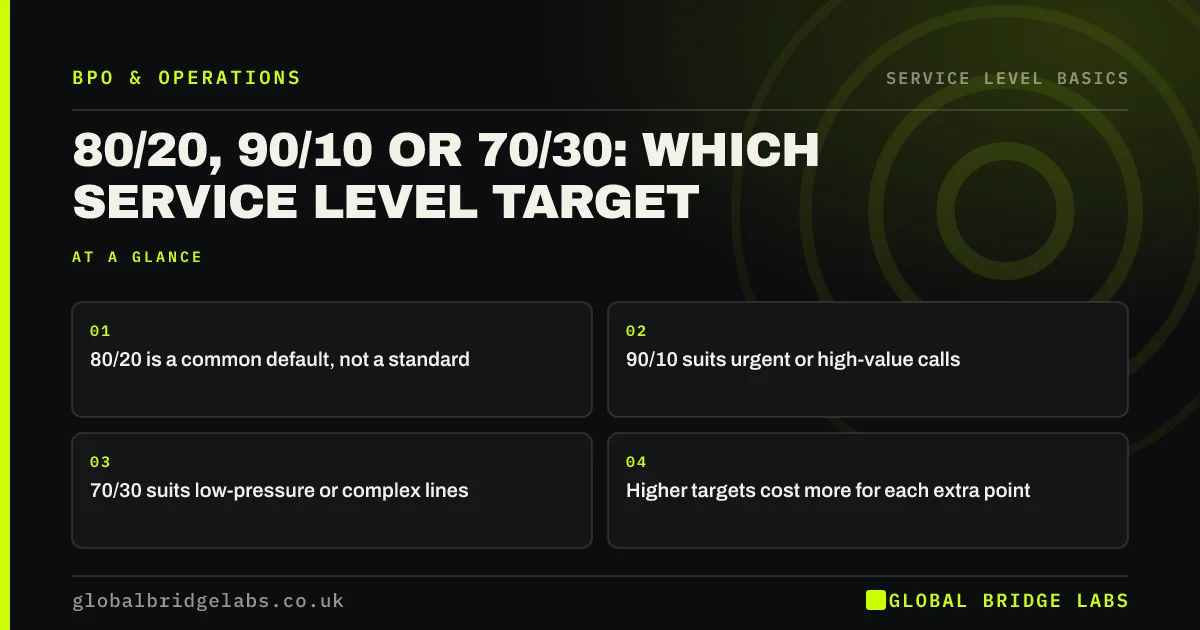
It is a widely used convention. No general UK law sets a call answering speed for most businesses. Some regulated sectors have rules about treating customers fairly that make long waits a risk, but the target itself is your choice.
Myth: a good monthly figure means good service
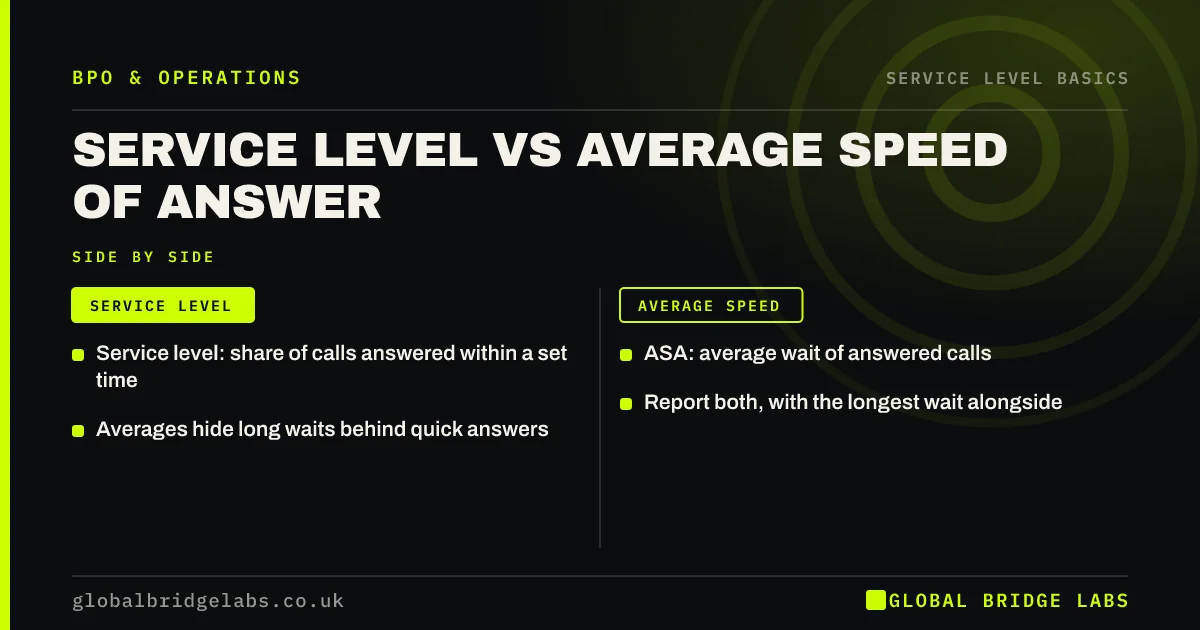
Monthly figures average many quiet half hours with a few busy ones. A month can show 85/20 while callers wait several minutes every Monday morning. Service is what each caller experiences, so read the figure by half hour and check the longest waits.
Myth: faster is always better
Beyond a reasonable answer time, speed adds little to satisfaction, and chasing it can push staff to rush or transfer calls. Resolution and low effort usually matter more once a call is answered.
Want your current target sense-checked? Send it to us on WhatsApp.
Chat on WhatsApp →Myth: the only fix is more staff
Staffing matters, but many service level problems come from breaks in the wrong place, long after-call work or avoidable calls. Removing the top call reason or moving lunch can lift service level without a new hire.
Myth: 80/20 means 20% of callers are ignored
Late callers are still answered, just after the threshold. The real risk is that nobody measures how late. Add the longest wait and abandonment rate so the slowest callers are not forgotten.
What does this look like in practice?
A pattern we see: an owner plans to hire to reach 80/20, believing it is required. After learning it is a convention, they set 80/30 for the accounts line, keep 80/20 on sales and fix lunchtime cover, without hiring.
Myth-busting checklist
- Treat 80/20 as a choice, not a law.
- Check regulated sector duties separately.
- Read figures by half hour.
- Pair speed with resolution.
- Look for non-staffing fixes first.
Next step
List what you believe about your service level target, check each belief against your own data, and adjust the target or the fix accordingly.
Message us on WhatsApp to review your call targets, or book a 30-minute consultation.
Chat on WhatsApp →Sources and further reading
- UK Customer Satisfaction Index · Institute of Customer Service
- Stop trying to delight your customers (Dixon, Freeman and Toman, 2010) · Harvard Business Review
Frequently asked questions
Is there a legal requirement to answer calls quickly in the UK?
For most businesses, no general law sets an answer speed. Some regulated firms, such as those under the FCA Consumer Duty, must avoid unreasonable barriers for customers, and long waits can count against them. Check any rules for your sector, but the target itself is a business decision.
Does 80/20 mean 20% of calls go unanswered?
No. It means 80% are answered within 20 seconds; the other 20% are answered later or abandon. The risk is that nobody tracks how much later. Add the longest wait and the abandonment rate to your reports so slow callers are visible.
Why do customers complain if we hit 80/20?
Usually because the monthly figure hides poor half hours, long waits in the tail, transfers or unresolved calls. Check your interval report, longest waits and repeat callers. Complaints often point to a specific time of day or call type that the headline figure averages away.
Written by

Global Bridge Labs (GBL) is a UK–Sri Lanka partner for social media, websites and BPO. Everything here comes from client delivery, not theory.